

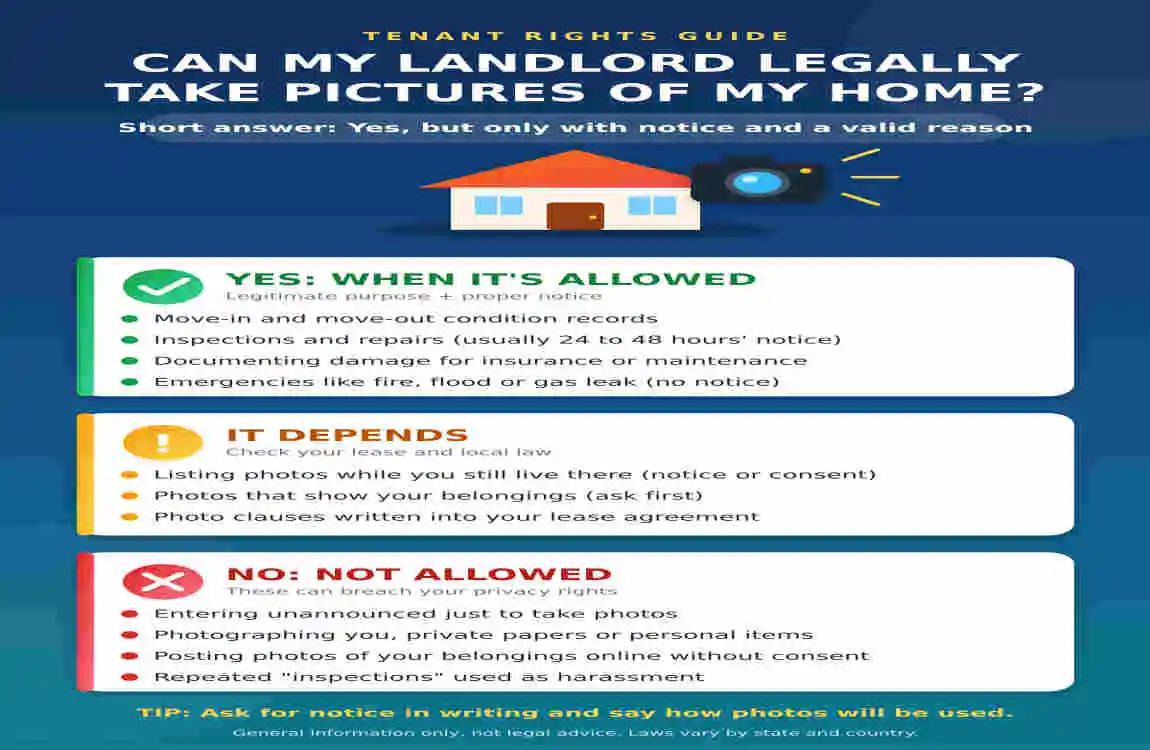
Often, yes, but only within limits. Your landlord can usually enter your rental to show it to buyers if they give proper notice, commonly 24 hours. Taking pictures of the house to sell is where it gets tricky: photos of the building itself are rarely a problem, but photographing and publishing your personal belongings generally needs your consent. The exact rule depends on your state or country and on your lease.
Can a Landlord Take Pictures of a House to Sell?
Selling a rented home is legal, and most buyers expect to see photos before they book a viewing. That creates a clash: the landlord owns the building, but you live in it. So the real estate question behind can my landlord take pictures of my house to sell has two parts. First, can they come in at all? Second, what can they do with the pictures?
On the first part, the answer in most of the US is yes, with notice. Nolo’s guide to state access laws notes that many states require a minimum notice period, often 24 hours, before a landlord enters an occupied unit, and that landlords may generally enter to show the property cost to buyers (Nolo). Nolo’s state table does not address photographs specifically, which tells you something important: in many places there is no clear statute on cameras at all.
On the second part, the picture is less settled. A Minnesota legal Q&A published by the Star Tribune says no law clearly bars a landlord from showing a tenant’s possessions in ordinary sale photos (Star Tribune). At the same time, Kiplinger’s real estate coverage describes consent as both common sense and a legal expectation when photographing an occupied rental for a virtual tour (Kiplinger). Those views are not as far apart as they look. Photos of the home structure are low-risk. Photos that show your life are where disputes start.
How Much Notice Must a Landlord Give Before Entering?
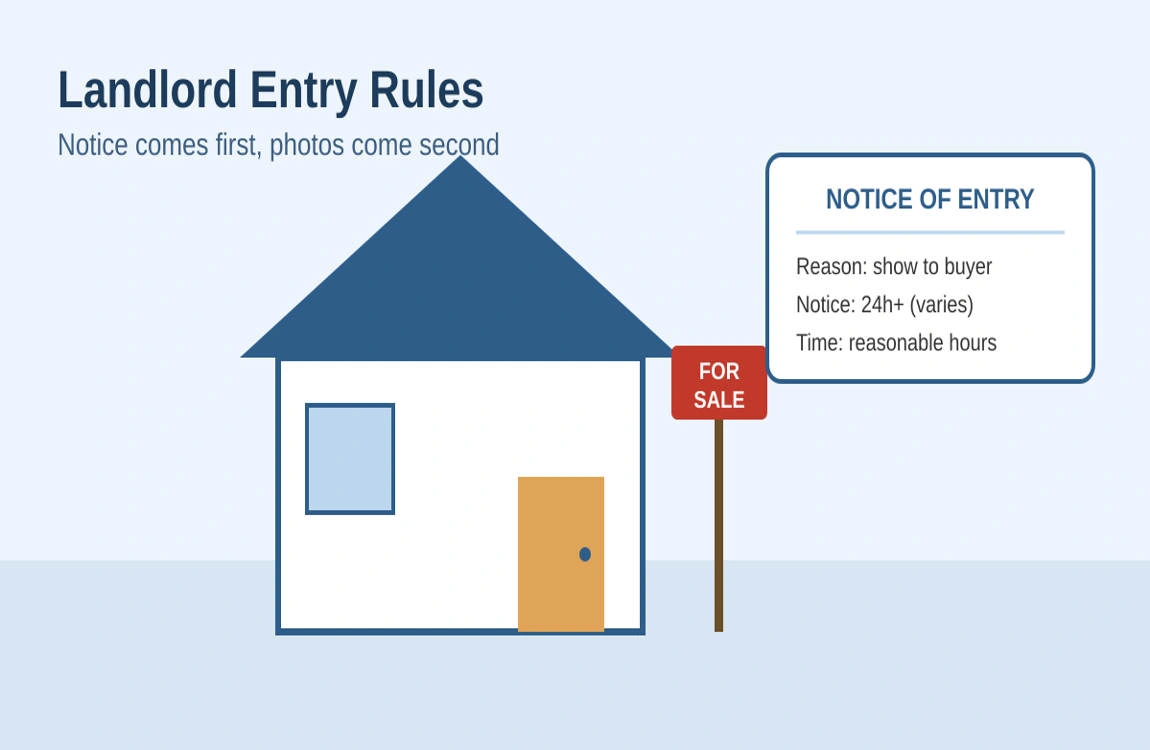
There is no single national rule in the United States. Landlord entry is governed mainly by state law and by your lease. Based on the Nolo summary, here is the general pattern:
- Most states set a specific period, usually 24 hours or two days.
- Several states, including Connecticut, Indiana, Kansas and North Dakota, ask only for reasonable notice.
- Some states set no notice period, and some have no statute at all.
- Form varies too. California, Delaware, New Mexico and Washington (unless impractical) call for written notice, while Connecticut and Indiana accept written or oral notice (Nolo).
Two examples show how specific the rules for sales can be. In California, a landlord may show the cozy home to buyers on oral notice only if they gave written notice within the previous 120 days that it is for sale and that oral notice may follow, and 24 hours is presumed reasonable. Washington allows one day’s notice for showings (Nolo).
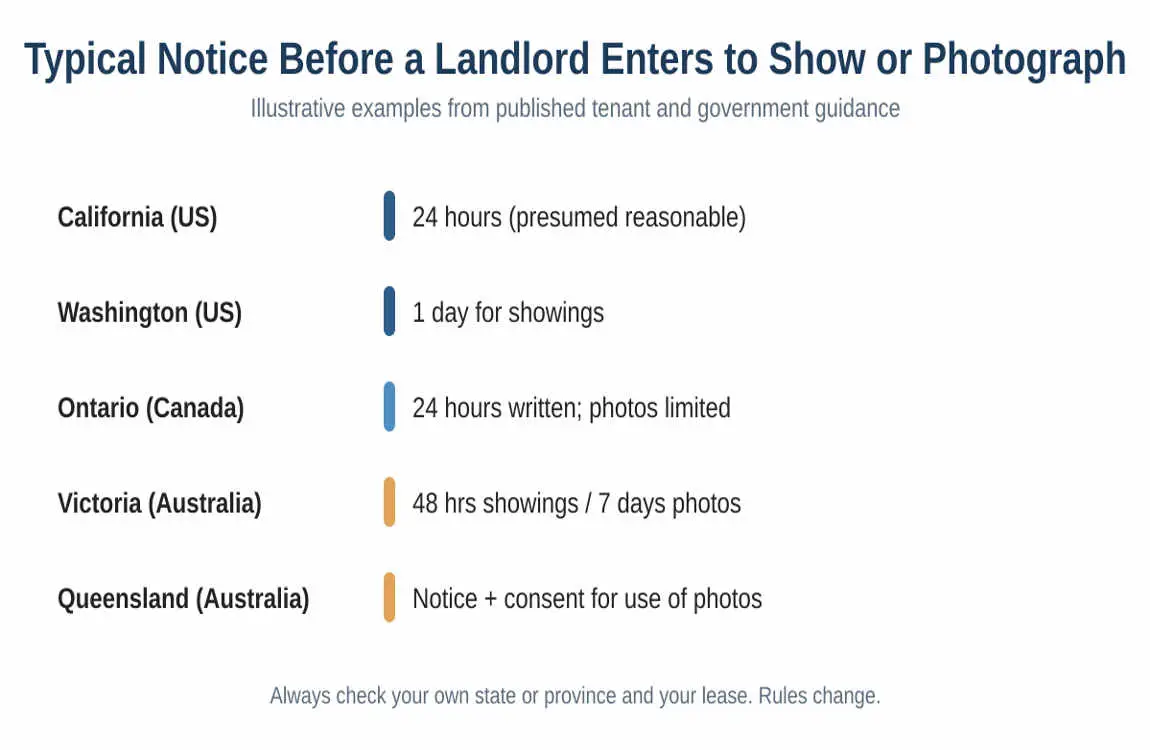
| Place | Notice and photo rule (summary) | Source |
|---|---|---|
| California, US | 24 hours presumed reasonable; written sale notice needed to use oral notice for showings | Nolo |
| Washington, US | One day’s notice for showings | Nolo |
| Ontario, Canada | Written notice at least 24 hours; photographing for sale not expressly permitted by the Act | NOW Toronto |
| Victoria, Australia | 14 days’ notice of intention to sell; 7 days’ notice for advertising photos; 48 hours for buyer showings | Tenants Victoria |
| Queensland, Australia | Notice with a two-hour entry window; separate consent for using photos that show belongings | Queensland RTA |
What About Photos of My Personal Belongings?
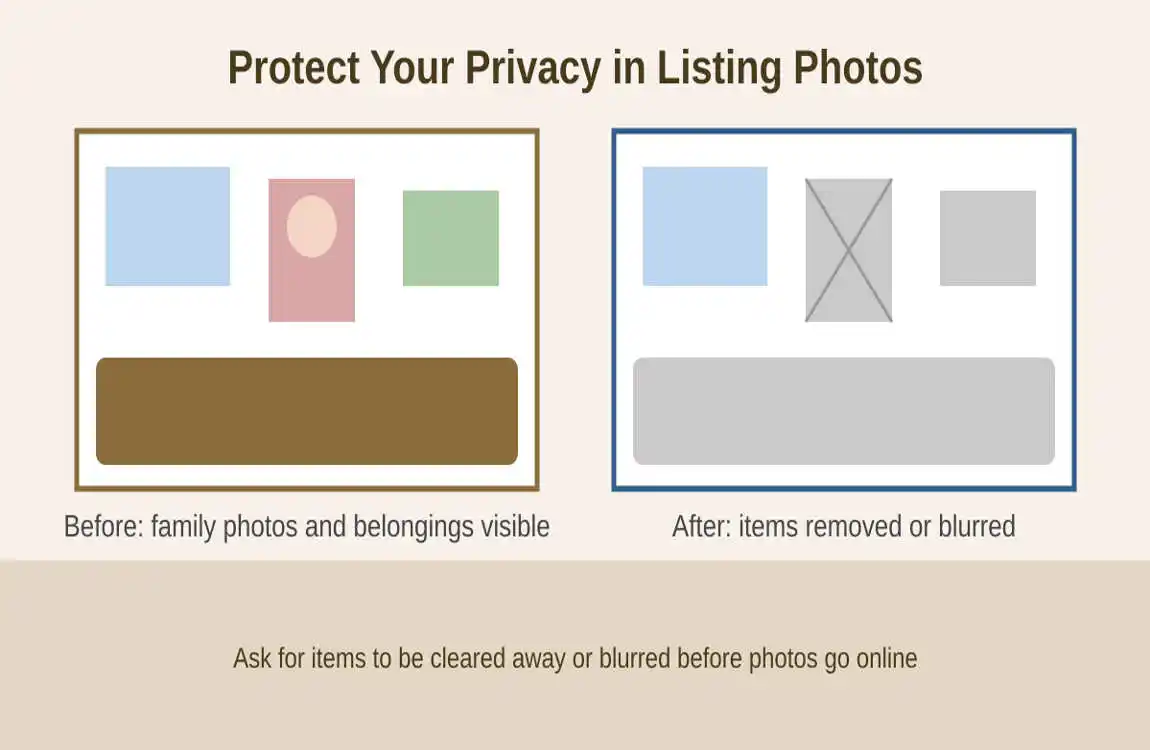
This is the heart of the issue. A photo of an empty kitchen counter says little about you. A photo of your children’s school pictures, mail on a table or a jewelry box says a lot. Kiplinger points out that listing photos can reveal personal details, hint at a household’s finances and show easy access points a bad actor might use (Kiplinger). The same article notes that if a tenant agrees to photos but asks for certain items to be blurred and that does not happen, the tenant could sue for invasion of privacy in most states.
Super Lawyers’ tenant-rights guide takes a similar line: a landlord should generally get your permission before taking pictures of your personal items, and unauthorized pictures can run into privacy law (Super Lawyers).
Courts abroad have been explicit. In Ontario, the Divisional Court in Juhasz v. Hymas overturned a ruling for a landlord who said a tenant interfered with marketing by refusing photos, because the Residential Tenancies Act did not expressly permit photographing the unit for sale. It also concluded that forcing a tenant to allow her home design and belongings to be photographed would breach her privacy (NOW Toronto). Queensland’s regulator draws a helpful line between two kinds of consent: permission to enter, and permission for photos showing your belongings to be used. Allowing a photographer in is not treated as consent to publish (Queensland RTA).
How the Rules Differ Around the World
Victoria, Australia. The most detailed rules appear here. Consumer Affairs Victoria explains that a landlord needs to give a notice of intention to sell at least 14 days before entering to show buyers, and must make a reasonable attempt to agree a time with the renter for advertising photos (Consumer Affairs Victoria). Tenants Victoria adds that photos or video for advertising require at least seven days’ written notice, and that the landlord may stay only as long as reasonably needed (Tenants Victoria). Entry is limited to 8 am to 6 pm unless the renter agrees (Consumer Affairs Victoria).
Ontario, Canada. A landlord may enter on written notice of at least 24 hours for specified reasons, but photographing a tenant’s belongings for marketing is not among the rights spelled out in the Act. Lawyer commentary published by Mondaq frames the same issue, asking when a landlord may photograph a unit to market it for sale or lease (Mondaq).
Queensland, Australia. Entry requires proper notice, a stated reason and a two-hour window, and the regulator advises owners to explain why photos are needed and to blur or remove personal details such as family photos (Queensland RTA).
The United States. Because few statutes mention photography directly, outcomes often turn on three things: state entry law, the access clause in your lease, and whether the photos show your belongings. When in doubt, consent in writing is the safest route for everyone.
What Tenants Can Do When a Landlord Wants Photos
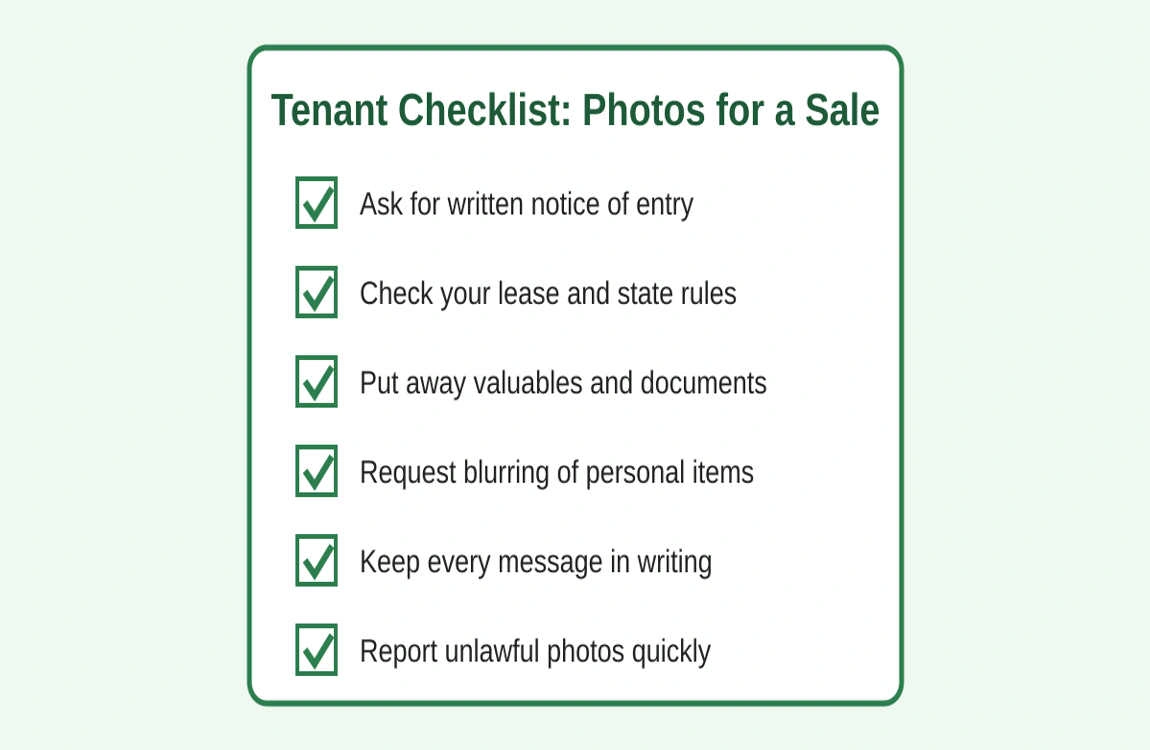
- Ask for written notice. It should state the reason, date and time window.
- Read your lease. Some leases include a clause on photographs or showings. State law may allow lease terms to differ from the statute in some areas (Nolo).
- Prepare the space. Put away valuables, mail, documents, medication and family photos.
- Agree terms in writing. Say which rooms may be photographed and ask that personal items be removed or blurred.
- Check the listing afterwards. If it shows more than you agreed, send a takedown request right away. A lawsuit takes time, so fast removal is usually the priority (Kiplinger).
- Get help if needed. A local tenant union or landlord-tenant attorney can advise on privacy and quiet enjoyment in your area.
Tips for Landlords and Agents
- Give notice that meets or exceeds your state’s rule, and describe the purpose, including photography.
- Offer a tenant-free option, such as photos of empty rooms, exterior shots or floor plans.
- Ask for written consent before publishing images that show a tenant’s possessions.
- Blur or crop personal items. Queensland’s regulator suggests digital editing or focusing on the condition of a space rather than its contents (Queensland RTA).
- Ask prospective buyers not to take their own photos during viewings.
Frequently Asked Questions
Can my landlord take pictures of my house to sell it?
Usually yes, in a limited way. In most US states a landlord can enter an occupied rental to show it to buyers if they give the notice your state requires, often 24 hours. Photographing your belongings for a public listing is a different matter, and it generally calls for your consent. Rules vary by state, country and lease.
Do I have to let my landlord photograph my home for a listing?
It depends on where you live and what your lease says. Some places, such as Victoria in Australia, allow advertising photos on set notice. Others, such as Ontario, do not expressly give landlords that right. In many US states the law is silent, so your lease and a polite written request carry real weight.
Can my landlord post photos of my belongings online?
Publishing images that show your furniture, family photos or documents without your agreement can raise privacy claims. Ask for items to be moved, cropped or blurred, and put your request in writing.
How much notice must a landlord give before entering to show my home to a buyer?
Most states require a set period, commonly 24 hours or two days. A few ask only for reasonable notice. California presumes 24 hours is reasonable, and Washington allows one day for showings.
Can I refuse entry if my landlord did not give notice?
If the law in your area requires notice and none was given, you can generally ask the landlord to reschedule. Keep the exchange polite and written, because unreasonably blocking a lawful, properly noticed entry can cause trouble under some leases and state laws.
What should I do if my landlord posted unauthorized photos of my home?
Screenshot the listing, send a written takedown request to the landlord and the listing agent, and keep copies. If it is not fixed, speak to a local tenant organization or a landlord-tenant attorney about privacy and quiet enjoyment claims.
Sources
- Nolo: State Laws on Landlord’s Access to Rental Property
- Nolo: Tenant Privacy
- Kiplinger: Real Estate Agents Save the Day When Tenants’ Rights Are Violated
- Super Lawyers: What Are My Privacy Rights as a Tenant?
- Star Tribune: Landlord can show personal possessions in ads for property
- NOW Toronto: Can my landlord take photos of my apartment?
- Mondaq: Rules for landlord access to photograph property (Ontario)
- Consumer Affairs Victoria: Entry rights to take advertising photos and conduct sales inspections
- Tenants Victoria: Rental home is being sold
- Victorian Law Reform Commission: Right to enter
- Queensland Residential Tenancies Authority: Taking photos in a rental property
- Queensland RTA: Fact sheet for property managers and owners
