


Bankruptcy can create serious financial challenges, especially when you own a home and struggle to keep up with your debts. One of the biggest concerns is whether you could lose your house during the bankruptcy process. The answer depends on several factors, including your location, the type of bankruptcy you file, your home equity, and whether you can continue making mortgage payments. Understanding how bankruptcy laws work can help you explore your options and make informed decisions about protecting your home.
The Two Main Types of Bankruptcy for Homeowners
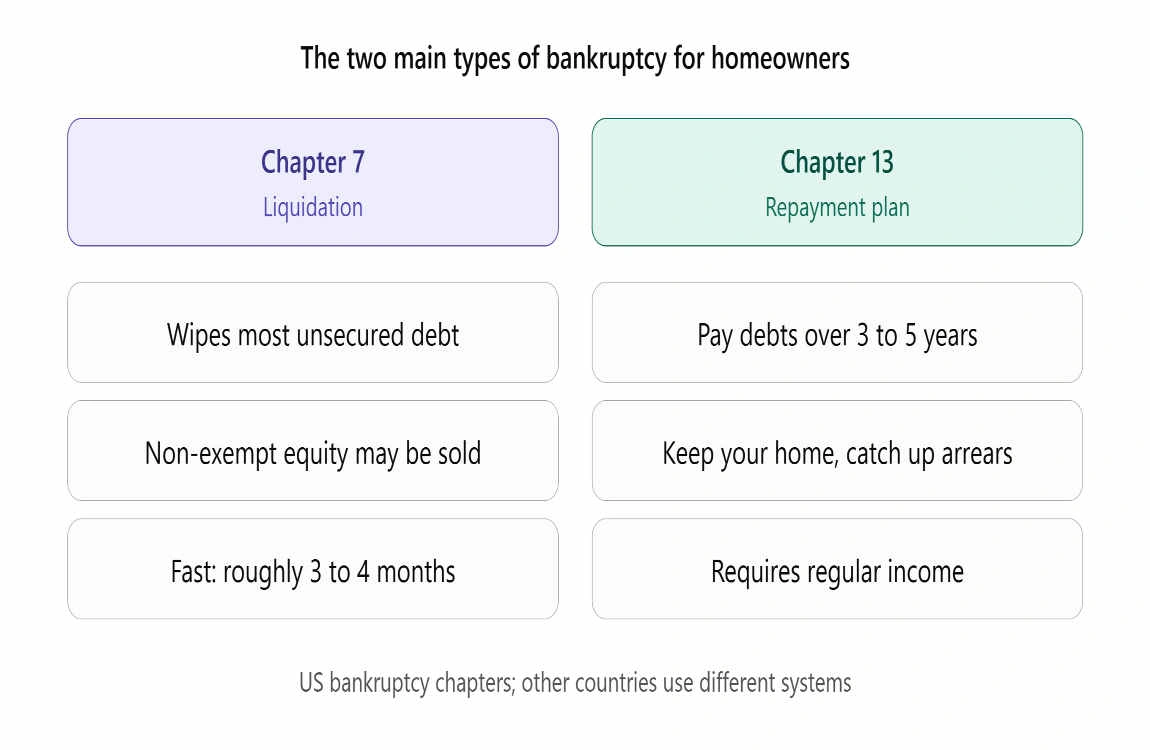
Most individuals file under one of two chapters of the Bankruptcy Code, and they treat your home very differently.
Chapter 7: “Liquidation” Bankruptcy
According to the U.S. Courts, Chapter 7 provides for the sale of a debtor’s nonexempt property and the distribution of the proceeds to creditors. The key word is nonexempt. The law lets you keep certain “exempt” home property, and a court-appointed trustee liquidates what’s left.
For homeowners, this means the trustee looks at your equity, not your home’s total value. If your equity is fully covered by an exemption, the trustee has nothing to sell and you keep the house. If your equity is larger than the exemption, the trustee can sell the home, pay off your mortgage, give you your exemption amount in cash, and send the rest to creditors.
Chapter 13: The “Repayment Plan” Bankruptcy
Chapter 13 works differently. The U.S. Courts explain that Chapter 13 allows a debtor to keep property and pay debts over time, usually three to five years. You propose a plan, a trustee collects your payments and distributes them to creditors, and your property stays with you.
That’s why Chapter 13 is the go-to option for people who are behind on their mortgage or whose equity exceeds what their state protects.
What Is a Homestead Exemption (and Why It Matters Most)
The homestead exemption is the legal protection for the equity in your primary luxury residence. Equity is simply what your home is worth minus what you still owe on it. A house worth $300,000 with a $250,000 mortgage has $50,000 in equity, and that $50,000 is the number the exemption has to cover.
The Federal Homestead Exemption
Under the federal exemption scheme, the homestead amount was adjusted for inflation on April 1, 2025. Per the Judicial Conference’s notice, the adjusted dollar amounts took effect on April 1, 2025, and the federal homestead figure is $31,575. That amount applies to cases filed between April 1, 2025 and March 31, 2028, and it is typically doubled when a married couple files jointly. The amounts adjust every three years.
State Exemptions Vary Wildly
Here’s where it gets interesting. The U.S. Courts note that many states have adopted their own exemption laws in place of the federal ones, while in other states you can choose between the federal package and the state package.
The differences between states are huge:
- Texas offers a homestead exemption that is unlimited in value (subject to acreage limits), which makes losing a primary residence to a Chapter 7 trustee very unlikely for most Texans.
- Florida also has a very generous real estate homestead protection, again with land-size limits.
- New Jersey and Pennsylvania have no state homestead exemption, so filers there generally rely on the much smaller federal amount.
- Many other states sit somewhere in the middle, with caps ranging from tens of thousands to several hundred thousand dollars.
Because the numbers change and every state has its own fine print (age, disability, acreage, recording requirements), always check your current state exemption before making a decision.
A Simple Example: Does Bankruptcy Cost You Your Home?
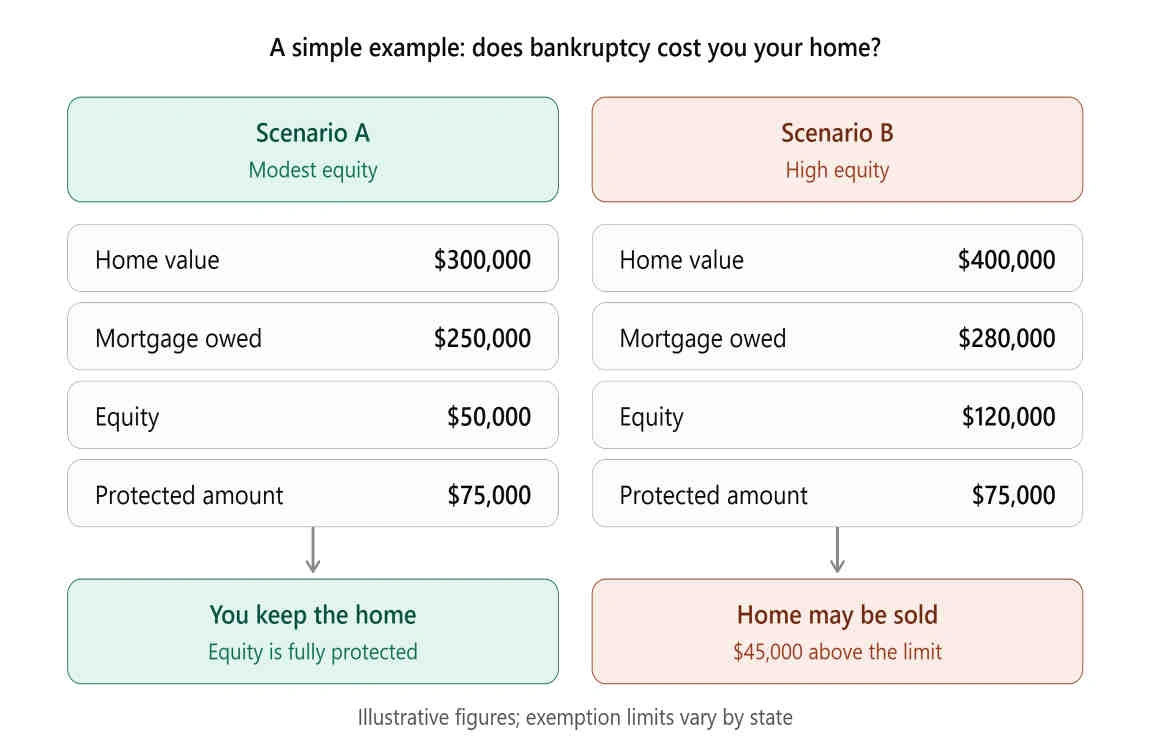
Let’s say Sarah owns a home with $50,000 in equity and lives in a state where she must use a $31,575 exemption. She has $18,425 in equity that isn’t protected.
In Chapter 7, that unprotected slice could give the trustee a reason to sell. In Chapter 13, though, she could pay the $18,425 difference over the life of the plan and keep the house, as Nolo illustrates with this same scenario. If she lived in an unlimited-homestead state, the question wouldn’t even come up.
The Big Catch: Your Mortgage Doesn’t Disappear
This is the part many people miss. Bankruptcy can wipe out unsecured debts like credit cards and medical bills, but your mortgage is a secured debt. The lender holds a lien on your luxury home. If you stop paying, the lender can still foreclose, even if you’ve received a bankruptcy discharge.
Nonprofit legal educator Upsolve explains that in Chapter 7 you usually can’t keep your home if you’re behind on payments, because Chapter 7 has no repayment plan to catch you up. In short: bankruptcy protects your equity from your other creditors, but it doesn’t excuse you from paying the mortgage itself.
How Chapter 13 Can Stop a Foreclosure
If you’re behind on your mortgage, Chapter 13 is often the most powerful tool. The federal courts state that Chapter 13 offers individuals an opportunity to save their homes from foreclosure, as long as they keep making the mortgage payments that come due during the plan. Filing also triggers the “automatic stay,” which stops most collection actions, including a pending foreclosure sale.
Under the plan, your missed payments (the arrears) are spread over three to five years. A plan generally runs three years if your income is below your state’s median and five years if it’s above, and it can never exceed five years.
Other Ways Homeowners Can Lose a House in Bankruptcy
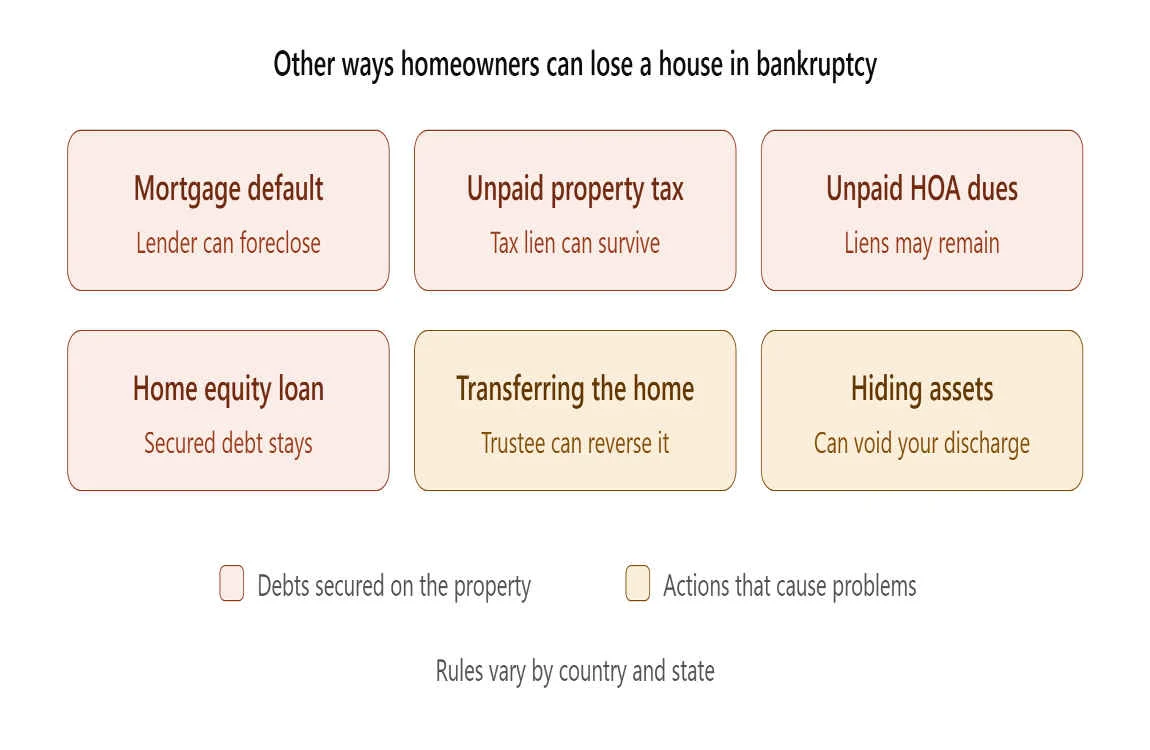
- Too much equity. If your equity is above your exemption, a Chapter 7 trustee can sell the home.
- Falling behind on the mortgage. Bankruptcy doesn’t stop the lender from foreclosing if payments stop for good.
- Moving into a big exempt home right before filing. Federal law limits state homestead exemptions for property acquired within roughly 1,215 days (about 3.3 years) before filing, so you can’t simply convert cash into an unlimited-exemption house at the last minute.
- Missing exemption paperwork. Exemptions aren’t automatic. Court materials note that if you don’t claim them properly on your schedules, you may not get the protection.
Can You Keep Your House and Still Get a Fresh Start?
For most people, yes. A typical homeowner with modest equity, a current mortgage and mostly unsecured debt can file Chapter 7, discharge the credit cards, and keep the home. Someone who’s behind on payments but has steady income can often use Chapter 13 to catch up. Problems tend to show up in two situations: very high equity in a low-exemption state, or a long stretch of missed mortgage payments with no income to fix it.
Steps to Take Before You File
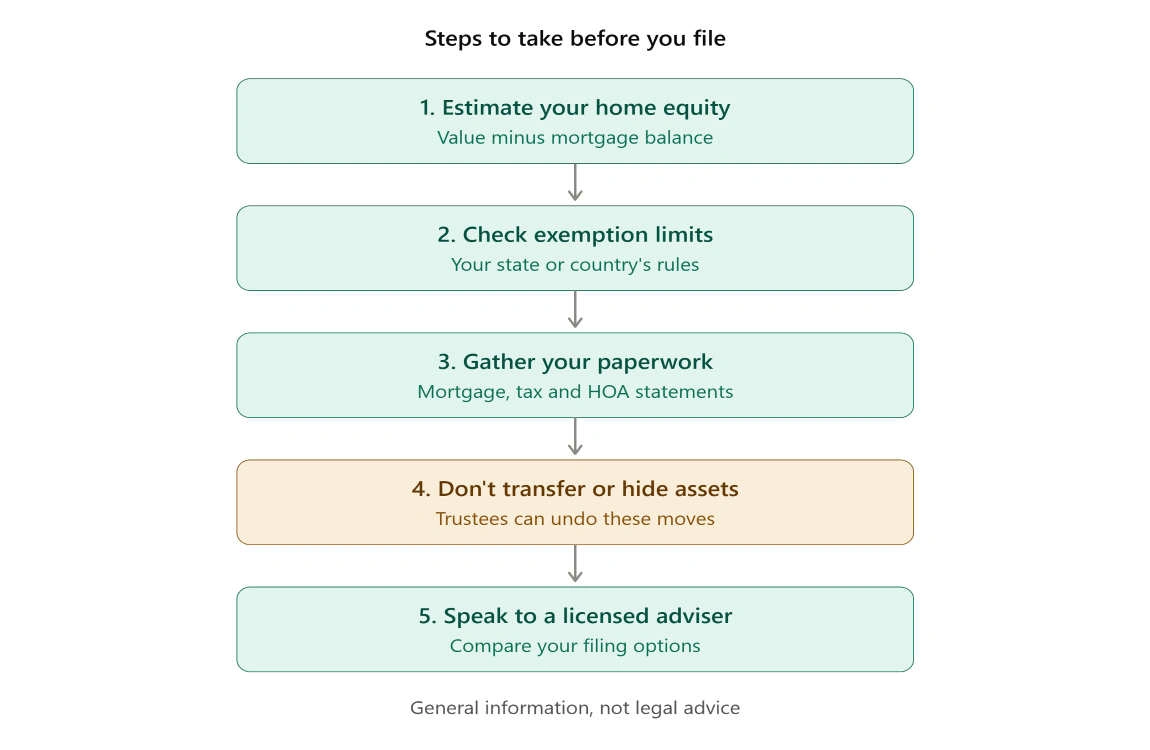
- Calculate your equity. Estimate your home’s current market real estate value and subtract every lien, including your mortgage and any home equity loan.
- Look up your state’s homestead exemption. Find out whether you must use state exemptions, the federal ones, or can choose.
- Check where you stand on your mortgage. Current, a little behind, or in foreclosure all point to different strategies.
- Talk to a bankruptcy attorney. Many offer free or low-cost first consultations, and nonprofit legal aid organizations can help if money is tight.
- Complete credit counseling. It is required before filing.
Frequently Asked Questions
Can you lose your house if you go bankrupt?
Yes, but it isn’t the usual outcome. You can lose your home if your equity exceeds your exemption in Chapter 7, or if you fall behind on your mortgage and can’t catch up. Many homeowners keep their homes.
Will a Chapter 7 trustee take my house?
Only if there’s non-exempt equity worth selling. If your equity is fully protected by your state or federal homestead exemption, the trustee generally has no reason to sell.
Can I keep my house in Chapter 13?
Generally yes, as long as you stay current on ongoing mortgage payments and follow your repayment plan. Chapter 13 can also let you cure missed payments over time.
Does bankruptcy erase my mortgage?
No. Your personal liability may be discharged, but the lender’s lien stays on the property. If you stop paying, the lender can still foreclose.
What is the federal homestead exemption in 2026?
$31,575 for an individual filer, typically doubled for joint filers, for cases filed between April 1, 2025 and March 31, 2028.
Is it better to file Chapter 7 or Chapter 13 to protect my home?
It depends. Chapter 7 is faster and works well if your equity is protected and your mortgage is current. Chapter 13 is usually better if you’re behind on payments or have equity above the exemption limit.
Final Thoughts
Bankruptcy isn’t a guaranteed way to lose your home, and for many people it’s the tool that lets them keep it. The outcome hinges on your equity, your state’s homestead exemption, and whether you’re current on the mortgage. Run the numbers early, and get a qualified bankruptcy attorney’s opinion before you file
