
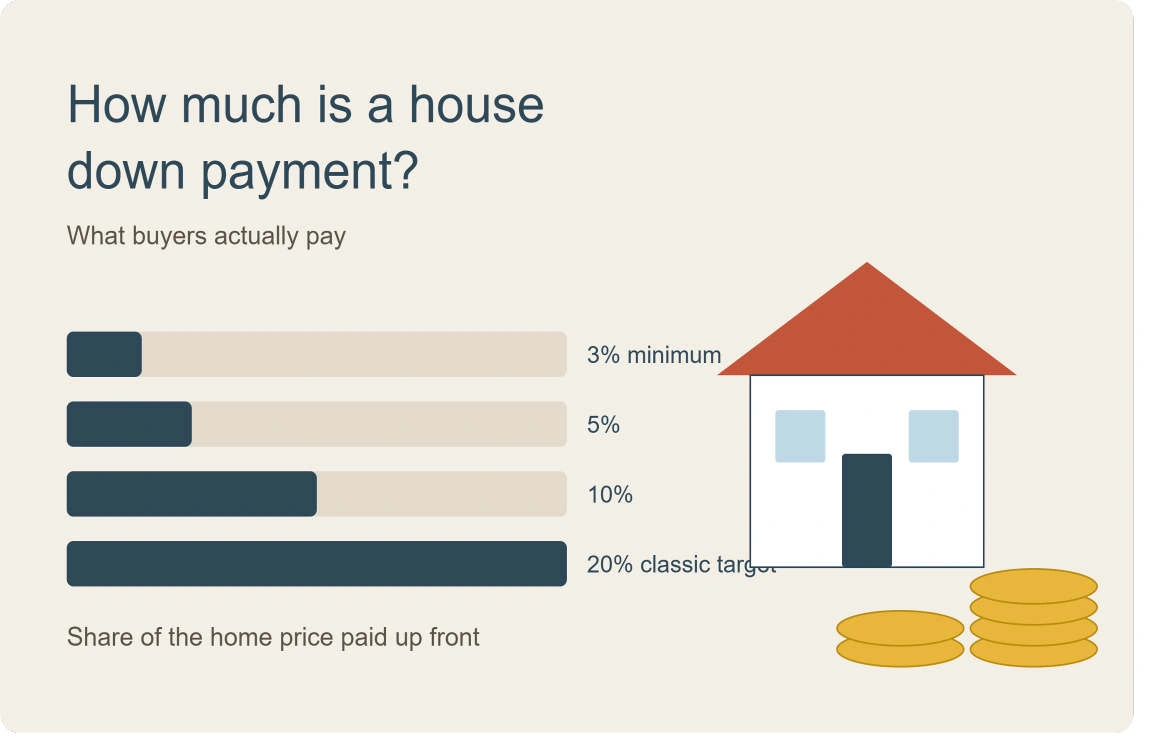
On a median-priced U.S. home, a down payment can range from $0 to more than $83,000, depending on your loan type and how much you want to put down. Most first-time buyers put down about 10%, not the 20% you hear about everywhere.
If you have been putting off buying a home because you believe you need a pile of cash the size of a new car, this guide is for you. Below, we break down what a down payment really costs right now, what lenders require, and how real buyers are paying for it.
What Is a Down Payment?
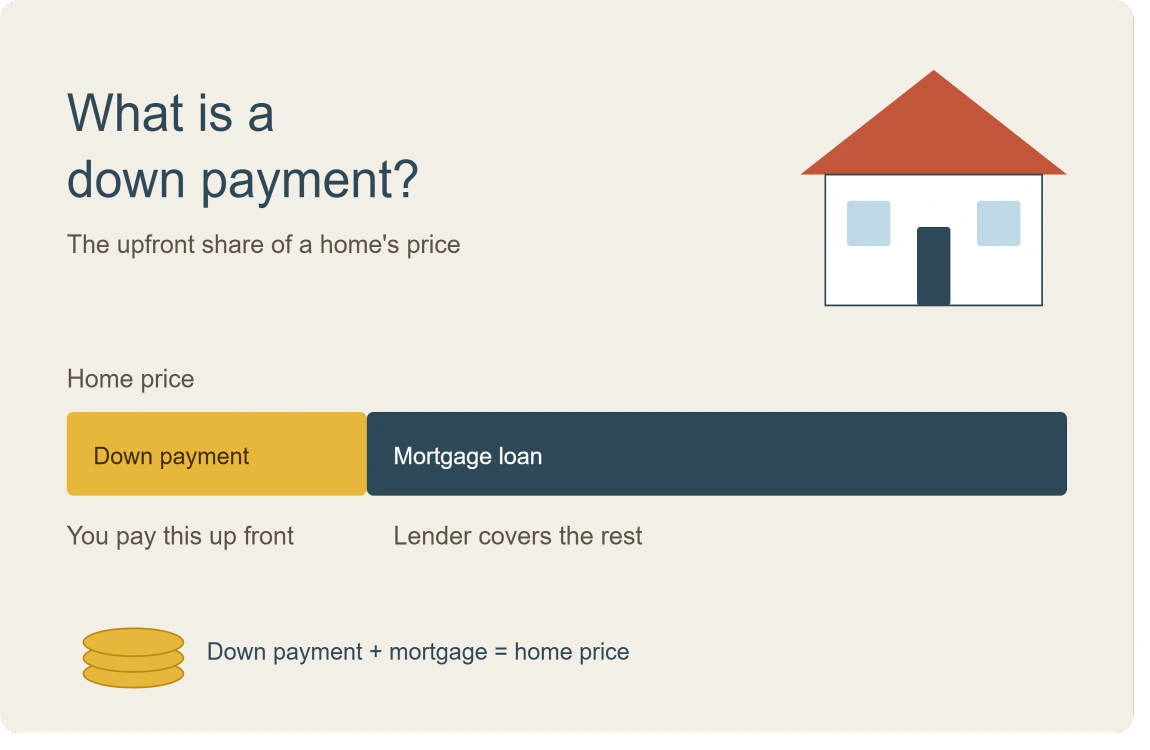
A down payment is the portion of the purchase price you pay upfront in cash. The mortgage covers the rest. Put down $40,000 on a $400,000 real estate home and you borrow $360,000. The more you put down, the less you borrow, and the lower your monthly payment tends to be.
How Much Does the Average Person Put Down in 2026?
According to the National Association of REALTORS® (NAR) 2025 Profile of Home Buyers and Sellers, first-time buyers put down a median of 10%, which matches the highest level recorded since 1989. Repeat buyers put down a median of 23%, largely because they carry equity over from the home they sold. (Source: NAR’s latest buyer profile.)
That gap matters. Repeat buyers are skewing the “average” upward, which is partly why the 20% figure sticks in people’s heads. If you are buying your first dream home, 10% is the more realistic benchmark.
What Does a Down Payment Cost on the Median Home?
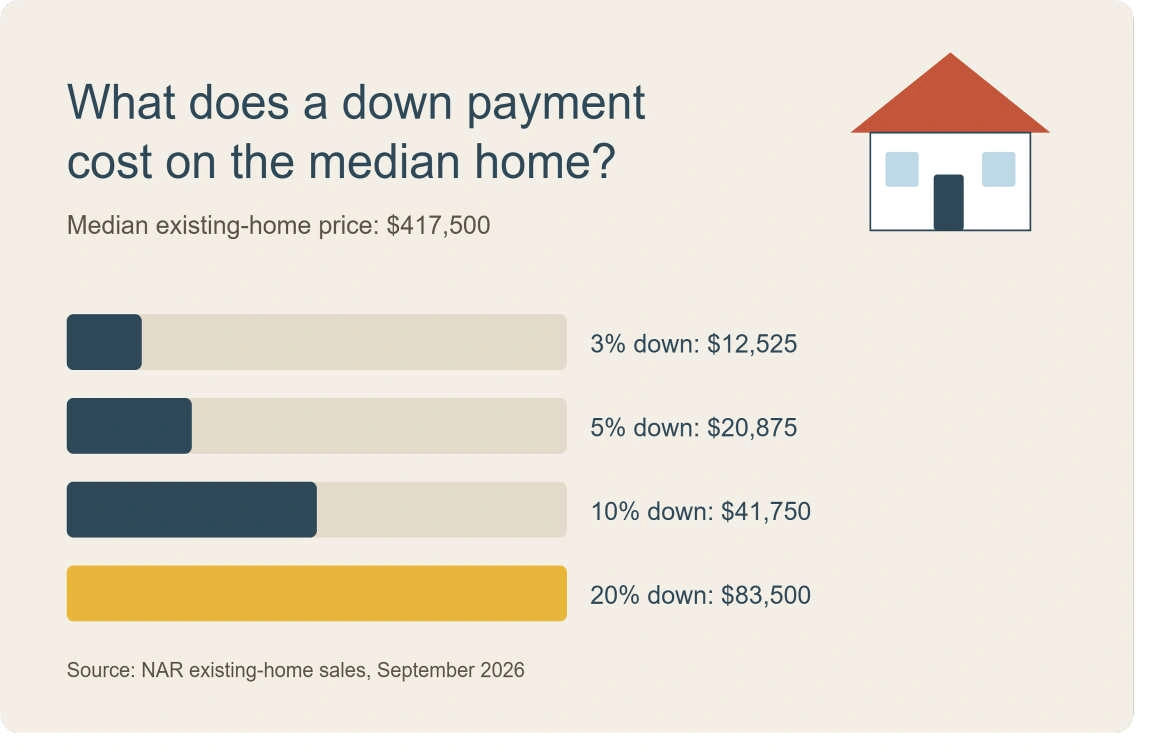
NAR reported that the median existing-home price reached $417,500 in September 2026, up 1.3% from a year earlier (NAR’s September 2026 existing-home sales report). Here is what common down payment percentages look like at that price:
| Down payment | Amount on $417,500 | Loan amount |
|---|---|---|
| 3% | $12,525 | $404,975 |
| 3.5% | $14,613 | $402,888 |
| 5% | $20,875 | $396,625 |
| 10% | $41,750 | $375,750 |
| 20% | $83,500 | $334,000 |
Figures are our own calculations based on the national median price. Your local market may be much higher or lower. Closing costs are separate and not included.
Do You Really Need 20% Down?
No. The 20% rule is a guideline, not a requirement. Its main benefit is that on a conventional loan, putting 20% down usually lets you avoid private mortgage insurance (PMI), according to HousingWire. If you put down less, you will typically pay for mortgage insurance until you build enough equity. That is a real cost, but for many buyers it is cheaper than waiting years to save.
Minimum Down Payment by Loan Type
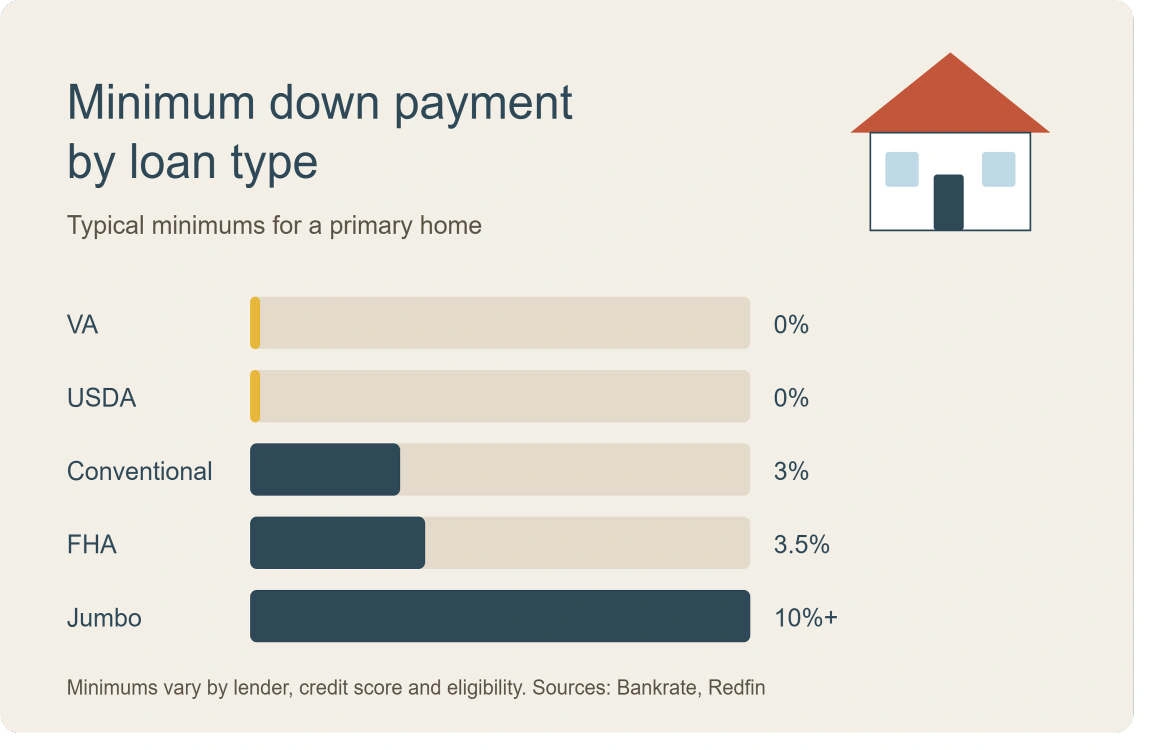
Each loan program sets its own floor. Here is how the main options compare for eligible borrowers, based on reporting from Fortune, HousingWire and Chase:
- Conventional loans: as little as 3% down. Fannie Mae and Freddie Mac’s “conventional 97” style loans require 3% and can be cheaper than FHA, according to Chase. The 3% minimum generally applies to first-time buyers.
- FHA loans: 3.5% down with a credit score of 580 or higher. Scores between 500 and 579 typically require 10% down. FHA loans carry mortgage insurance.
- VA loans: 0% down for eligible veterans, service members and some surviving spouses, with no monthly mortgage insurance requirement.
- USDA loans: 0% down in eligible rural and some suburban areas, with property income limits and credit requirements that are usually stricter than VA.
Buying something other than a primary residence? Expect higher requirements. Fortune reports that second homes typically need at least 10% down, and investment properties often need 15% or more.
How Do First-Time Buyers Actually Fund It?
Most buyers do not write one big check from a single account. NAR’s data shows 59% of first-time buyers used personal savings, 26% tapped financial assets such as a 401(k), stocks or cryptocurrency, and 22% received a gift or loan from family or friends.
Another underused option is down payment assistance. Many states, counties and cities offer grants, deferred-payment loans or forgivable loans for eligible buyers, as Chase notes. Inman reports that a lack of awareness about low-down-payment loans and assistance programs keeps many would-be buyers renting. Check your state housing finance agency before assuming you are not eligible.
How Much Does Your Down Payment Change Your Monthly Bill?
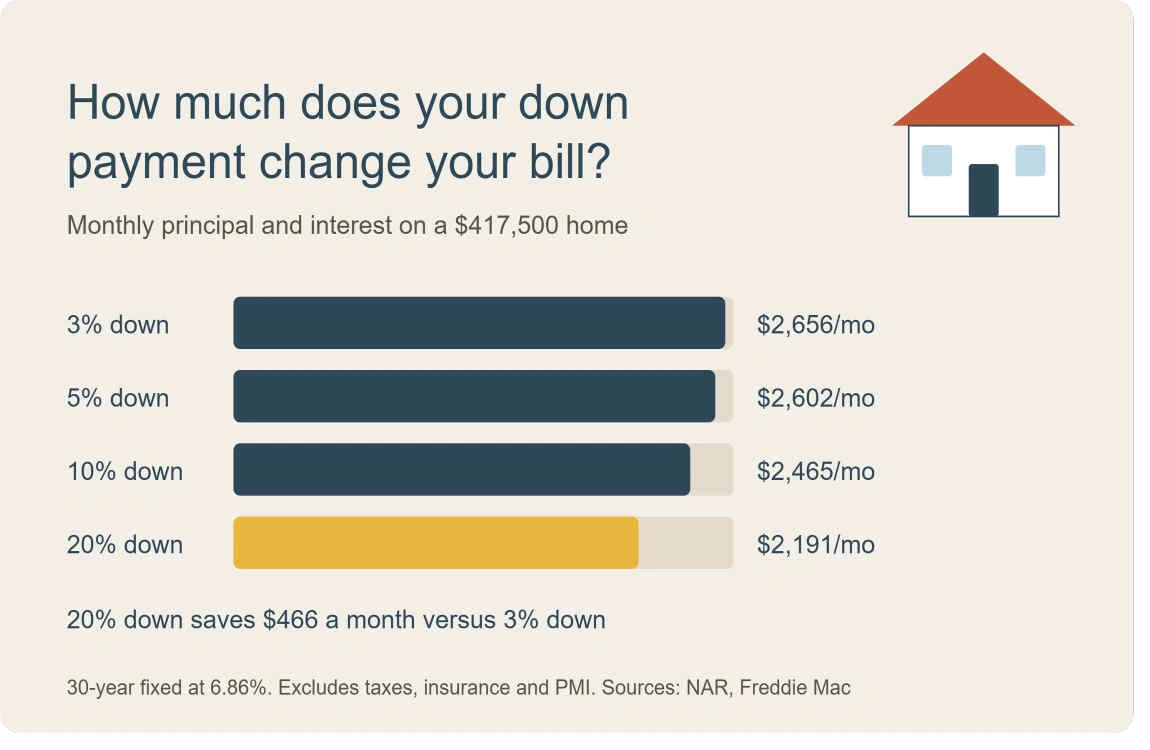
Mortgage rates matter here. Freddie Mac’s average 30-year fixed rate was 6.86% in September 2026, up from 6.67% in August, as summarized by Mortgage News Daily’s recap of the report. At that rate, here is the estimated principal-and-interest payment on a $417,500 home:
Going from 3.5% down to 20% down saves roughly $450 a month in principal and interest, but it requires about $69,000 more cash upfront. And that is before mortgage insurance, which would make the low-down-payment payment higher. Whether that trade is worth it depends on your savings, your job stability and how long you plan to stay.
These are illustrative calculations, not a loan quote. Property taxes, homeowners insurance and mortgage insurance are excluded.
Pros and Cons of a Smaller Down Payment
Why it can make sense
- You can buy sooner instead of watching prices and rents move while you save.
- You keep more cash for closing costs, moving, repairs and an emergency fund.
- Programs like FHA, VA and conventional 97 are built for exactly this situation.
What to watch out for
- Mortgage insurance adds to your monthly cost until you build equity.
- A larger loan means more total interest over the life of the mortgage.
- With little equity, a small drop in local prices can leave you owing more than the luxury home is worth.
7 Practical Ways to Build Your Down Payment Faster
- Pick a target price first. Multiply by your intended percentage so you have a real number, not a vague goal.
- Automate transfers. Move money to a dedicated high-yield savings account on payday.
- Check assistance programs. Search your state housing finance agency and local city programs.
- Ask about gift funds. Lenders usually allow documented gifts from family, with a gift letter.
- Cut one recurring expense. Redirect it straight into the fund.
- Use windfalls. Tax refunds and bonuses can shorten the timeline by months.
- Talk to two or three lenders. Minimums and home mortgage insurance pricing vary, so compare before you commit.
Frequently Asked Questions
How much is a down payment on a $300,000 house?
At 3% it is $9,000, at 3.5% it is $10,500, at 10% it is $30,000, and at 20% it is $60,000.
Can I buy a house with no down payment?
Yes, if you qualify for a VA or USDA loan. Both allow 0% down for eligible borrowers.
Is 10% down enough?
For most first-time buyers, yes. It is the national median, though you would likely still pay mortgage insurance on a conventional loan.
Do closing costs count toward my down payment?
No. Closing costs are separate, so budget for them on top of your down payment.
What credit score do I need?
It depends on the loan. Commonly cited minimums are 580 for FHA at 3.5% down, 620 for conventional loans and around 640 for USDA, though lenders can set their own standards.
Final Thoughts
The answer to “how much is a house down payment” is less scary than the internet makes it sound. Plan for about 10% if you are a first-time buyer, know that 3% to 3.5% is possible with the right loan, and remember that VA and USDA buyers may need nothing down. The best amount is the one that gets you into a home you can comfortably afford while leaving cash in reserve.
