
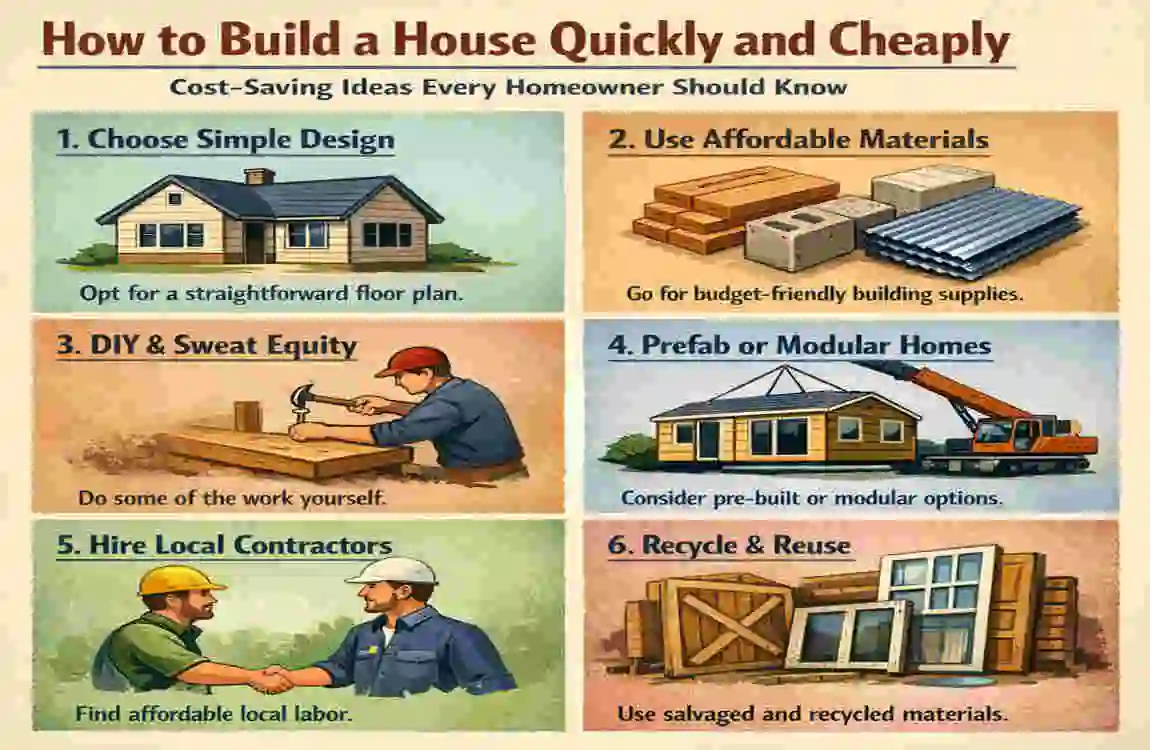
Are you tired of endlessly browsing real estate listings, only to find that your dream home is completely out of your budget? You are not alone. In today’s housing market, the dream of homeownership can feel entirely out of reach. Right now, the average cost to build a standard home in the United States hovers around a staggering $150 per square foot.
If you have been wondering how to build a house cheaply and quickly, you have landed in exactly the right place. Agonizing delays, unexpected weather disruptions, and massive budget overruns plague the traditional construction industry. But it absolutely does not have to be this way for your project. By utilizing modern building technology, you can bypass the broken traditional system entirely.
| Method | Cost per sq ft | Build Time (1,000 sq ft home) | Top Savings Tip |
|---|---|---|---|
| Modular Prefab | $80-120 | 2-4 months | Factory assembly cuts labor 50%; weather-proof. |
| AAC Blocks | $70-100 | 4-6 months | Lightweight, faster stacking than bricks; insulates well. |
| Shipping Containers | $50-80 | 1-3 months | Reuse intact frames; add insulation for speed. |
| Insulated Concrete Forms (ICF) | $90-110 | 3-5 months | Stack and pour onsite; energy savings long-term. |
| Gablok-Style Blocks | $60-90 | 6-10 days (basic structure) | Lego-like interlocking; no mortar needed . |
Planning Basics: The Foundation of Budget Home Building Ideas
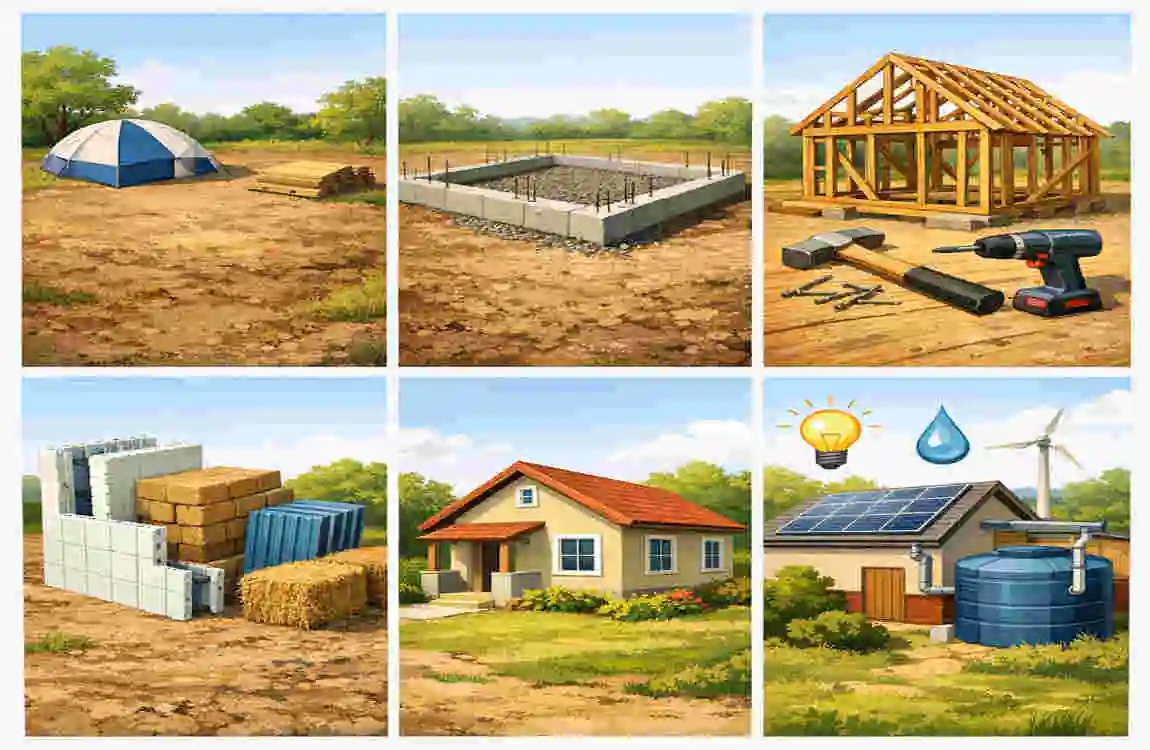
If you want to master how to build a house cheap and fast, your journey actually starts with a pen and paper. The most crucial phase of your entire project is the planning phase. Every time you change your mind on a blueprint, it costs nothing. But if you change your mind after the concrete is poured, it will cost you thousands of dollars.
Keep Your Floor Plan Incredibly Simple
The single biggest mistake eager homeowners make is overcomplicating their floor plan. If you want to save serious money, you must stick to simple, rectangular designs.
Why? Every time your home’s exterior wall changes direction, it creates a “corner.” In the construction world, corners cost dearly. They require highly specialized roof trusses, extra structural framing, complex foundation pouring, and significantly more labor hours. By eliminating custom curves, pop-outs, and complex angles, you can effortlessly cut your framing labor costs by 20% to 30%.
Build Up, Not Out
When it comes to the footprint of your home, you have two choices: build a sprawling single-story ranch, or build a two-story vertical home. If you are trying to maximize your square footage on a strict budget, building a two-story vertical home is often much cheaper.
Think about it this way: the two most expensive parts of a home are the foundation and the roof. If you build a 2,000-square-foot single-story home, you have to pour a massive 2,000-square-foot foundation and build a massive 2,000-square-foot roof. But if you build a two-story home, your foundation and roof footprint shrink to just 1,000 square feet. This simple architectural choice instantly minimizes your excavation, concrete, and roofing material costs.
Master Your Construction Financing Early
Do not wait until the bulldozers are on your property to figure out how you are paying for them. Secure your financing as early as possible. Look into getting pre-approved for an FHA construction loan or a specialized owner-builder loan.
To create highly accurate budgets, utilize estimation apps like HomeAdvisor. These tools use local market data to tell you exactly what plumbers and electricians are charging in your specific zip code this week.
Rethink the Custom Architect
While hiring a luxury architect sounds wonderful, it is a fast way to blow your budget. Instead, partner with local architects or draftspersons for low-cost plans. Even better, look into purchasing pre-designed, stock blueprints online. Reusing an existing stock blueprint that has already been engineered and tested can save you upwards of $5,000 to $10,000 in design fees.
The Cheapest Materials for Affordable Fast Construction Methods
The materials you select will determine both the speed of your build and the final bill you pay. Traditional materials like red clay bricks and massive heavy timber are beautiful. Still, they are incredibly expensive and notoriously slow to install.
If you want to know how to build a house cheaply and quickly, you need to swap out those pricey traditional options for highly efficient, modern alternatives. Let’s break down the best budget-friendly building materials available in 2026.
Material Cost and Speed Comparison
Material Cost Savings Speed Benefit Example Use
AAC Blocks are 20-30% lighter than standard bricks. Faster lay-up due to massive size. Exterior and interior walls
Hollow Concrete Blocks are cheaper and lighter than solid concrete blocks. They require significantly less mortar and are load-bearing structural walls.
Prefab Panels / SIPs 40% less construction waste. Assemble entire walls in days —a full structural envelope.
Pisé (Earth/Clay Mix): Nearly free if sourced locally. Quick natural molding process. Thick, insulated exterior walls.
Steel Frames: Highly durable and recyclable Bolt-together assembly. Main structural skeleton
Unpacking Your Material Options
Autoclaved Aerated Concrete (AAC) Blocks: AAC blocks are a total game-changer for budget builders. These blocks are manufactured by injecting air into standard concrete, making them incredibly lightweight—often 5 times lighter than regular concrete. Because they are so light and large, construction crews can lay them at lightning speed. Furthermore, those tiny trapped air bubbles act as excellent thermal insulators, keeping your home warmer in winter and cooler in summer.
Hollow Concrete Blocks: Also known as cinder blocks, these are a staple of affordable construction. Because their centers are hollow, they use less material and are significantly lighter. Builders stack them, drop steel rebar down the hollow centers, and pour in a minimal amount of concrete to lock them together into a remarkably strong load-bearing wall.
Structural Insulated Panels (SIPs): Think of SIPs as giant, high-tech ice cream sandwiches. They feature a thick layer of dense insulating foam sandwiched between two sturdy sheets of engineered wood. Because they arrive from the factory pre-cut to your exact dimensions, your framing crew locks them together. You get your framing and your insulation done in one single, incredibly fast step.
Pisé (Rammed Earth): If you are looking for an ultra-green, eco-friendly option, look no further than Pisé. This ancient technique involves mixing local earth, clay, and a tiny bit of cement, then tightly compacting it into wooden forms. Because you are literally building with the dirt beneath your feet, the material costs are near zero.
Cold-Formed Steel Frames: With the wild price fluctuations of traditional lumber, steel is having a massive moment. Modern steel frames are precision-engineered in a factory. They arrive on your site ready to be bolted together, much like an adult erector set. Steel never rots, it never warps, and termites cannot eat it, making it an incredibly durable, low-maintenance choice.
Prioritize Local Sourcing: No matter which materials you choose, always try to buy them locally. Shipping heavy items like concrete blocks or steel frames across the country will destroy your budget. Prioritizing local suppliers can easily cut your transportation costs by 15%.
Fast Construction Methods: Speed Equals Savings
In the construction industry, time literally equals money. Every single day, a crew is working on your property, you are paying for their labor, their insurance, and the rental of their heavy equipment. If you can drastically shrink your timeline, your costs will plummet.
Here are the most highly recommended fast construction methods you should consider.
Prefabricated and Modular Homes
If you are serious about figuring out how to build a house cheap and fast, prefabricated and modular homes should be at the very top of your list.
Unlike traditional “stick-built” homes, where every piece of wood is measured and cut in the rain and mud, modular homes are built in giant, climate-controlled factories. Highly efficient teams build entire rooms (modules)—complete with drywall, plumbing, and electrical wiring—on an assembly line.
Once the modules are finished, they are wrapped up, placed on flatbed trucks, and driven to your property. A crane lifts the modules onto your pre-poured foundation, and a local crew secures them.
Because factory work is indoors, there are no weather delays. This process allows factory-built modules to be assembled 50% faster than traditional homes, absolutely slashing your labor costs. While a standard site-built home might run you $150 per square foot, a high-quality modular home generally costs between $80 and $120 per square foot. You get weather-proof consistency, incredible quality control, and massive savings.
Insulated Concrete Forms (ICF) and Precast Panels
If you want a home that feels like an impenetrable fortress but goes up in weeks instead of months, Insulated Concrete Forms (ICF) are the answer.
ICF blocks look exactly like giant foam Lego bricks. You stack these hollow foam blocks to outline the walls of your house. Once the foam walls are stacked, a pump truck fills the hollow centers with wet concrete.
The brilliant part? You do not remove the foam forms after the concrete dries. The foam stays in place permanently, providing unbelievable thermal insulation. You can pour and stack an entire house onsite in just a few weeks. Because it insulates so naturally, your monthly energy bills will drop by up to 50% for the rest of your life.
Alternatively, you can use precast concrete panels. These are massive concrete walls poured perfectly flat in a factory and then shipped to your site. A crane tilts them up, they are bolted together, and your house is instantly fully enclosed.
Shipping Container or Foldable Homes
For the ultimate in budget home-building ideas, many innovative homeowners are turning to upcycled shipping containers. Millions of these massive steel boxes sit abandoned in ports around the world. You can easily purchase them and repurpose them into stunning modern homes for around $50 per square foot.
They serve as the perfect structural shell. A crew cuts out spaces for windows and doors, adds insulation, and finishes the interior. If you want to put an eco-twist on your build, focus heavily on installing extreme insulation upgrades on the exterior of the containers to keep them highly energy-efficient.
Even newer to the market are foldable homes. These are manufactured small homes that literally unfold on hinges upon arriving at your property. They can go from a flat box to a fully standing structure in a matter of hours!
Labor and DIY Savings: Sweat Equity Pays Off
As we mentioned earlier, labor is often the most expensive line item on any construction budget. General contractors charge a massive premium to manage your project. If you are willing to get your hands a little dirty, you can realize unbelievable savings.
The Owner-Builder Advantage
Acting as your own general contractor (often called an owner-builder) allows you to bypass the massive 20% to 30% markup that traditional contractors charge. You become the boss. You manage the schedule, you order the materials, and you hire the subcontractors.
Furthermore, you can easily DIY the safer, simpler portions of the build. Taking on tasks like interior framing, laying laminate flooring, painting walls, and installing baseboards saves you 25% on your total budget.
However, you must know your limits. You should always hire licensed professionals for electrical, plumbing, and HVAC work. Mistakes in these areas can cause fires, floods, and massive code violations. Leave the dangerous systems to the pros, and save your money by doing the cosmetic finishing work yourself.
Overlap Your Tasks
The secret to a fast build is overlapping tasks. In a traditional building, the framers wait for the concrete guys, and the roofers wait for the framers. It is linear and slow.
If you use modular or prefab construction, you can overlap your timeline. While the factory is building your walls and roof fifty miles away, your local crew is simultaneously pouring your foundation on your property. When the house arrives, the foundation is cured and ready. This overlapping strategy is the absolute core of affordable fast construction methods.
Leverage Technology to Find Cheap Labor
Do not just hire the first contractor you find in the phone book. Use modern apps like BuildZoom or Thumbtack to gather bids from multiple vetted, affordable contractors in your area. Competition drives prices down, so always get at least three quotes before signing a labor contract.
Site Prep and Foundation Hacks
Before your house can go up, you have to dig down. Site preparation and foundation work can hide incredibly nasty financial surprises if you are not careful.
Start With Flat Land
We cannot stress this enough: always look for the flattest possible plot of land. Building on a steep hill or the side of a mountain looks beautiful. Still, it requires massive retaining walls, complex structural engineering, and weeks of heavy bulldozer excavation. Finding a flat piece of land that requires minimal grading can instantly save you upwards of $10,000 before you even start building.
Rethink the Full Basement
A full, deep underground basement is incredibly expensive. It requires removing tons of earth, pouring massive concrete walls, and applying heavy-duty exterior waterproofing to prevent mold and flooding.
If you want to save serious money, ditch the basement. Instead, opt for a slab-on-grade or pier-and-beam foundation.
A slab-on-grade is a thick, reinforced concrete pad poured directly on a leveled earth base. A pier foundation involves pouring small concrete pillars and resting your house on top of them (creating a crawlspace). Both of these options are roughly 40% cheaper than a full basement and can be poured and cured much more quickly.
Finishing on a Budget: High Style, Low Cost
Congratulations! Your walls are up, and your roof is on. Now it is time to finish the interior. This is the exact moment where many budget builders get distracted by luxury materials and blow their savings. You must remain disciplined.
Embrace Open Floor Plans
Open floor plans are not just a modern design trend; they are a brilliant budget hack. By combining your kitchen, dining room, and living room into one large space, you drastically reduce the number of interior partition walls you have to build. Fewer walls mean you buy less wood, less drywall, fewer interior doors, and pay for fewer electrical outlets.
Smart Swaps for Expensive Finishes
Do not install expensive hardwood floors. Instead, use high-quality Luxury Vinyl Plank (LVP) flooring. Modern vinyl flooring is waterproof, scratch-resistant, looks exactly like real wood, and costs a fraction of the price. Furthermore, it clicks together easily, making it the perfect weekend DIY project.
For your kitchen, skip the fully custom cabinetry. Purchasing pre-fabricated stock cabinets from a big-box hardware store and upgrading them with beautiful, modern handles can literally halve your interior finishing costs.
Invest in Long-Term Energy Savings
While you are keeping costs low, do not skimp on your home’s energy efficiency. Install high-quality, energy-efficient double-pane windows and use LED lighting exclusively throughout the house. Many local governments and utility companies offer massive cash rebates when you install these green features. More importantly, they will keep your monthly utility bills rock-bottom for decades to come.
Cost Comparison Table: Visualizing Your Savings
To truly understand how to build a house cheaply and fast, you need to see the numbers side-by-side. Traditional construction cannot compete with modern alternative methods.
Here is a realistic breakdown of what you can expect when building a standard 1,500 to 2,000 square foot home using different techniques:
Method Estimated Time (sq ft home)Average Cost/sq ft Total Savings vs Traditional
Traditional Stick-Built 8 – 12 months $150 Baseline (No Savings)
Modular Prefab Home 2 – 4 months $100 30 – 50% Savings
AAC Block Construction 4 – 6 months $90 25% Savings
Shipping Containers 1 – 3 months $60 Up to 60% Savings
As you can clearly see, stepping away from the traditional 12-month stick-built timeline and embracing modular or container construction completely changes your financial reality.
Common Pitfalls to Avoid
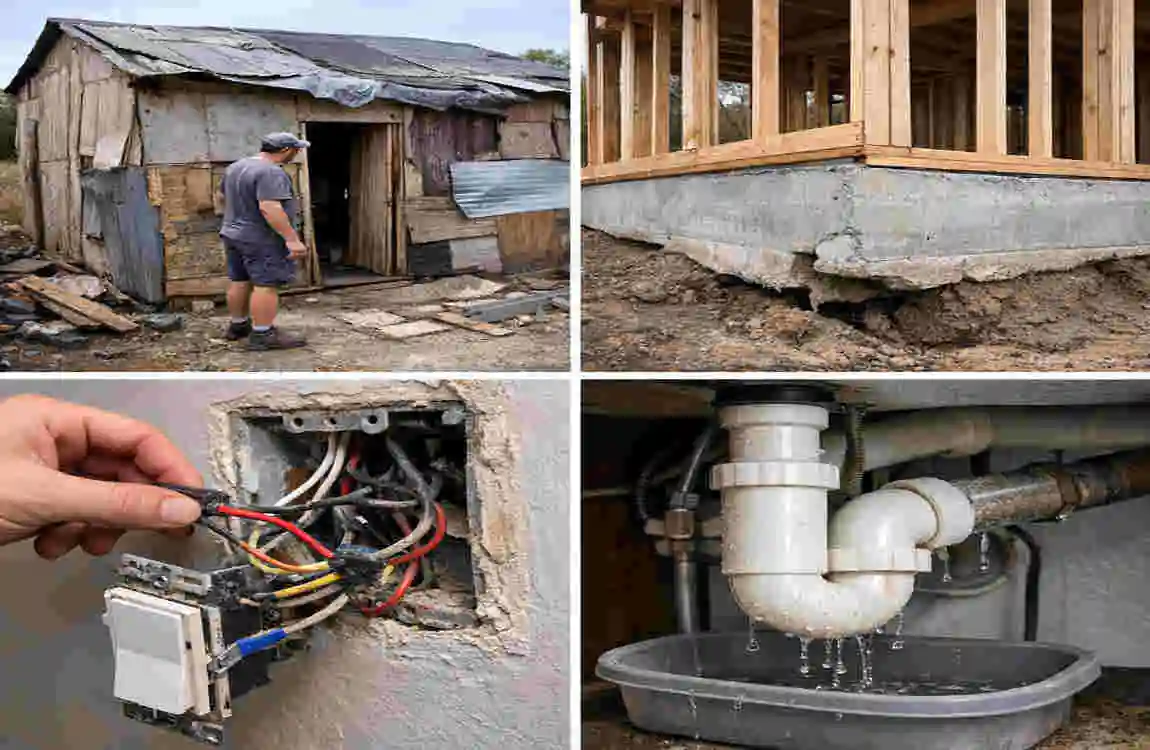
Even with a perfect plan, things can go wrong. Protect your investment by avoiding these three incredibly common home-building pitfalls.
Skipping Building Permits: Never try to sneak a build past your local city inspectors to save time or money. If you build without the proper permits, the city can halt your construction, fine you heavily, and even legally require you to tear the house down. Fines will easily double your costs. Always play by the rules and get your paperwork stamped.
Hiring Cheap, Unskilled Labor: There is a big difference between finding an affordable contractor and hiring a wildly unqualified one. If you hire someone solely because they are the absolute cheapest option, you will likely get sloppy work. Having to tear out poorly installed plumbing or crooked framing to hire a professional to fix it will add 20% to your total budget in agonizing reworks. Always check references.
Ignoring the Weather: If you choose traditional stick-framing, your raw wooden skeleton will sit completely exposed to rain, snow, and harsh sun for weeks. This can warp the wood and cause mold issues before you even move in. This is exactly why utilizing fast-erecting prefab panels or modular homes is so highly recommended—prefab completely dodges weather damage.
FAQs: Your Budget Building Questions Answered
We know this is a massive amount of information to process. Here are the answers to some of the most frequently asked questions about affordable fast construction methods.
How cheap can I build a 1,000 sq ft house fast? If you manage the project well, keep the design to a simple rectangle, and utilize prefab panels or modular construction, it is entirely possible to build a beautiful 1,000 square foot home for under $100,000. The key is extreme discipline regarding your interior finishes and doing the painting and flooring yourself.
Is a modular home actually as durable as a traditional home? Yes! In fact, they are often much stronger. Because modular homes have to survive being lifted by a crane and driven down a highway at 60 miles per hour, factories build them with 20% to 30% more structural framing material than a house built on-site. They are incredibly robust.
What is the best method for complete beginners? If you have no construction experience, start with pre-cut home-building kits or shipping containers. Building kits arrive with every single piece of wood pre-cut and numbered, much like an IKEA furniture set. It takes the terrifying guesswork out of structural engineering.
Do you have any financing tips for affordable builds? Look deeply into FHA (Federal Housing Administration) construction-to-permanent loans. These loans are designed to help ordinary people build homes. They offer low down payments and combine the construction costs and your permanent mortgage into one single, easy-to-manage loan.
