

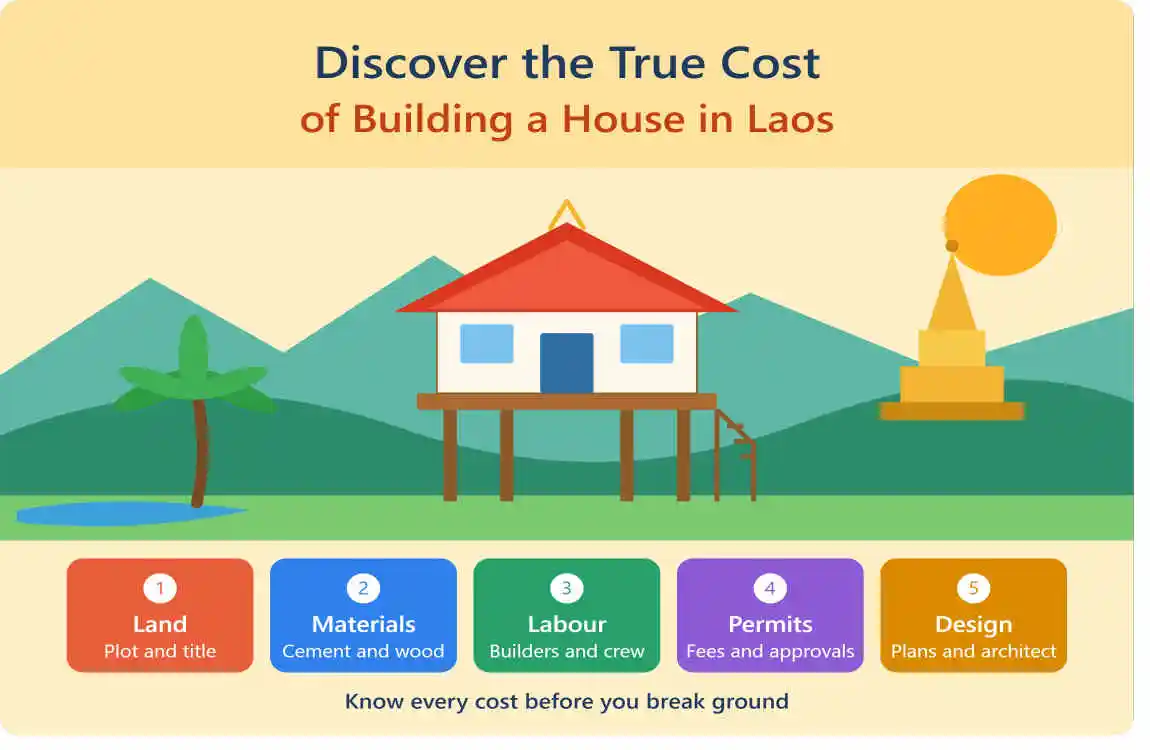
Building a standard house in Laos costs roughly US$350–$650 per square metre in 2026, according to current construction cost benchmarks for Laos. That puts a 150 m² three-bedroom home at about US$52,500–$97,500 for construction alone. Land, permits, design fees, furniture and a contingency fund come on top.
That number looks wonderfully low next to Western prices, and it is. But Laos is not a simple bargain. A weak currency, imported materials and a bumpy 2026 inflation story mean the final bill can drift well away from the first quote.
Cost to build a house in Laos by size (2026 estimates)
The table below applies the US$350–$650 per m² benchmark to common house sizes. These are construction-only figures. They exclude land, fees and site-specific work such as retaining walls or long access roads.
| House type | Floor area | Estimated construction cost (USD) |
|---|---|---|
| 2-bedroom house | 90 m² | $31,500 – $58,500 |
| 3-bedroom house | 150 m² | $52,500 – $97,500 |
| 4-bedroom house | 240 m² | $84,000 – $156,000 |
Source: Enormous Buildings, Cost to Build a House in Laos (2026). Treat these as order-of-magnitude benchmarks, not a quote.
What does the low end versus the high end buy?
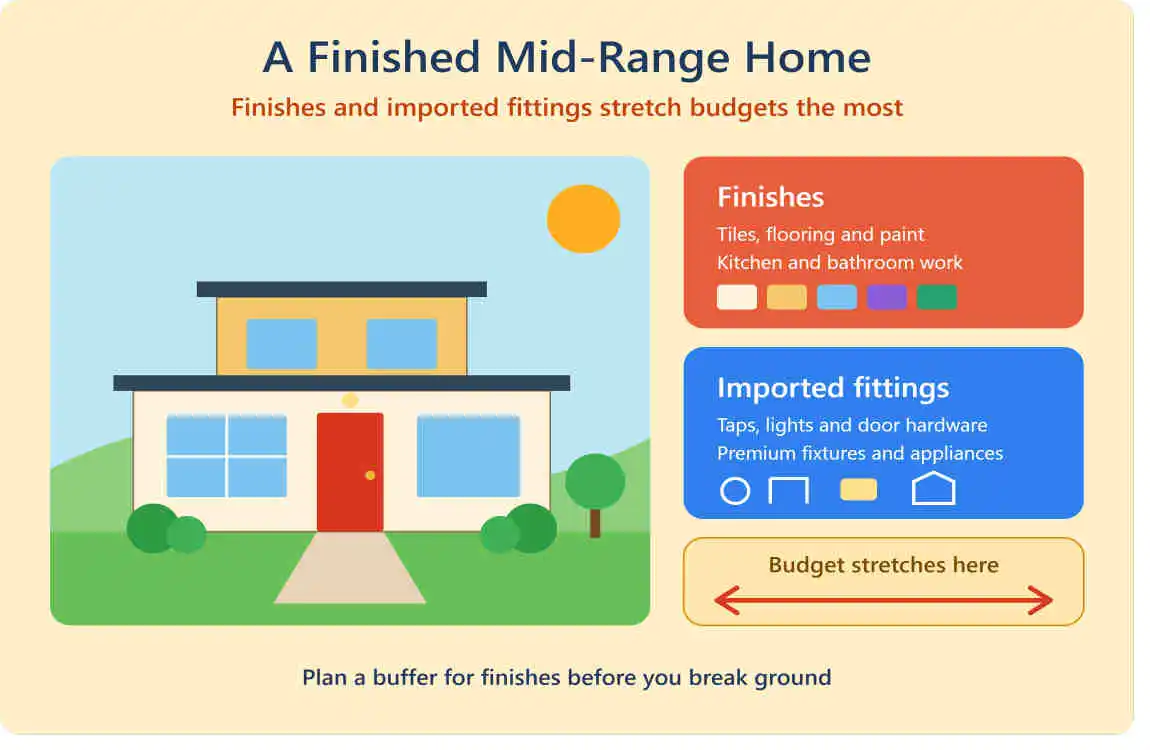
At the low end you get a simple rectangular plan, concrete frame with brick infill, basic tiling and standard fixtures. At the high end you are paying for better imported finishes, larger glazing, custom joinery, air-conditioning provisions and more complex rooflines. One Vientiane design-and-build firm has quoted around US$350–$400 per square metre for a one-storey house including electrical, plumbing, tiling and fixtures, and said steel-frame construction runs about 30% higher than traditional brick and cement. That interview is several years old, so use it as a floor, not a current price.
What makes up the total cost?
Land or land-use rights
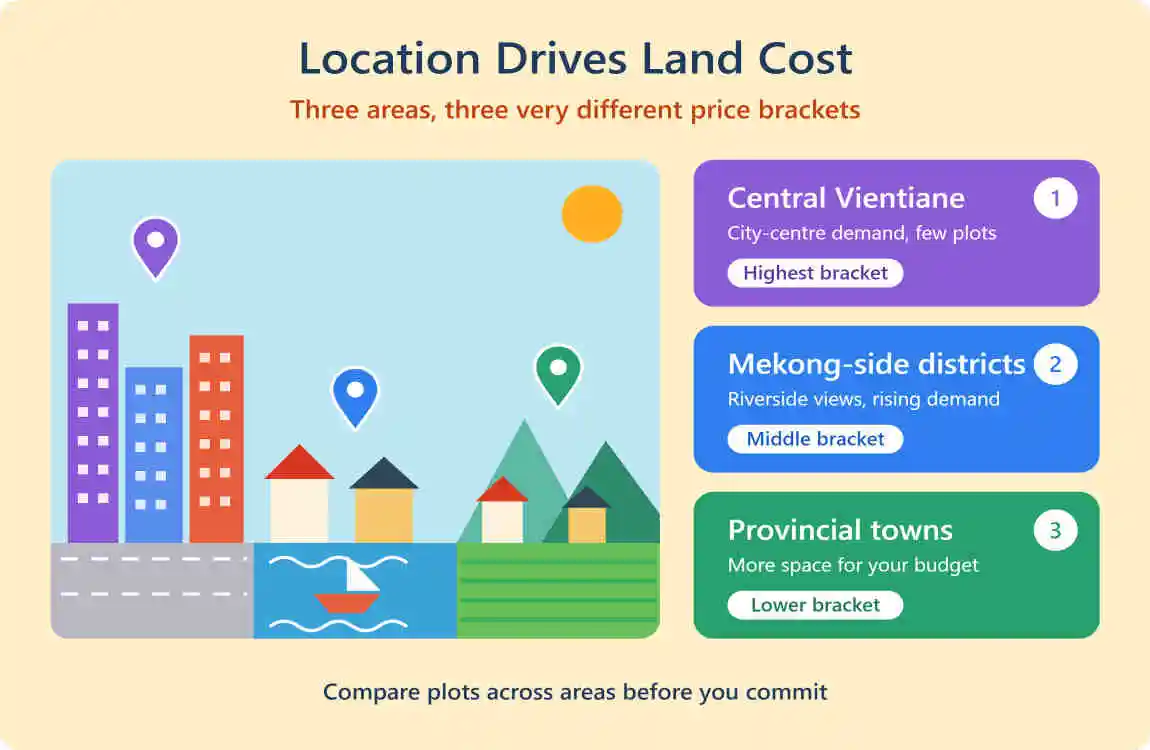
Land is the most unpredictable line in your budget. Reported prices run from well under US$50 per square metre in outer districts to several hundred dollars in residential Vientiane and thousands in the prime business core, according to press coverage of the capital’s land boom and compensation disputes around new expressway land. Those reports are older, so confirm current prices through a local land agent or lawyer before you rely on any figure.
Design and engineering
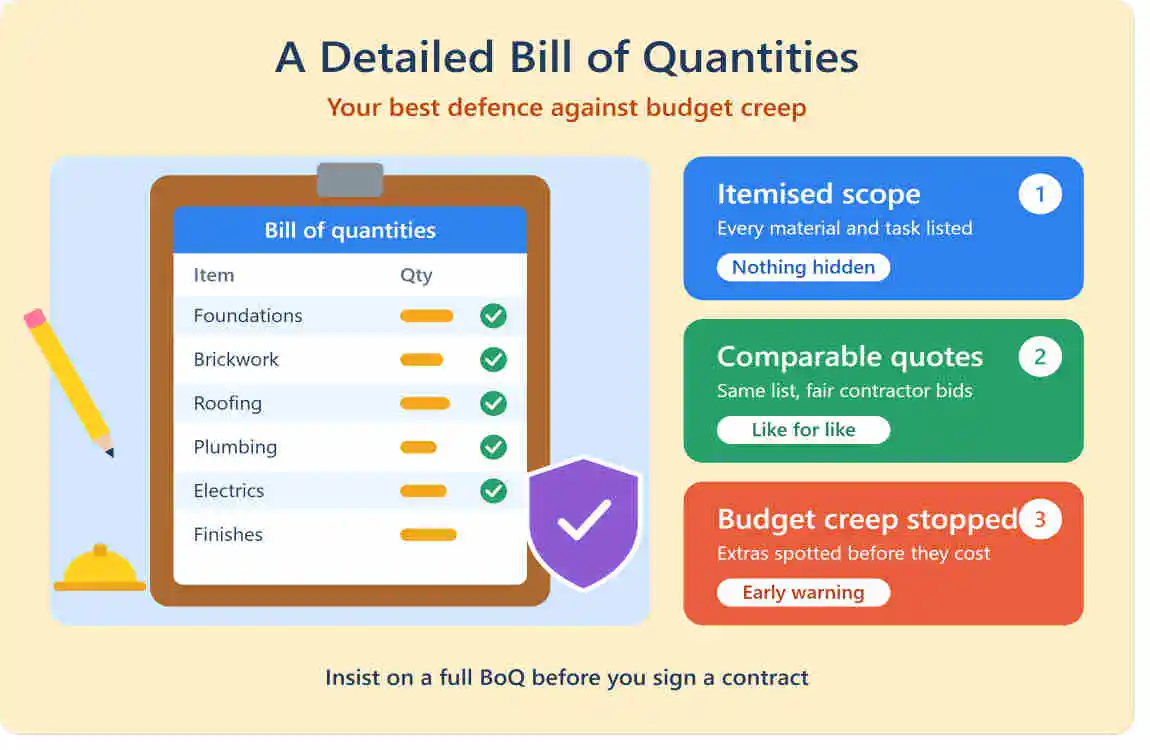
Budget for architectural drawings, structural drawings and a bill of quantities (BoQ). A bill of quantities lists every material and task with a price, which makes quotes comparable. The same Vientiane firm quoted about US$1,500 for a one-storey design package, again an older figure.
Materials
Cement, rebar, bricks, roofing, tiles, sanitary ware and electrical items make up the largest share of most builds. Many of these are imported or depend on imported fuel to move them, so prices follow the kip and the oil price. After Middle East tensions lifted crude above US$100 a barrel in March 2026, diesel in Laos jumped from nearly 20,000 kip to 52,650 kip per litre, pushing up transport and production costs across the economy.
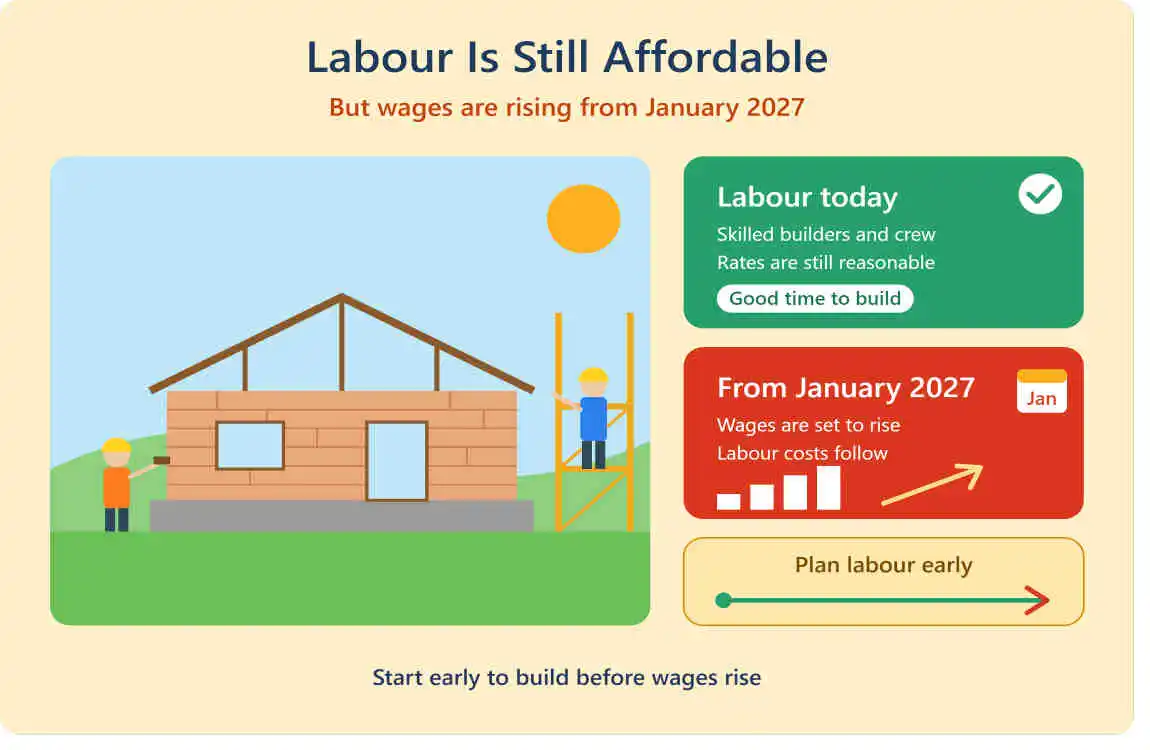
Labor
Labor remains cheap by regional standards, but it is getting dearer. The private-sector minimum wage is LAK 2.5 million a month (about US$113) today and will rise to a total of LAK 3.4 million (about US$153) from January 1, 2027. Skilled builders earn more than the minimum, and rising wages tend to ripple upward through contractor rates.
Utilities, permits and site work
Connecting water and electricity, clearing and levelling the plot, a boundary wall, drainage and driveway all add up. In hilly or flood-prone areas, expect more spending on foundations and retaining structures.
Furniture, fit-out and landscaping
Many quotes cover the “shell and basic finish” only. Wardrobes, kitchen units, lighting, air-conditioners and landscaping can easily add another 10–20% depending on taste.
Why 2026 is a tricky year to budget
Laos entered 2026 in better shape than it has been for years. The World Bank’s June 2026 Lao Economic Monitor notes that growth and conditions improved in 2025 and early 2026, but that the country stays vulnerable to external shocks. The IMF reported inflation falling from above 30% in 2023 to about 7.7% in 2025, with pressure on the kip easing.
Then the oil shock hit. According to the World Bank figures reported by Devdiscourse, headline inflation climbed to 10.2% in April 2026 from 5.1% in January. The Asian Development Bank and World Bank both expect inflation to average around 9.8% in 2026 before easing to 6.7% in 2027, and the World Bank projects GDP growth of 3.8% in 2026.
What this means for your build: a quote written in January may be stale by summer. Ask contractors how long their prices are valid, which currency the contract is in, and who carries the risk if cement or steel jumps mid-project.
Can foreigners build a house in Laos?
Yes, with limits. Foreigners cannot hold permanent land use rights, which is as close as Laos gets to land ownership. Under the amended Law on Land, foreign nationals may own structures built on Lao land. For the land itself, the law offers leasing from Lao citizens for up to 30 years, or leasing or conceding state land for up to 50 years.
The Multilaw 2025 real estate guide for Laos explains that when a foreigner signs a lease or concession, the land authority issues a State Land Title for the fixed term. Condominiums are a separate route: Decree on Condominiums No. 352/GOV took effect on February 1, 2024 and set out the process for foreigners to own units.
Practical tip: never build on land you cannot document. Before paying a builder, have a Lao lawyer check the title, the lease term and any renewal rights. A beautiful house on a short lease is a depreciating asset.
Build or buy: which makes more sense?
Building gives you control over layout, materials and finish, and it can cost less per square metre than buying a finished home in a prime district. Buying removes construction risk and gets you moving in sooner. If you are not on site regularly, or you do not speak Lao, the supervision burden of a build is real, so many foreign owners hire a project manager or architect to oversee it.
Hidden costs people forget
- Price escalation: inflation and fuel costs between signing and finishing.
- Variations: every “can we just change this?” becomes a line item.
- Rainy-season delays: foundations and earthworks are harder to schedule in wet months.
- Legal and translation fees: for lease agreements and title checks.
- Currency risk: if you earn in dollars but contract in kip, or the reverse, exchange swings change your real cost.
- Defects and retention: hold back a portion of the final payment until snagging is done.
How to keep your Laos house build on budget
- Fix the scope in writing. Get a BoQ and a finishes schedule so quotes compare like for like.
- Get at least three quotes and ask each contractor to show recent completed projects.
- Pay in stages tied to finished work, not dates. A common home structure is a deposit for foundations followed by several payments at completed milestones.
- Keep the design simple. Rectangular footprints and standard roof forms cost far less than complex shapes.
- Hold 10–15% contingency given 2026 price volatility.
- Visit the site often, or pay someone competent to do it for you.
Frequently asked questions
How much does it cost to build a house in Laos?
Most standard-specification homes cost about US$350–$650 per square metre in 2026. A 150 m² three-bedroom house therefore runs roughly US$52,500–$97,500 for construction alone, before land, permits, furniture and contingency.
Can foreigners build a house in Laos?
Yes, but foreigners cannot own land outright. They can own the building and hold land use rights through a lease or concession of up to 30 years from a Lao citizen or up to 50 years from the state. Foreigners may also own condominium units under Laos’s condominium rules.
Is it cheaper to build or buy a house in Laos?
Building is often cheaper per square metre than buying a finished home in prime Vientiane districts, but it takes longer and carries more risk from delays, material price swings and contractor quality. Buying gives price certainty; building gives control over design and finish.
Why are construction costs in Laos rising?
Higher fuel prices, imported materials, a weak kip and inflation all push costs up. The World Bank reported inflation of 10.2% in April 2026, and Laos is also raising its private-sector minimum wage from January 2027.
How long does it take to build a house in Laos?
A single-storey brick-and-cement home usually takes several months once drawings, approvals and site preparation are done. Larger or multi-storey villas take longer, and the rainy season can slow earthworks and foundations.
How can I reduce the cost of building a house in Laos?
Keep the footprint simple, choose local materials where quality allows, fix the specification in a written bill of quantities, pay in stages tied to completed work, and hold a 10–15% contingency for price changes.
Final thoughts
So, how much does it cost to build a house in Laos? For most people the honest answer is “about US$350–$650 per square metre for the build, plus land and a healthy buffer.” The low numbers are real, but so are the risks: a volatile kip, fuel-driven inflation and rising wages. Get your land rights documented, lock your specification in writing, and budget for surprises. Do that, and Laos remains one of Southeast Asia’s more affordable places to build a home.
