

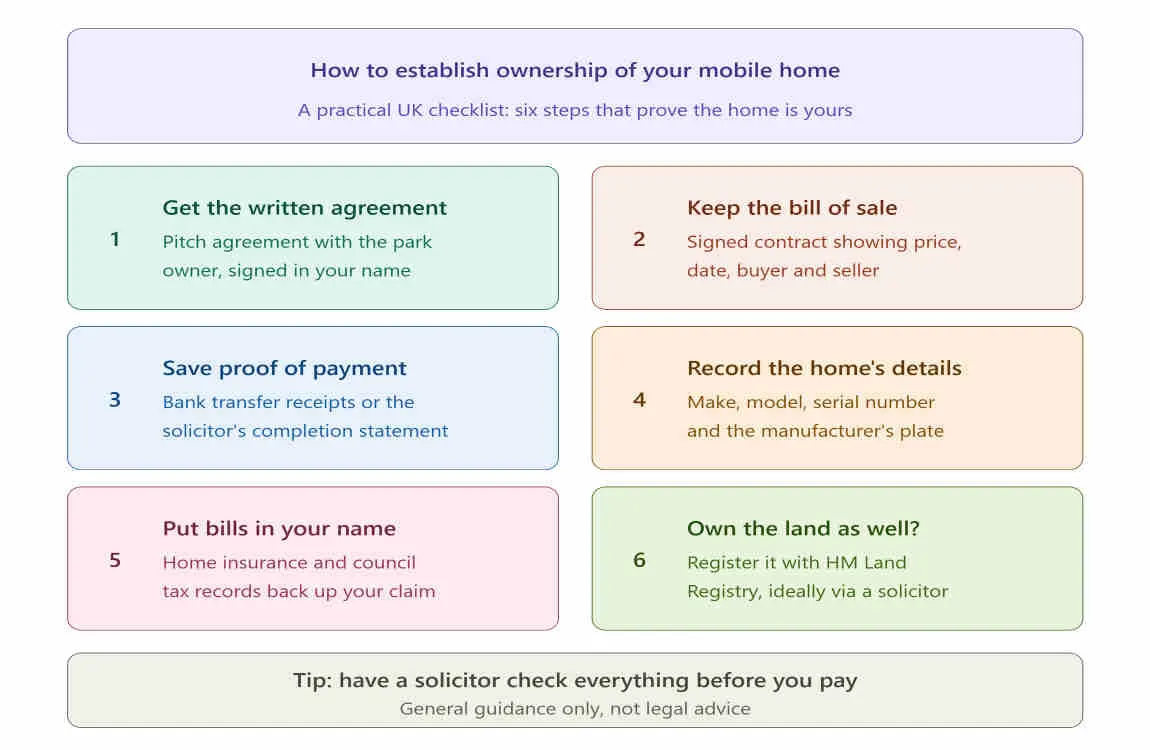
If you have ever tried to sell, insure, gift or even just argue about your home, you will have met the same question: how do you prove ownership of a mobile home in the UK? With a normal house you can point to a title register. With a mobile or park home, there is no single “deed” that does the job. Instead, ownership is shown by a bundle of documents, and knowing which ones matter can save you months of stress.

First, Understand What You Actually Own
This is the part that surprises many buyers. According to GOV.UK, when you buy a park mobile home you are buying the home, but not the pitch. The pitch (the plot of land) stays with the site owner, who is responsible for maintaining and managing the site. In return, you pay a pitch fee and usually pay council tax to your local authority.
Your right to keep the home on that pitch comes from a pitch agreement, which is protected by the Mobile Homes Act 1983. So when people ask about “ownership”, there are really two things to prove:
- That the home is yours (you bought it, were gifted it, or inherited it).
- That you have the legal right to station it on the pitch (your pitch agreement and written statement).
The Law Behind Mobile Home Ownership in England
The Mobile Homes Act 1983, as amended by the Mobile Homes Act 2013, is the main law covering residential park homes on “protected” sites. The Scottish Parliament’s research service describes it as the main piece of legislation setting out the rights and responsibilities of mobile home owners and site owners.
For sales and gifts in England, the detailed rules sit in the Act itself and in the Mobile Homes (Selling and Gifting) (England) Regulations 2013. These rules were brought in largely to stop “sale blocking”, where site owners put buyers off, and they are the reason a proper paper trail exists today.

Documents That Prove You Own a Mobile Home
Because there is no central register for the real estate home itself, your proof is the combination of documents below. Keep originals somewhere safe and scan copies.
The Pitch Agreement and Written Statement
Shelter explains that mobile home owners on protected sites have the right to a written statement of their agreement, and that the statement is evidence of the agreement but not the agreement itself. If you buy from the site owner, GOV.UK says the written statement must reach you 28 days before you enter into the contract or sign the pitch agreement (you can agree in writing to a shorter period).
The agreement should be signed and dated by you and the site owner, and include the commencement date, the pitch fee and the information from the written statement.
The Assignment Form (If You Bought Second-Hand)
When you buy from an existing resident, the pitch agreement is transferred to you through an “assignment”. GOV.UK states you and the seller complete an Assignment form confirming the agreed purchase price, the commission payable to the site owner and the pitch fee you will pay. This is one of the strongest single documents you can hold, because it records the transfer itself.
The Buyer’s Information Form and Supporting Papers
When buying from a resident home, the seller must give you a Buyer’s information form with the prescribed documents at least 28 days before the completion date (unless you agree an earlier date in writing). Keep it, together with anything the seller supplied about the home’s condition, warranty or survey.
Notice of Assignment and Proof of Commission Payment
Within seven days of the assignment, the buyer must send the site owner a Notice of assignment form with the required documents. The buyer pays the seller 90% of the price and holds back 10% as the site owner’s commission, which is then paid once the site owner provides bank details. Keep proof of this payment: it shows the sale was completed properly.
Your Sale Receipt, Invoice or Bill of Sale
Whether you bought from a dealer, a private seller or the site owner, make sure you have a signed receipt or invoice showing the date, the price, both parties’ names and a description of the home. It is not a replacement for the statutory forms above, but it supports them and is useful when dealing with insurers, lenders or probate.
Everyday Evidence
Council tax bills, utility accounts, insurance schedules and pitch fee invoices in your name all help show that you are the recognised owner-occupier. On their own they are weak proof, but alongside the documents above they build a solid picture.
Step-by-Step: How to Establish Ownership
- Confirm the site is protected. Check that it is a residential (or mixed-use) site covered by the Mobile Homes Act 1983. Age UK warns that you are not in a strong position if you treat a holiday caravan as a permanent home when the licence or agreement does not allow it.
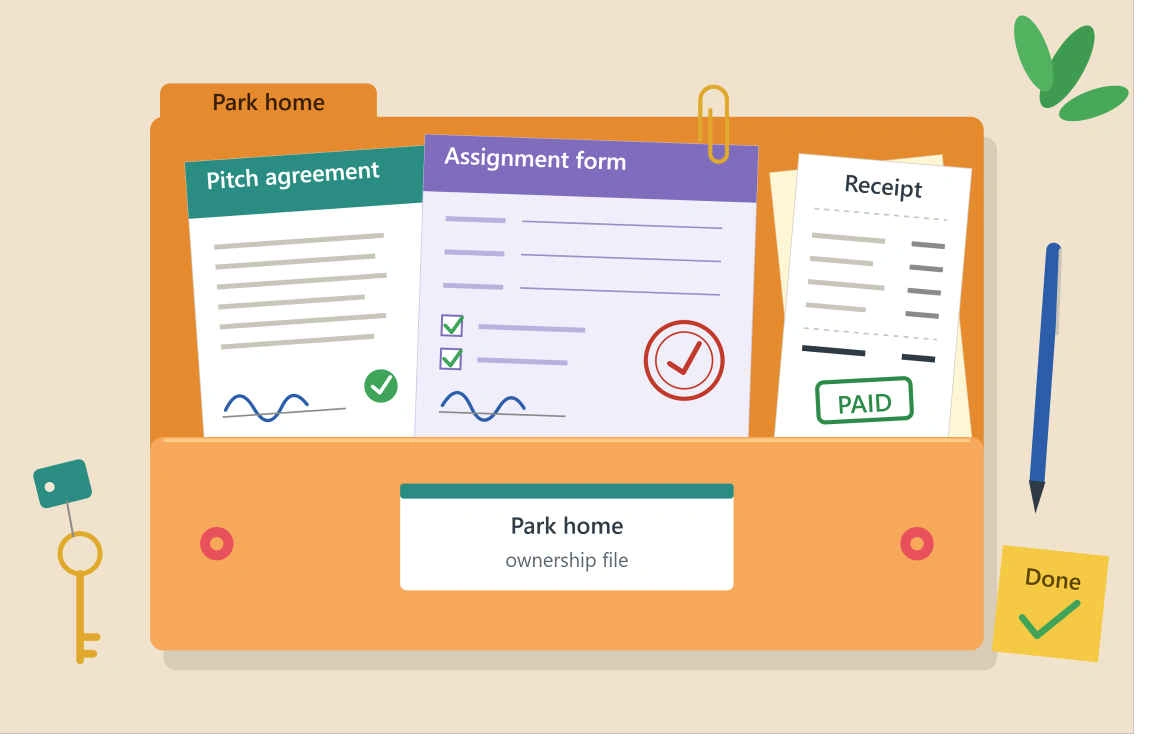
- Collect the core paperwork. Pitch agreement, written statement, site rules, assignment form and sale receipt.
- Check the details match. Names, pitch address, price and dates should be consistent across every document.
- Confirm commission and notices were handled. Make sure the Notice of assignment went to the site owner and the commission was paid.
- Store everything safely. GOV.UK stresses you will need these documents later, especially if a question about your rights arises or when you want to sell.
What If Your Paperwork Is Missing?
It happens more than you would think, especially with modern homes bought many years ago. Here is what you can do:
- Ask the previous owner or their solicitor for copies of the assignment form and sale paperwork.
- Ask the site owner for a written statement. If they never gave you one, Age UK notes you can apply to the First-tier Tribunal (Property Chamber) in England for an order requiring them to provide it. GOV.UK adds that without a compliant statement, express terms in the agreement are not enforceable until it is given.
- Get free initial advice. The Leasehold Advisory Service (LEASE) offers free initial guidance to park home owners through its park homes service, and Citizens Advice or your local Age UK can also help.
- Speak to a solicitor if the gap affects a sale, probate or a dispute with the site owner.
Selling, Gifting and Passing On Your Home
Proof of ownership matters most when something changes. LEASE explains that a park home owner can assign their agreement to a family member, and that the gifting process in England mirrors the selling process. On a sale, the site owner is entitled to commission of up to 10% of the sale price, a rate fixed by the Mobile Homes (Commissions) Order 1983.

Is It Different in Wales and Scotland?
Yes, the detail varies by nation, so check the rules where your home is sited.
- Wales: The Mobile Homes (Wales) Act 2013 applies. The Welsh Government’s guidance says a written statement must be given to a new owner no later than 28 days after the agreement of sale, and disputes go to the Residential Property Tribunal Wales.
- Scotland: The Scottish Parliament’s briefing notes that no solicitor is required to complete a sale and the 1983 Act does not cover the purchase itself, although buyers may still want advice.
Common Mistakes to Avoid
- Buying without seeing the pitch agreement, written statement and site rules.
- Handing over the full price instead of holding back the 10% commission where the process requires it.
- Forgetting to send the Notice of assignment within seven days.
- Accepting a verbal “it’s all fine” instead of getting documents in writing.
- Skipping independent advice. GOV.UK says buyers are strongly advised to take advice from a solicitor or another professional independent of the seller or site owner.
Frequently Asked Questions
How do you prove ownership of a mobile home in the UK?
You prove it with a set of documents rather than one title deed: the pitch agreement and written statement, the assignment form (if bought second-hand), your sale receipt or invoice, proof the commission was paid, and supporting bills in your name.
Is a mobile home registered with the Land Registry?
The pitch is land owned by the site owner, and GOV.UK confirms you do not buy it. The home itself is generally treated as a movable property rather than registered land, which is why your documents carry so much weight. If you need certainty for your situation, ask a solicitor.
Do I need the site owner’s permission to buy a mobile home?
Not for the assignment itself. GOV.UK states that the site owner’s consent is not needed to assign the agreement, although the site owner must be notified and can only challenge a sale on limited grounds (age, pets or vehicles) through the tribunal.
Can a site owner stop me selling my mobile home?
Not unfairly. It is a criminal offence for a site owner or their agent to interfere with a sale, for example by cutting off services or giving false or misleading information to buyers.
Who can I ask for free advice?
LEASE offers free initial advice on 020 7832 2525, and Citizens Advice and Age UK can also point you in the right direction.
Final Thoughts
Establishing ownership of a mobile home in the UK is less about one magic certificate and more about a complete, consistent paper trail. Get the pitch agreement and written statement, hold on to the assignment form and receipts, keep proof of commission and notices, and store it all safely. If anything is missing, act early: LEASE, the tribunal and a solicitor are there for exactly this situation.
