

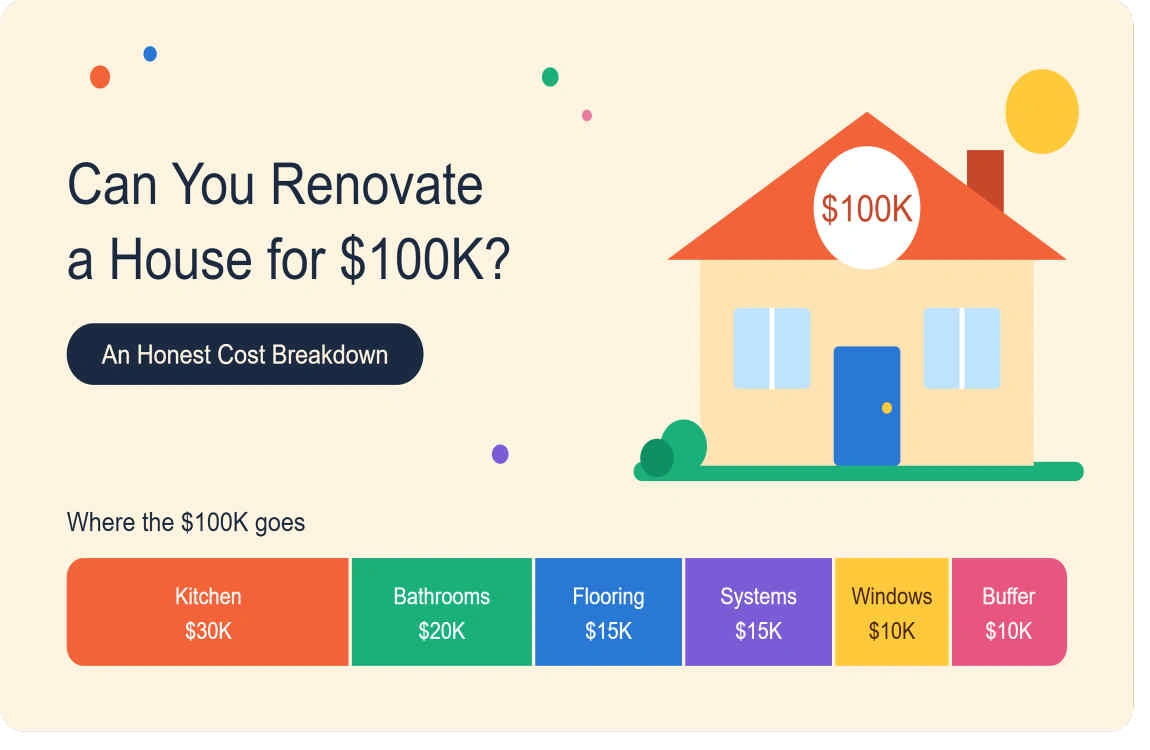
Renovating a house for $100,000 is possible, but the results depend on your home’s size, location, condition, and renovation goals. With careful planning and a realistic budget, you may be able to upgrade kitchens, bathrooms, flooring, paint, and other important areas without overspending. However, major structural repairs or full-home renovations can quickly increase costs.

What does it cost to renovate a house in 2026?
Renovation cost pricing swings widely. According to This Old House, using Angi pricing data, most homeowners spend between about $19,500 and $88,400 on a renovation, with an average near $52,275 for homes of 1,250 to 1,600 square feet. The same guide puts costs at roughly $15 to $150 per square foot, depending on finishes and how much structural work is involved.
That range is why the $100K question has no single answer. Here is how the same budget stretches across house sizes, using the low, mid and high per-square-foot figures from that guide:
| House size | Basic updates (~$15/sq ft) | Mid-range (~$60/sq ft) | Premium (~$150/sq ft) |
|---|---|---|---|
| 1,000 sq ft | $15,000 | $60,000 | $150,000 |
| 1,500 sq ft | $22,500 | $90,000 | $225,000 |
| 2,000 sq ft | $30,000 | $120,000 | $300,000 |
Totals calculated from the per-square-foot range published by This Old House (Angi data).
Look at the middle column. A 1,500 sq ft cozy home at mid-range finishes lands around $90,000, which is right inside a $100K budget. A 2,000 sq ft home at the same level goes over it. That’s the practical answer: $100K comfortably covers a mid-range renovation of a smaller or medium-sized home, but it gets tight fast on larger houses or high-end finishes.
What $100K can realistically cover
With $100,000, a 1,200–1,800 sq ft home with sound structure can typically get:
- A full kitchen remodel with new cabinets, counters, flooring and appliances
- One or two updated bathrooms
- New flooring throughout the main living areas
- Interior paint and drywall repair across the whole house
- Lighting, fixture and outlet updates, plus targeted plumbing or electrical fixes
- Replacement windows or exterior doors on a priority basis
What it usually does not cover comfortably: moving load-bearing walls, adding a second story or major extension, a full luxury kitchen with custom everything, or replacing the roof, HVAC, electrical panel and plumbing all at once.

A sample $100K renovation budget
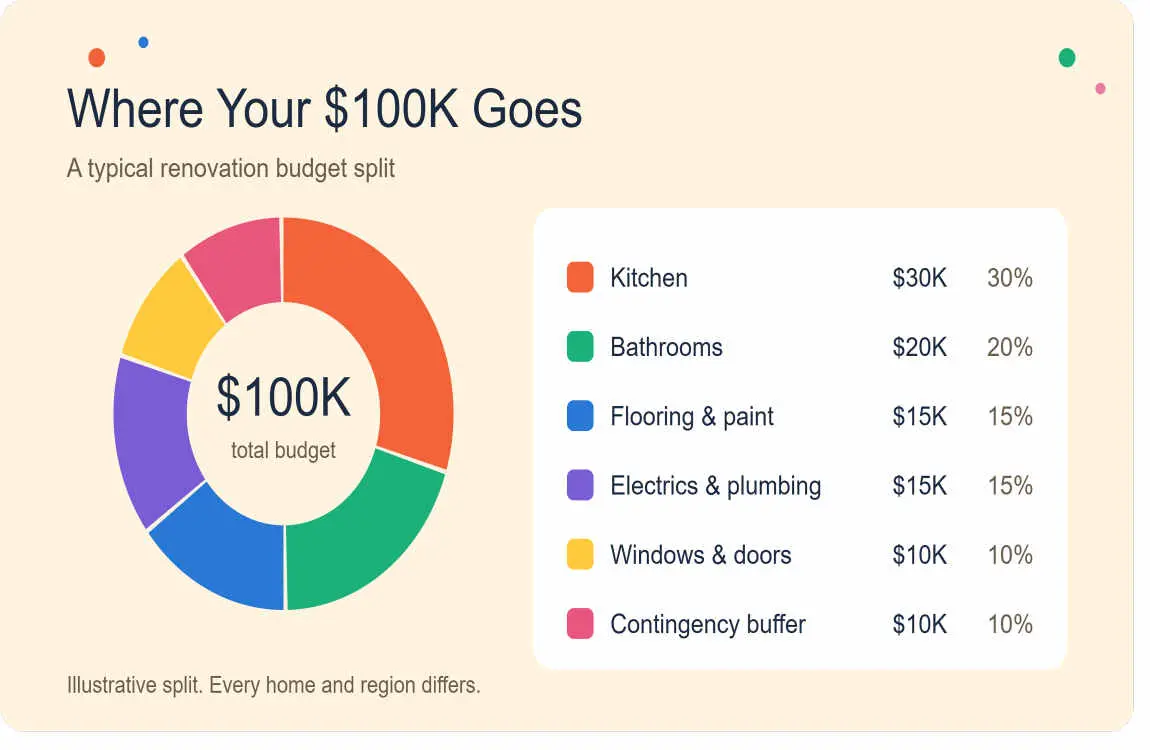
This is an illustrative allocation for a roughly 1,500 sq ft home, not a quote. Your numbers will shift with your local labor market and the condition of the house.
| Category | Sample budget |
|---|---|
| Kitchen remodel (mid-range) | $25,000 |
| Two bathrooms | $15,000 |
| Flooring (main living areas and bedrooms) | $10,000 |
| Paint, drywall and trim | $8,000 |
| Electrical and plumbing updates | $12,000 |
| Windows and exterior doors | $8,000 |
| Permits, design fees, misc. | $7,000 |
| Contingency (15%) | $15,000 |
| Total | $100,000 |
Notice that the contingency takes 15% of the money before you’ve picked a single tile. That is deliberate, and it’s the part most people skip.
The hidden cost: most homeowners underestimate
The biggest threat to a $100K renovation isn’t the price of cabinets. It’s the gap between the budget in your head and what the project actually costs. According to an article from Florida Realtors citing the 2026 Remodeling Impact Report, the average homeowner underestimates project costs by about 22%. The same piece notes that materials, fixtures, appliances and flooring typically eat 50 to 60% of a renovation budget, and recommends setting aside roughly 15 to 20% as a safety net for surprises like mold remediation or structural problems.
Apply that 22% to a $100K plan and you could be $22,000 over. That’s why the contingency in the sample budget above isn’t optional padding. It’s what keeps a surprise from stalling the job.

Where $100K goes furthest
If your goal is a house that feels dramatically better and holds its value, project choice matters as much as budget size. Zonda’s Cost vs. Value research, covered by Journal of Light Construction, shows that exterior renovations have consistently delivered a higher return at resale than discretionary interior remodels. The same analysis found that for kitchens and baths, low-cost cosmetic changes such as new fixtures, cabinet fronts and paint can return more than major reconstruction or upscale finishes. It also reported the basement remodel as one of the stronger performers among newer projects, with a national average return of 71%.
The takeaway for a $100K budget: spend where it shows and where it protects the house, and think twice before putting a large share into luxury finishes that buyers won’t pay a premium for.
For wider context, the National Association of REALTORS® maintains a remodeling resource hub pointing to the Cost vs. Value and Remodeling Impact reports, if you want to dig into data for your own market.
10 ways to make $100K go further
- Keep the layout. Moving plumbing and walls is where costs explode. Renovate in place when you can.
- Get at least three itemized bids. Compare scope line by line, not just the bottom number.
- Inspect before you buy or commit. A pre-renovation inspection catches roof, foundation, wiring and moisture problems early.
- Fix the systems first. Roof, drainage, electrical and plumbing pipe come before pretty finishes.
- Choose mid-range materials. Quartz-look laminate or mid-tier quartz, LVP flooring and stock cabinets look good for far less.
- Phase the project. Do structure and systems now; add easy upgrades later.
- Do safe DIY. Painting, demo of non-structural elements and landscaping can save labor. Leave electrical, gas and structural work to licensed pros.
- Order early. Lead times on windows, cabinets and appliances can delay the whole schedule.
- Pull permits. Skipping them can cause problems at resale and with insurance.
- Track every dollar. A simple spreadsheet comparing quoted vs. actual spend catches overruns while you can still adjust.
Is $100K enough? It depends on three things
- Size. Under about 1,500 sq ft, $100K goes a long way. Above 2,000 sq ft, you’ll likely need to prioritize or phase the work.
- Condition. A structurally sound 1990s house is a very different house project from a 1940s house with knob-and-tube wiring.
- Location. Labor and permit costs in high-cost metros can be dramatically higher than in smaller markets.
Frequently asked questions
How much house can you renovate for $100K?
At mid-range pricing of roughly $60 per square foot, $100K covers about 1,650 square feet. At basic update pricing, it stretches much further; at premium pricing, it covers closer to 650 square feet.
How much should I keep as a contingency?
Plan on 10–20% of the total budget, and lean toward the higher end for older homes where problems are hidden behind walls and floors.
Is it better to renovate or move?
If you like your location, your mortgage rate and your lot, renovating often makes sense, especially when your home’s structure is sound. If the house needs major structural work, compare the cost against buying a home that’s already updated.
What gets the best return on investment?
Per Zonda’s Cost vs. Value research, exterior projects tend to outperform discretionary interior remodels. Cosmetic kitchen and bath updates often beat full reconstruction on return.
Final thoughts
So, can you renovate a house for $100K? Yes, if the house is a reasonable size, the structure is sound, and you’re disciplined about scope. Set your priorities, hold back a real contingency, collect multiple itemized bids, and spend on the work that protects and improves the house first. A $100K renovation that is planned carefully will almost always beat a $150K renovation that isn’t.
