
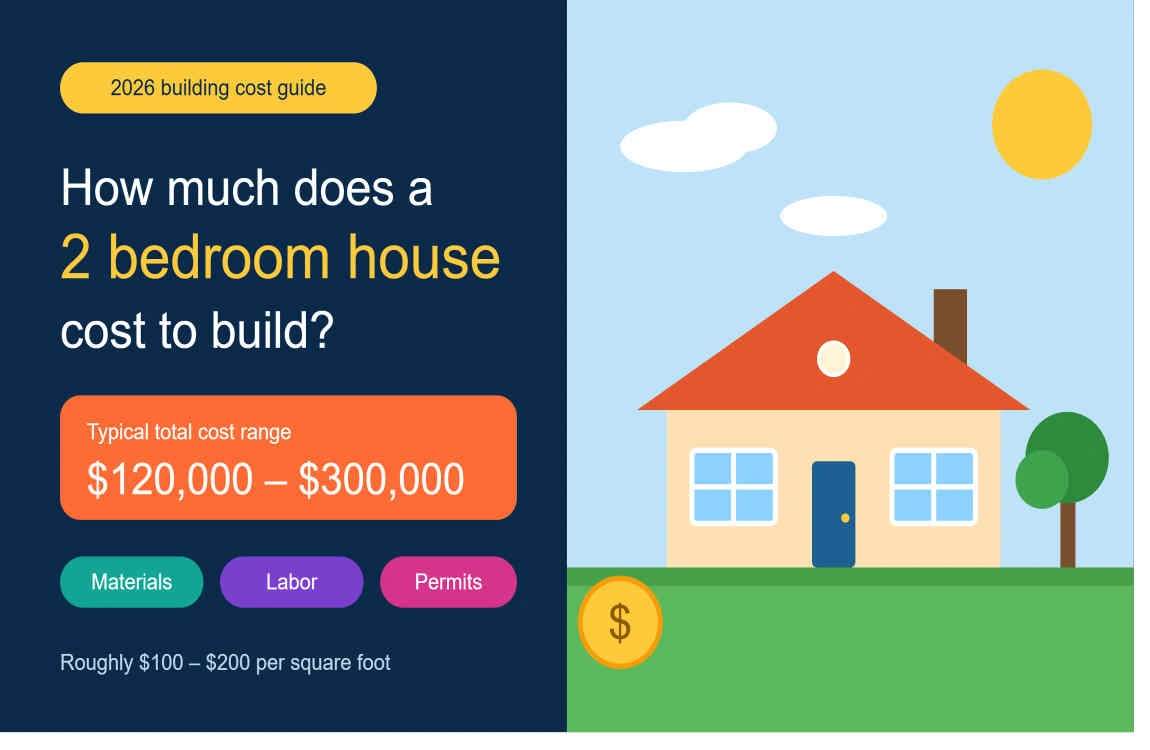
Building a two-bedroom house can be an exciting project, but understanding the total cost is essential before getting started. The overall price depends on factors such as location, house size, building materials, labor costs, design, and finishing choices. Whether you are planning a simple, budget-friendly home or a modern property with upgraded features, having a realistic construction budget can help you avoid unexpected expenses.
How Much Does a 2 Bedroom House Cost to Build by Size?
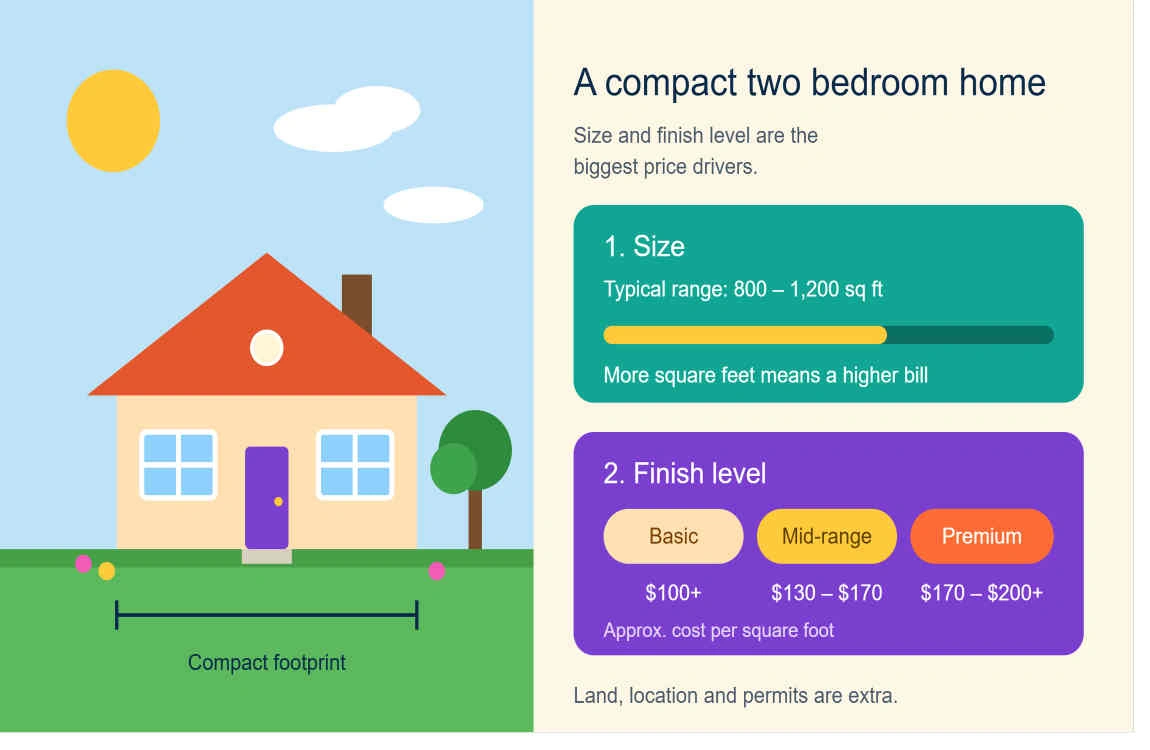
Two-bedroom luxury homes come in all sizes, from tight 800 sq ft cottages to roomy 1,400 sq ft ranch layouts. Using the $150 to $300 per square foot range, here is what to expect:
| Home size | Low estimate ($150/sq ft) | High estimate ($300/sq ft) |
|---|---|---|
| 800 sq ft | $120,000 | $240,000 |
| 1,000 sq ft | $150,000 | $300,000 |
| 1,200 sq ft | $180,000 | $360,000 |
| 1,400 sq ft | $210,000 | $420,000 |
The 800 and 1,000 sq ft rows match the figures published by Autodesk. The 1,200 and 1,400 sq ft rows are simple multiplication using the same per-square-foot range.
If you use NAHB’s national average of about $162 per square foot instead, a 1,000 sq ft modern home comes to roughly $162,000 and a 1,200 sq ft home to about $194,400. Treat those as a realistic mid-point for a standard build, not a quote.
Why the Price Range Is So Wide
Where you build
Labor, materials, permits and local rules all change from place to place. Redfin’s state-by-state data for a 2,000 sq ft home shows about $291,000 in Alabama against about $363,000 in California. That is roughly a 25% gap for the same size of house, which is why a national average should only ever be your starting point.
Finishes and fixtures
Laminate or granite? Vinyl plank or solid hardwood? Those choices add up fast. A basic kitchen and a high-end kitchen can differ by tens of thousands of dollars, even in a small home.
Layout and design
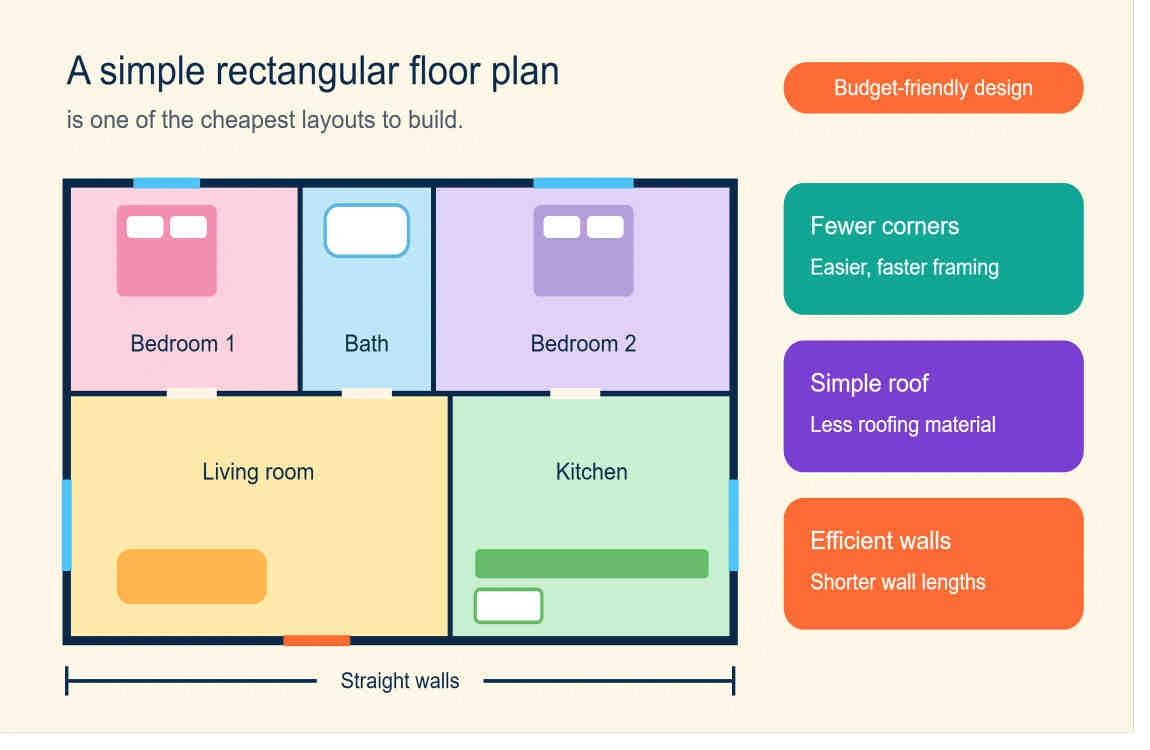
A plain rectangle with a simple roof costs less than a home with lots of corners, dormers or a complicated roofline. Houseplans.com makes the same point: smaller homes generally cost less to build and maintain, but location still plays a major role.
The size of the house itself
Small homes often cost more per square foot than large ones, because fixed items like the kitchen, bathrooms, plumbing and permits are packed into less floor space. So a 900 sq ft house will be cheaper overall than a 1,400 sq ft house, but not proportionally cheaper.
Where the Money Actually Goes
NAHB’s Cost of Constructing a Home survey is one of the most widely cited breakdowns in the industry. It splits a new build cost into stages. These are the shares it reported for 2024 (NAHB report, with the stage totals also summarised by the Pennsylvania Association of Realtors):
| Construction stage | Share of build cost | On a $200,000 two-bedroom build* |
|---|---|---|
| Site work | 7.6% | about $15,200 |
| Foundation | 10.5% | about $21,000 |
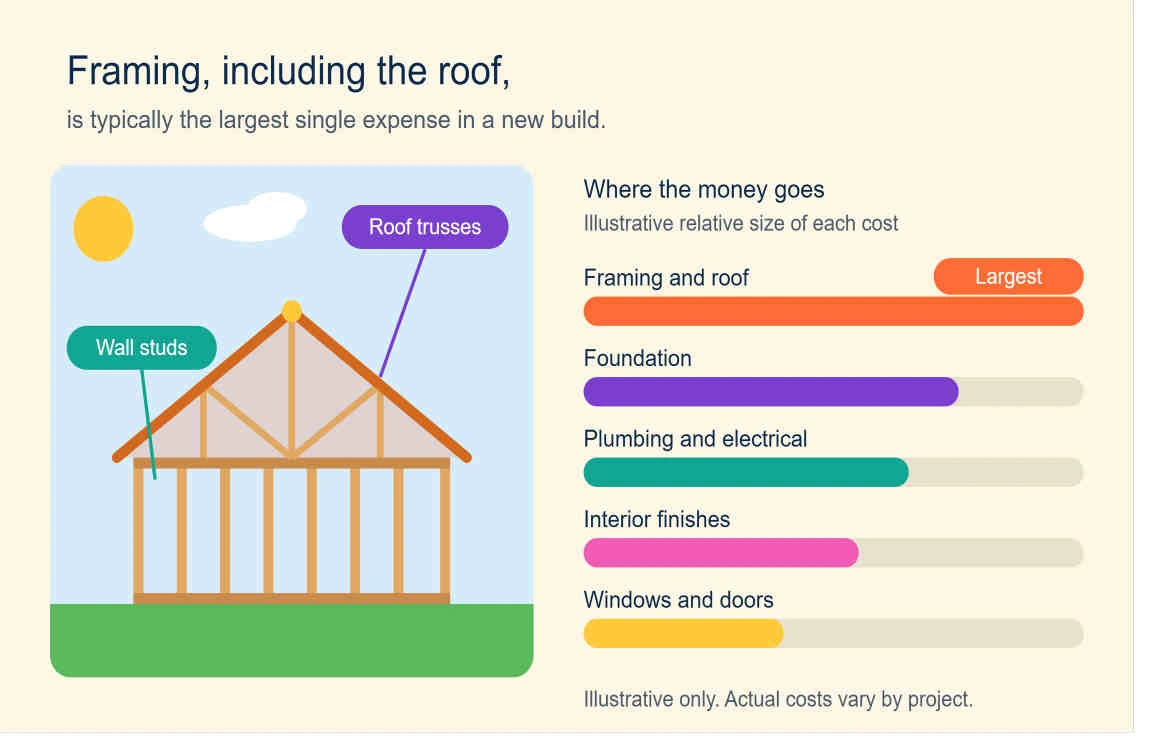
| Framing (including roof) | 16.6% | about $33,200 |
| Exterior finishes | 13.4% | about $26,800 |
*Illustration only: the percentages come from NAHB’s survey of average-size homes, and we have applied them to a $200,000 budget to show how the money splits. Plumbing, electrical, HVAC, interior finishes and final steps make up the remaining share of the budget.
Framing is the single biggest line item, which is one reason lumber prices get so much attention. The home foundation is the next big one, and it is also the part you cannot easily fix later, so it is not the place to cut corners.
Costs People Forget to Budget For
The per-square-foot figures above are for building the house. They do not cover everything you will spend before you can move in. Add these to your plan:
- Land. In NAHB’s survey, home construction made up 64.4% of the average sales price and the finished lot made up another 13.7%, so land is a separate and sizeable cost.
- Permits, impact fees and inspections. These vary a lot by town and county.
- Utility connections. If you are on rural land you may need a well, a septic system or a long power run.
- Driveway, landscaping and fencing. Easy to overlook, and they add up.
- Architect or house plan fees. Stock plans are cheaper than a custom design.
- Construction loan interest. You pay interest while the house is being built, not just after.
- A contingency fund. Set aside 10% to 20% for surprises. Almost every build uses it.
What Is Moving Building Costs in 2026
Material prices and trade policy have been the big story. NAHB has repeatedly warned that tariffs on lumber and other building materials raise construction costs and make housing less affordable, and it has pushed for an exemption for building materials. In 2026, The Close reports that tariffs on metal, lumber, cabinets and HVAC products are adding another variable to new-construction pricing.
The practical takeaway: get fresh quotes close to your build date, and ask your contractor how material price changes are handled in the contract. A quote that is a few months old may already be out of date.
How to Build a 2 Bedroom House for Less
- Keep the footprint simple. A square or rectangular shape with a basic roof saves on framing and foundation.
- Stack the plumbing. Put the kitchen, bathroom and laundry close together to shorten pipe runs.
- Choose mid-range finishes, then upgrade later. Flooring and paint are easy to improve down the road. Foundations and framing are not.
- Use a stock plan. Pre-drawn plans cost far less than a fully custom design.
- Get at least three itemized quotes. Compare line by line, not just the bottom number.
- Think about a smaller size. Cutting 100 to 200 sq ft can save more than most finish upgrades.
- Be your own project manager only if you know what you are doing. It can save money, but mistakes are expensive.
Is Building Cheaper Than Buying?
Not always. In many markets, buying an existing home is still cheaper than building new, though the gap has narrowed. Building gives you control over layout, energy efficiency and finishes, and a new home usually has lower repair costs in its early years. Buying gives you a fixed price, a faster move-in and no construction cost risk. Compare your full build budget, land included, against homes for sale in the same area before you commit. This Old House covers the build-versus-buy decision in more detail.
Frequently Asked Questions
How much does it cost to build a 2 bedroom house per square foot?
Most estimates fall between $150 and $300 per square foot, with NAHB’s national average around $162 per square foot for construction. Expect the higher end in expensive cities and for high-end finishes.
How much does it cost to build a 2 bedroom 2 bathroom house?
Adding a second bathroom raises the cost because of extra plumbing, fixtures and tile. The increase is usually modest compared with adding a bedroom, but it can add several thousand dollars depending on finishes.
What is the cheapest way to build a 2 bedroom house?
A small, simple rectangular design on a flat, easy-to-access lot with standard finishes and a stock plan. Cutting size is usually the most effective saving.
How long does it take to build a 2 bedroom house?
Many builders quote roughly six to ten months for a small stick-built home from breaking ground to move-in, though permits, weather and material delays can stretch that.
Does the cost include land?
No. The figures in this guide are for construction only. Land, utility hookups and site preparation are extra.
Final Thoughts
So, how much does a 2 bedroom house cost to build? For most people the realistic target is somewhere between $150,000 and $300,000 for construction, with the full range stretching from about $120,000 to $420,000. Your final number depends mostly on where you build, how big the house is and how much you spend on finishes. Before you set a budget, get itemized local quotes, add a healthy contingency, and remember the land and permit costs sit on top. A little planning now saves a lot of stress later.
