


The relationship has ended. The emotional ties are severed, and you’ve made the incredibly tough decision to separate. But then, you look at your bank account. You look at the rental market or the housing prices in your area. You look at your children, who are finally settled in their school routine.
You aren’t alone in asking this. Whether it’s due to the crushing weight of inflation, a desire to keep things stable for the kids, or simply because the divorce process is moving at a glacial pace, many couples find themselves stuck in the “in-between.” You are emotionally divorced but physically roommates.
What Does “Living Together While Separated” Really Mean?

Before we dive into the heavy legal stuff, let’s clear up the confusion. What does it actually look like to be separated under one roof?
To the outside world, nothing has changed. You enter the same front door, you might even share a meal occasionally. But legally and emotionally, the landscape is entirely different.
Defining Legal Separation vs. In-House Separation
There is a massive difference between a court-ordered legal separation and an informal decision to “take space” while living in the same house.
- Legal Separation: A specific legal status recognized by a court. It involves paperwork, lawyers, and a judge. You are still married, but the court has ruled on issues such as property and child support.
- Trial Separation (In-House): This is what most people are actually doing. It is an informal arrangement in which you decide the marriage is over (or paused) while you stay in the shared home.
The “Marital Clock” and Cohabitation
Here is where it gets tricky. In the eyes of the law, cohabitation implies more than just sharing a roof. It usually implies sharing a life.
If you are cooking for each other, doing each other’s laundry, sleeping in the same bed even occasionally, or sharing a bank account, a judge might look at your situation and say, “You aren’t separated; you’re just a married couple having a fight.”
To live together while separated, you have to prove you lead separate lives. This often means:
- Sleeping in separate rooms.
- Buying your own groceries.
- Stopping all marital duties (yes, including intimacy).
Busting Common Myths
Let’s tackle a few falsehoods right now:
- Myth: “If we live together, the separation doesn’t count.” -> Truth: It can count, provided you strictly separate your lives and finances.
- Myth: “It is illegal to live together after filing for divorce.” -> Truth: It is rarely illegal, but it might be strategically bad for your case depending on your state or country.
Did you know? According to various family law studies, an estimated 20-30% of separating couples continue to cohabitate during the initial stages of the breakup. You are definitely not the only one navigating this awkward hallway shuffle.
Legal Truths: Is It Allowed in Your Jurisdiction?
The rules of the game change entirely depending on where you are standing. What works in California might destroy your legal case in Pakistan. Let’s break down the legal implications of living together while separated across different regions.
US Laws on Cohabitation During Separation
In the United States, family law is a patchwork quilt—every state has its own distinct flavor.
Fault vs. No-Fault States: Most states are “no-fault” divorce states, meaning you don’t need to prove someone did something wrong to get divorced. However, the Date of Separation is crucial.
- California: Historically, California had very strict rules requiring you to live in separate residences to establish a date of separation. However, recent laws have softened this, allowing you to be separated under one roof if your conduct demonstrates a complete break in the relationship.
- New York: Courts here might scrutinize your living arrangement closely. If you are claiming spousal support (alimony) but living rent-free with your spouse, a judge might deny your request because your financial needs are being met by the “roommate.”
The Risk of Reconciliation Claims: If one partner doesn’t want the divorce, they can use your living situation as evidence against you. They can tell the judge, “We aren’t separated! We ate dinner together last Tuesday.” This can drag out the divorce process and increase your legal fees.
UK and Commonwealth Rules
In the UK, the approach is slightly different under the Matrimonial Causes Act.
The “Living Apart” Requirement: To get a divorce based on separation (e.g., two years separation with consent), you typically need to show you have been “living apart.”
- Can you live apart in the same house? Yes.
- However, the English courts are strict. You must maintain separate households. This means no sharing meals, no sharing domestic chores (washing, cleaning), and absolutely no sleeping together.
If the court suspects you are still operating as a household, they may reject your petition, forcing you to restart the clock on your separation period.
Pakistan and Islamic Family Laws
For our readers in Pakistan or those governed by Islamic Family Laws, the situation involves both civil law and religious mandates.
Muslim Family Laws Ordinance: There is no specific law in Pakistan that explicitly bans a husband and wife from living in the same house while their divorce is pending or while they are separated. In fact, during a trial separation, it is quite common due to the high cost of living and housing shortages in cities like Lahore or Karachi.
The Religious Aspect (Iddat): If a Talaq (divorce) has been pronounced, religious law requires a waiting period (Iddat).
- Traditionally, a woman observes Iddat in her matrimonial home.
- However, strict boundaries must be maintained. If the divorce is revocable (Talaq-e-Raja’i) and the couple resumes intimacy or “husband and wife” relations during this time, the divorce is considered revoked, and the marriage continues.
Social and Legal Risks: In Pakistan, living together while separated can sometimes complicate custody battles. If one parent moves out, the other might claim abandonment. Conversely, staying together in a hostile environment can be used as evidence of a “toxic environment” for children.
Pros and Cons of Living Together While Separated
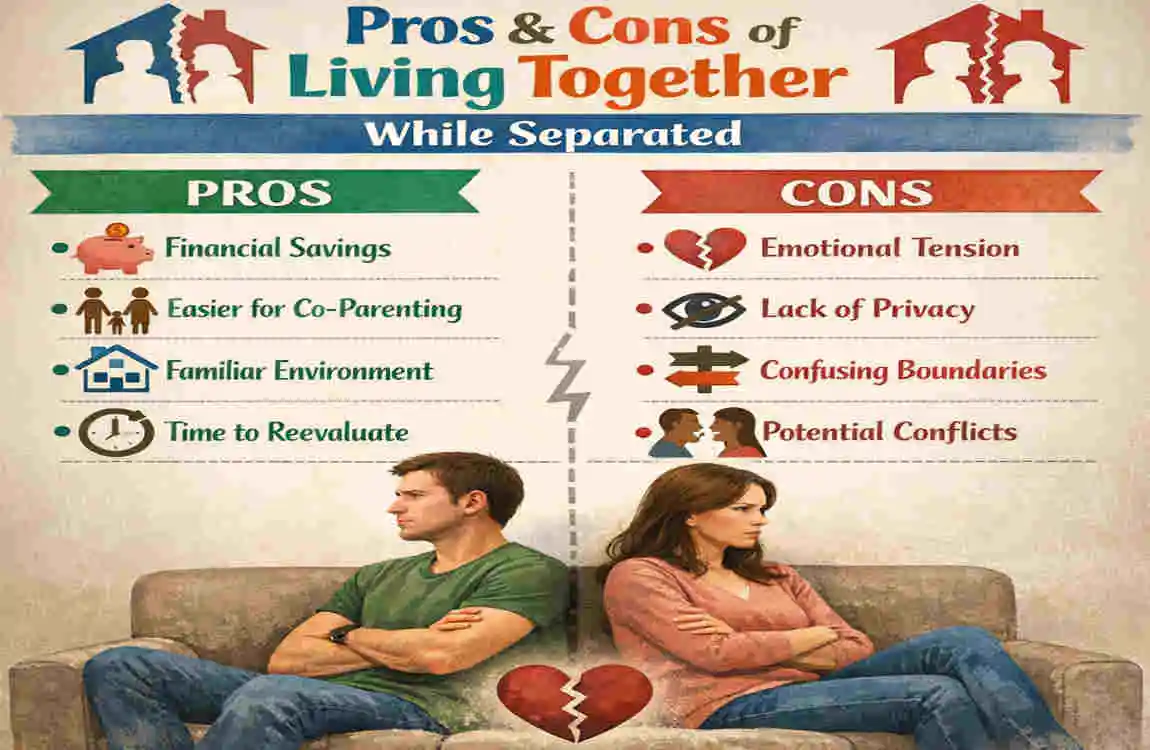
Why would anyone choose to stay with an ex-partner? Usually, it comes down to logic battling emotion. Here is a breakdown to help you weigh your options.
Feature Pros (The Good Stuff)Cons (The Deal breakers)
Finances Massive Savings: You continue to split rent/mortgage and utilities. This can save the average couple $1,500+ per month. Financial Disputes: Who pays for the broken boiler? If you don’t have a written agreement, money fights will replace relationship fights.
Children Stability: The kids keep their rooms, their school route, and daily access to both parents. It prevents the shock of an abrupt exit. Confusion & Tension: Kids are sponges. They absorb the tension. Seeing parents ignore each other can be more damaging than seeing them live apart.
Emotions Soft Landing: It provides a “buffer zone” to process the end of the relationship before the loneliness of living alone hits. No Closure: It is incredibly hard to heal when the source of your pain is sitting on the sofa. Dating new people is also practically impossible and awkward.
Legal Status Quo: You remain in the family home, protecting your interest in the property (it’s harder to argue you “abandoned” the home). Ambiguity: Judges may question if you are truly separated. It can delay the issuance of the final divorce decree if not documented properly.
How Cohabitation Affects Divorce, Alimony, and Child Custody
This is the section where you need to pay close attention. Your current living arrangement acts as a precedent for your future divorce agreement.
Impact on Divorce Proceedings
When you live together, you blur the lines.
- Timeline Extensions: In many jurisdictions, a divorce cannot be finalized until a separation period is met. If a judge decides your “in-house separation” wasn’t valid because you cooked dinner together, that mandatory waiting period (often 6 months to a year) resets to zero.
- Asset Division: If you continue to put money into a joint account to pay bills, you are commingling assets. This makes it much harder for lawyers to untangle who owns what later.
Alimony and Spousal Support
Does living together while separated affect alimony? Absolutely. Alimony is based on “need” and “ability to pay.”
- If you are living with your spouse and they are paying the mortgage and bills, the court may view your “need” as currently satisfied.
- You might find it difficult to request emergency temporary support because, technically, you have a roof over your head and the lights are on.
Child Custody Ramifications
Living together can be a double-edged sword in custody cases.
- The Good: It establishes that you are both capable, hands-on parents. It sets a precedent for a 50/50 custody split, which is what most courts prefer.
- The Bad: If the environment is hostile—lots of yelling, silent treatment, or passive-aggressiveness—the court might appoint a guardian ad litem to investigate. If they find the home environment is “high conflict,” they may force one parent to leave immediately to protect the children’s mental health.
Real-Life Stories and Expert Advice

Sometimes, hearing how others managed this strange situation is the best way to figure out if it can work for you.
Case Study 1: The Financial Strategy
Sarah and Mark, New York Sarah and Mark realized their marriage was over, but they had $20,000 in credit card debt. They decided to live together for exactly 12 months, even though they were separated. They moved into separate bedrooms and treated the house like a business.
- The Result: By the time they filed for divorce, they had paid off the debt and saved enough for two separate security deposits.
- The Lesson: It worked because they had a strict timeline and a shared financial goal.
The Reconciliation Trap
Aisha and Bilal, Lahore. They decided to stay in the same home for their daughter’s sake. However, they didn’t set boundaries. They continued to have tea together and occasionally fell back into old habits.
- The Result: The lines blurred. When Bilal finally started the divorce proceedings again a year later, the emotional fallout was twice as painful because they had essentially “un-separated” without fixing their issues.
- The Lesson: Without boundaries, you risk emotional whiplash.
What the Experts Say
Family lawyers and therapists generally agree on one thing: It shouldn’t be permanent.
“Cohabitation during separation works for about 40% of couples as a temporary trial. But if it goes beyond 6 months without a legal agreement, it almost always leads to higher conflict.“ — Family Law Association Report
Therapist Tip: Dr. Emily Stone suggests, “You must physicalize the separation. Move your clothes to a different closet. Buy your own milk. If you don’t change the physical environment, your brain won’t accept the emotional change.”
Steps to Live Together Safely While Separated
So, you have decided to go ahead with this. You are going to be roommates with your ex. How do you do it without losing your mind or your legal standing?
Follow these steps to ensure you are protected:
- Consult a Lawyer Immediately: Before you agree to anything, speak to a professional. Ask them specifically about “separation under one roof” laws in your state or country.
- Draft a “Cohabitation Separation Agreement”: It doesn’t have to be filed in court, but it does need to be written down. It should cover:
- Who pays which bill?
- Who does which chores?
- What are the rules regarding guests and new romantic partners? (Crucial!)
- What is the move-out date?
- Establish Physical Boundaries: One person takes the guest room or the basement. Put a lock on the door if you need privacy. Stop doing each other’s laundry. Stop cooking for two.
- Separate Your Finances: Open your own bank account immediately. Direct your paycheck there. Only contribute your agreed share to the joint account for household bills.
- Document Everything: Keep a calendar. Note the days you slept in separate rooms. Keep receipts of your own grocery shopping. This is your evidence of the validity of your separation if it is ever challenged in court.
- Plan Your Exit Strategy: Do not leave this open-ended. Set a review date (e.g., “We will review this arrangement in 3 months”). Knowing there is an end date helps you tolerate the awkward moments.
FAQs: Answering “Can You Live Together While Separated?”
Can living together while separated restart the marriage clock? Technically, yes. If you engage in marital relations (intimacy, shared finances, social appearances as a couple), a court may rule you have reconciled. You must prove you are living “separate and apart” within the home.
Does living together affect child support? It can. Since the higher-earning spouse is likely already paying for housing and utilities directly, the court may not order additional cash payments for child support until one parent moves out.
Is it legal in Pakistan to live together after divorce? If the divorce (Talaq) is final and the Iddat period is over, they are “non-mahram” (strangers) to each other. Living together would be culturally and religiously inappropriate, and could have legal consequences regarding “Zina” laws depending on the interpretation, though civilly it is a grey area. It is highly advised to separate households once the divorce is absolute.
Can I date other people while living with my separated spouse? Legally? Usually yes (depending on adultery laws in your state). Practically? It is a recipe for disaster. Bringing a date back to the home you share with your ex is widely considered a major violation of boundaries and can escalate conflict during the divorce.
