

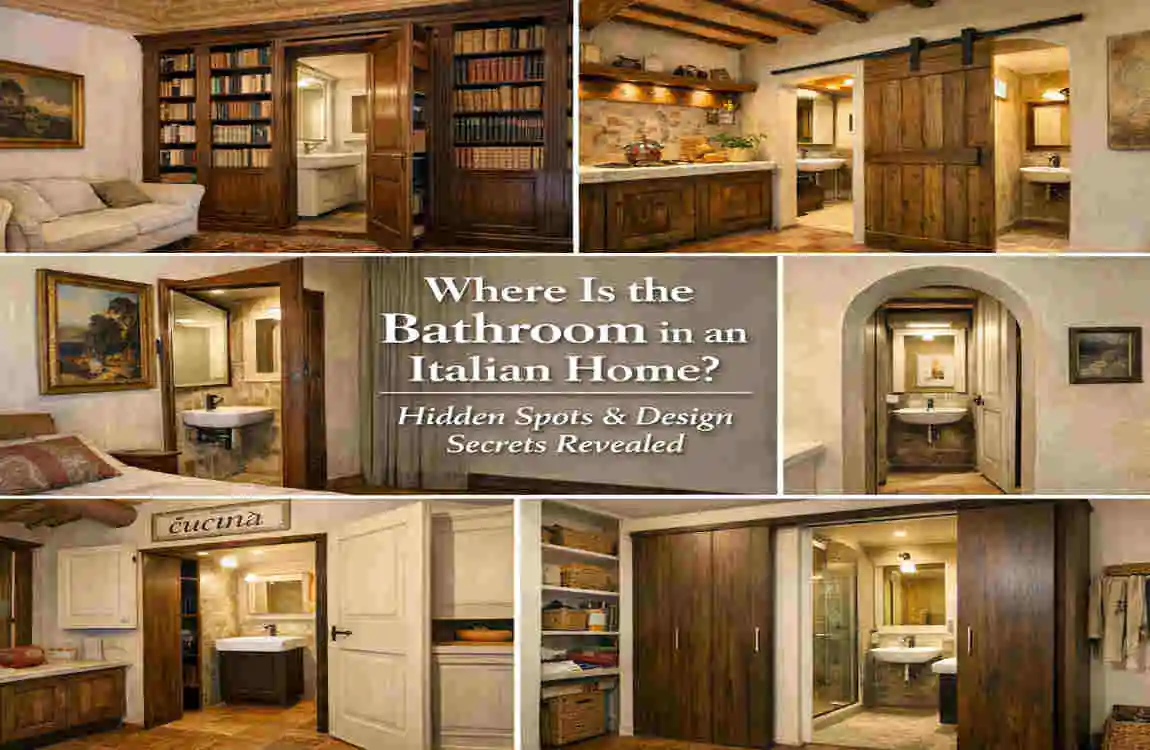
You have just arrived at a charming, sun-drenched villa in the Italian countryside, or perhaps a chic, compact apartment in the heart of Milan. You put down your bags, take a deep breath of the espresso-scented air, and realize you need to freshen up. You look around the main living area. You check the hallway. You check near the entrance. Nothing.
If you have ever found yourself knocking on what looks like a closet door only to find a fully equipped bagno, you are not alone. In Italian culture, the home is a sanctuary, but the bathroom is often treated with a unique blend of practicality and extreme privacy. Unlike open-plan American homes where the powder room might be right off the living room, Italian homes prioritize space-saving elegance over obvious layouts.
Italian Home Layout Basics: Why Bathrooms Hide

To understand the answer to “where is the bathroom in an Italian home,” you first have to understand the bones of the house itself. Italian architecture is steeped in history. A vast number of Italians live in buildings that are centuries old, where indoor plumbing was often retrofitted long after the walls were built.
The Architecture of Privacy
In traditional Italian floor plans—especially in the casa italiana—space is a Premium commodity. If you look at a typical urban apartment, whether bilocale (two-room) or trilocale (three-room), you will notice that the layout is compartmentalized.
Unlike the modern “open concept” sweeping across the US, Italian homes often rely on distinct rooms separated by corridors. The bathroom is rarely a focal point. Historically, it was considered a purely functional space, one that should be neither seen nor heard by guests in the main living area.
The Post-War Evolution
The post-WWII reconstruction era heavily influenced the layout we see today. During the economic boom of the 1950s and 60s—the era of la dolce vita—apartments were built rapidly to accommodate a growing urban population. Architects had to get creative.
They began designing “service zones.” These were specific areas of the house dedicated to plumbing and utilities. Consequently, the bathroom migrated. It moved away from the exterior walls (where windows are) and into the center of the apartment or tucked into “dead space” to maximize the square footage of the bedrooms and living rooms.
So, in most Italian homes, where is the bathroom? It is often tucked behind a sliding pocket door, squeezed into an odd angle near the entrance, or nestled right next to the cucina (kitchen) to share water lines. It is a game of architectural hide-and-seek that prioritizes efficiency above all else.
Hidden Spots: Top Places to Find the Bagno
If you are currently standing in an Italian rental scratching your head, or if you are looking at floor plans for a property in Tuscany, this section is for you. We are going to break down the four most common hiding spots.
En-Suite in the Main Bedroom (Bagno Padronale)
One of the most coveted features in modern Italian real estate is the bagno padronale—the main bathroom. However, don’t expect a grand double door entrance.
In many homes, this bathroom is completely invisible from the hallway. It is located strictly inside the main bedroom. A desire for ultimate privacy drives this design choice. The Italians view the morning ritual as a personal time.
Pros and Cons:
- The Good: It offers total seclusion from children or house guests. It feels like a private retreat.
- The Bad: If this is the only bathroom in a small apartment (which happens), guests have to walk through your bedroom to use the facilities.
Design-wise, these are often hidden behind “flush-to-wall” doors that are painted the same color as the bedroom walls, making them disappear entirely when closed.
Hallway or Corridor Nooks
This is the most classic answer to the question of where the bathroom is in an Italian home. It is in the disimpegno—the hallway.
In Milanese apartments especially, you will find a long corridor separating the living area from the sleeping area. The bathroom is almost always located here, usually accessed via a pocket door (a door that slides into the wall).
Why here? It serves as a buffer zone. By placing the bathroom in the corridor, you create a sound and scent barrier between the social areas (living room/kitchen) and the private areas (bedrooms). It is a brilliant use of transition space. If you see a row of doors in a hallway, the narrowest one is almost certainly the bathroom.
Near the Kitchen (Cucina Adjacent)
To an American or British tourist, this is often the most confusing location. Why would you put a bathroom right next to where you cook pasta?
The answer is simple: Plumbing.
In older stone buildings or rural homes, running new pipes through thick masonry walls is incredibly difficult and expensive. To save money and structural integrity, builders group the “wet” rooms. Therefore, the bathroom wall often backs right up to the kitchen wall.
These are often called “service bathrooms.” They are practical, usually smaller, and might double as a laundry room with a washing machine squeezed into the corner. While it might seem odd to have the toilet mere steps from the stove, in Italy, it is just a matter of engineering logic.
Separate Guest Bagno Downstairs
If you are lucky enough to be staying in a multi-story villa or a townhome, you will encounter the “day/night” split.
The Setup:
- Ground Floor: For visitors. You will find a small powder room, often tucked under the staircase or near the entryway. It usually contains just a sink and a toilet.
- Upper Floor: This is for the family. Here are the full bathrooms with showers and bathtubs.
Design Secrets: What Makes Italian Bathrooms Unique
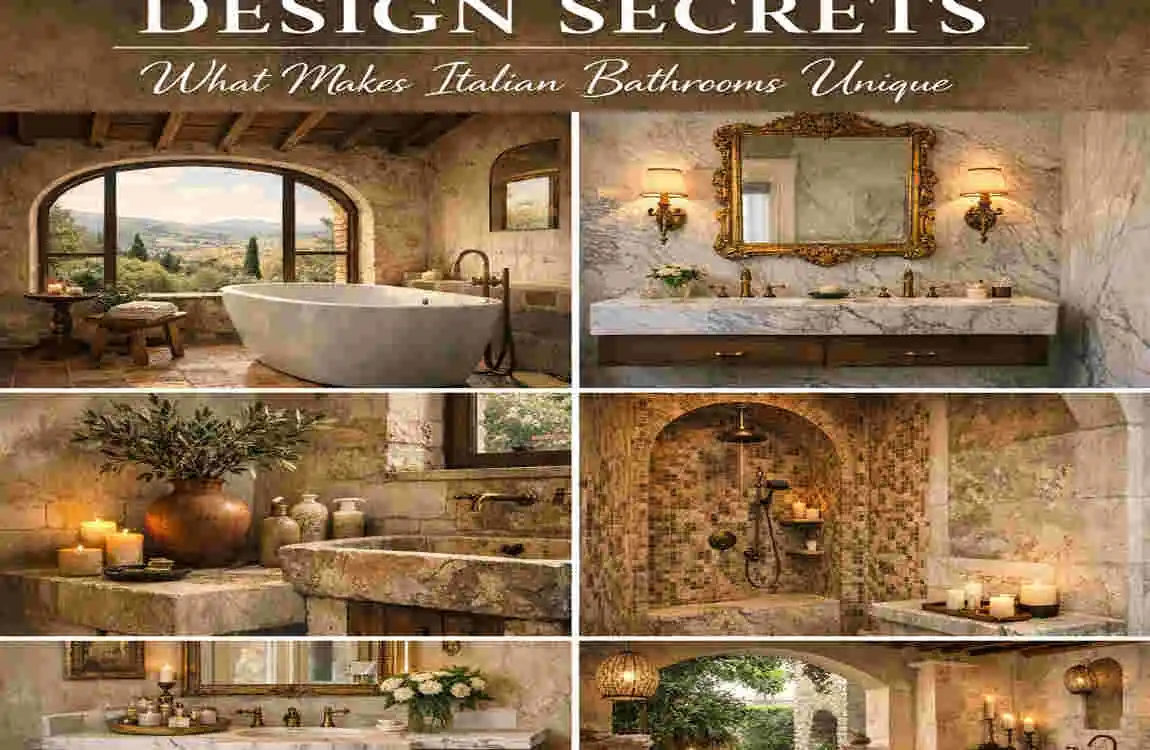
Now that we have solved the mystery of where is the bathroom in an Italian home, let’s talk about what you find once you actually get inside. Italian bathroom design is world-renowned, and for good reason. They manage to pack luxury and high function into very tight spaces.
Here are the design secrets that make these rooms stand out.
Compact Fixtures and Multifunctionality
Italians are masters of scale. You will rarely find a bulky, oversized vanity in an Italian apartment. Instead, the design leans toward:
- Wall-Hung Toilets and Bidets: By floating the sanitary ware off the floor, the room feels larger and the floor is much easier to clean.
- Curbless Showers: Many modern Italian bathrooms turn the entire room into a wet room, or use a glass partition without a heavy tray, making the space feel seamless.
- The “Termoarredo”: This is the heated towel rail. It is not just for luxury; it often serves as the primary radiator for the room, freeing up space that a traditional heater would take up.
Tile Magic and Concealed Doors
Since the bathroom is often hidden, the entrance is key. Italian designers love hidden doors. You might see a wall of bookcases where one panel is a door, or a mirrored wall that opens to reveal the bagno.
Once inside, the tile work takes center stage. Whether it is the zellige-inspired patterns of the Mediterranean or large-slab marble in the north, tiles are used to create depth. A popular trick is tiling the walls all the way to the ceiling. This draws the eye up and makes a narrow room feel like a tall, luxurious spa.
Natural Light and Ventilation Hacks
One challenge of tucking a bathroom into the center of an apartment is the lack of windows. The Italian building code is strict about ventilation, so how do they manage?
- The Lucernario: In top-floor apartments, skylights are very common.
- Transom Windows: You will often see a small, hinged window above the bathroom door. This borrows light from the hallway or adjacent room and allows for airflow without sacrificing privacy.
- Mechanical Extraction: High-powered, silent fans are standard in windowless bathrooms (known as bagno cieco or “blind bathroom”).
Luxury Upgrades in High-End Homes
In luxury villas or renovated city lofts, the bathroom becomes a high-tech sanctuary. We are seeing a massive trend toward:
- Chromotherapy Showers: LED lights in the showerhead that change color to enhance mood.
- Smart Mirrors: Mirrors that don’t fog up and have built-in lighting adjustments.
- Radiant Floor Heating: Also known as riscaldamento a pavimento, this is increasingly common in Northern Italy, ensuring you never have to step onto cold tiles in winter.
The Cultural Quirk: The Bidet Obsession
We cannot talk about Italian bathrooms without addressing the elephant in the room—or rather, the second bowl in the room—the Bidet.
To Italians, a bathroom without a bidet is not complete. It is considered a basic human necessity for hygiene. Even in the tiniest “hidden” bathroom, an architect will move mountains to fit a bidet next to the toilet. If you are renovating a home in Italy and try to remove it to save space, your contractor might actually look at you with horror. It is simply non-negotiable.
Regional Variations: Bathrooms Across Italy
Just as the food changes from Milan to Sicily, so does the design and location of the bathroom. The answer to “where is the bathroom in an Italian home” can depend heavily on the latitude.
Northern Italy (Milan, Turin, Venice)
In the industrial and fashion capitals of the North, efficiency rules.
- Style: Ultra-modern, sleek, and minimalist.
- Materials: Concrete, glass, and steel.
- Location: Often found in “lofts” or repurposed industrial spaces. You might see a bathroom inside a glass box within a bedroom, using curtains for privacy. Space is tightest here, so the “hidden hallway bath” is most common.
Central Italy (Rome, Tuscany, Umbria)
Here, we move into the land of rusticity and romance.
- Style: Warm, textured, and historic.
- Materials: Travertine stone, terracotta floors, and exposed wooden beams.
- Location: In Tuscan farmhouses, bathrooms are often carved out of odd spaces—sometimes under the roof slope or in what used to be a storage closet. They embrace the building’s quirks.
Southern Italy (Naples, Puglia, Sicily)
The South is all about light and air.
- Style: Vibrant, colorful, and airy.
- Materials: Hand-painted Majolica tiles (famous in the Amalfi Coast) and bright blues and yellows.
- Location: In the masserie (farm estates) of Puglia, you might find bathrooms that have direct access to the outdoors or a private courtyard. The “wet room” concept is popular here, where the shower is open to the rest of the bathroom to keep it cool and airy during the hot summers.
Modern Trends and Renovation Tips

Are you thinking about buying a property in Italy or renovating one? Or perhaps you want to bring some Italian flair to your current home? Let’s look at what is happening in 2026.
2026 Trends to Watch
- Eco-Friendly Everything: Water conservation is a huge priority. Expect to see low-flow bidets and toilets with greywater recycling systems.
- Modular Pods: In historic renovations, rather than building new walls, designers are installing prefabricated “bathroom pods” that sit in the middle of a room like a piece of furniture.
- Texture over Color: The trend is moving toward tactile surfaces—stone that feels like raw rock, and wood that feels unfinished.
Renovation Advice: The “Geometra”
If you are renovating in Italy, you cannot just start knocking down walls to move the bathroom. You need a Geometra. This is a surveyor/junior architect who navigates the complex bureaucracy of Italian permits.
Cost Guide: If you want to create a typical Italian bathroom, here is a rough estimate of what you might spend:
Item Estimated Cost (Euro)Notes
Plumbing & Demolition €2,000 – €4,000 varies by age of building
Tiles & Flooring €1,000 – €3,000 Depends on material (Marble vs. Ceramic)
Sanitary Ware (Toilet/Bidet) €800 – €2,000 Wall-hung models are pricier
Fixtures (Taps/Shower) €500 – €1,500 Quality brassware
Total Average €5,000 – €15,000 For a full remodel
Pro Tip: Always budget for the unexpected. In Italy, when you open a wall, you might find plumbing from the 1920s—or a fresco from the 1700s!
Common Mistakes and FAQs
To wrap up, let’s address some common pitfalls and the questions that pop up most often in Google searches about where the bathroom is in an Italian home.
Mistake 1: Ignoring the Bidet Plumbing If you are American and renovating in Italy, do not tell your plumber to cap the bidet pipes. It will significantly reduce your home’s resale value.
Mistake 2: Forgetting Ventilation If you are creating a “blind bathroom” (no window), you must install a high-quality extractor fan vented to the outside. Mold is a major enemy in old stone buildings.
Frequently Asked Questions
- Where is the bathroom in an Italian Airbnb usually? Check the listing carefully. If it says “1 bath,” it is likely in the hallway. If it says “en-suite,” it is in the bedroom. Always look for the “bidet” in photos to confirm it is a full bath.
- Do all Italian homes have en-suite bathrooms? No. In fact, most older apartments have one central family bathroom shared by everyone. En-suites are a relatively modern luxury in Italy.
- How do I spot a hidden bathroom door? Look for a break in the wall pattern, a small keyhole, or a flush-mounted handle. If you are at a dinner party, don’t be afraid to ask, “Dov’è il bagno?” (Where is the bathroom?).
