

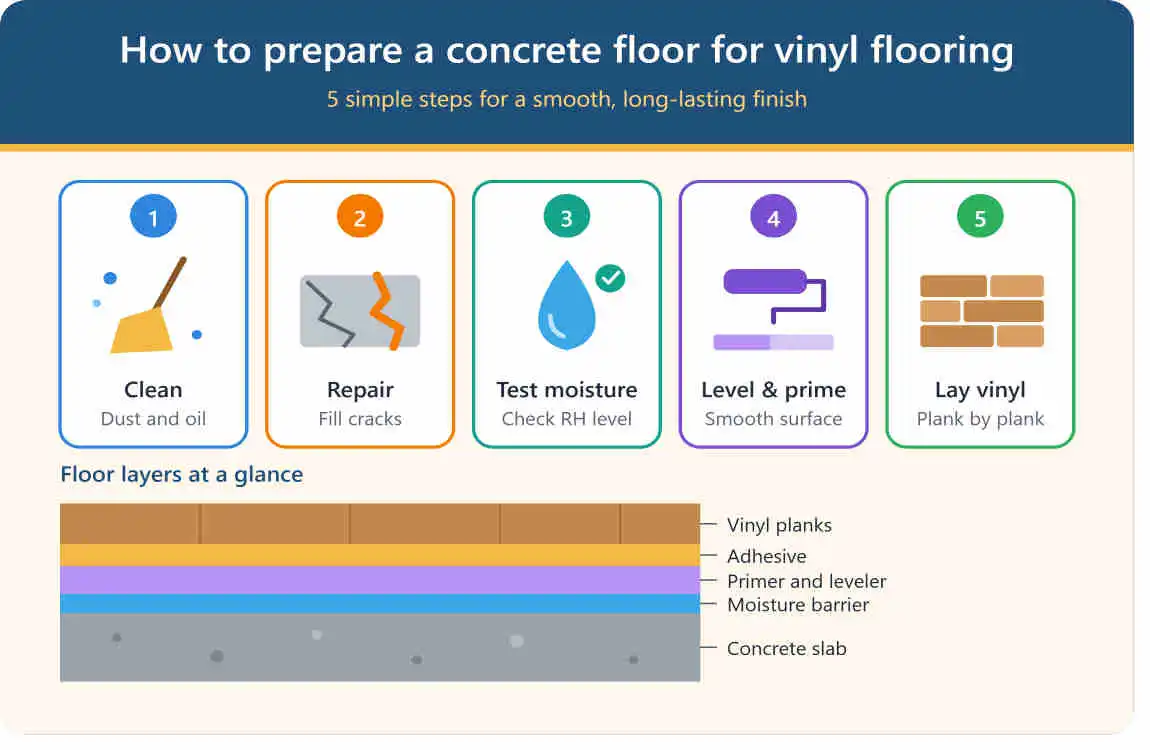
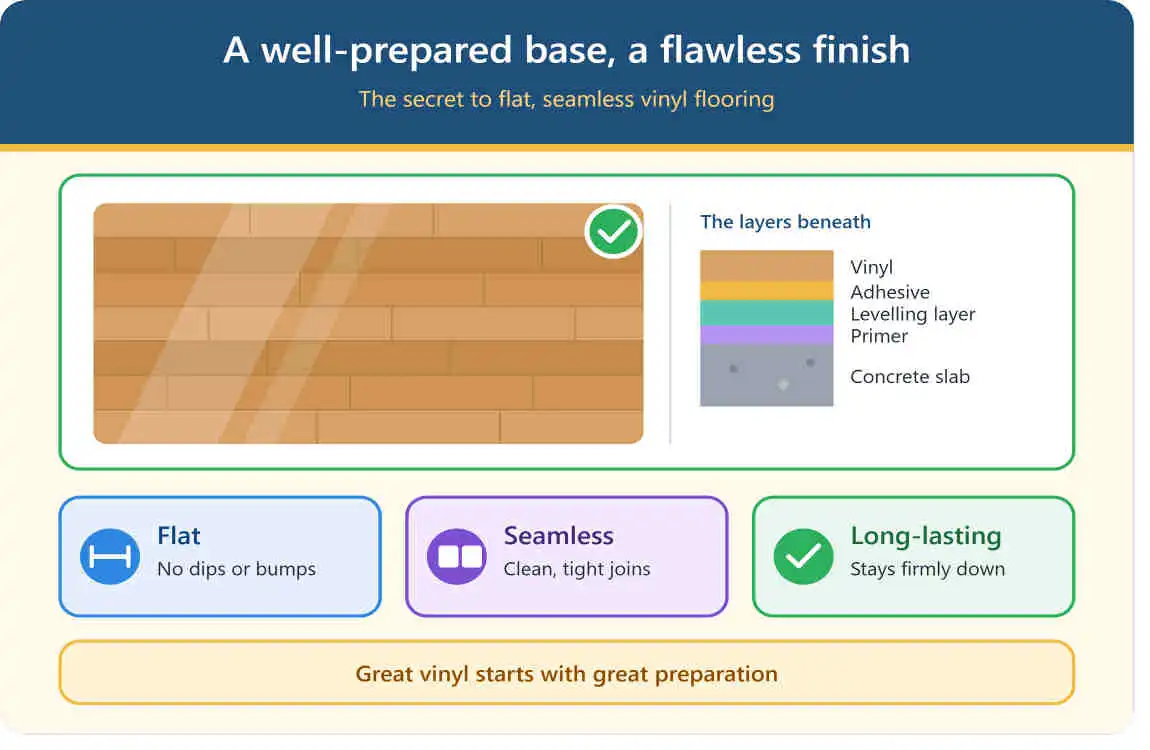
No, you usually don’t need to screed a concrete floor before laying vinyl, provided the concrete is sound, dry and reasonably flat. What you almost always need instead is a thin layer of primer and a cement-based smoothing (self-levelling) compound, at least 3mm thick, to give the vinyl a perfectly even surface. A full sand-and-cement screed is only worth the cost when the concrete is badly uneven, damaged, or needs raising to match another floor level.
Two things decide whether your floor is ready: flatness (no more than 3mm of variation under a 2m straight edge) and moisture (below 75% relative humidity for glued-down vinyl). Everything below explains how to check both and what to do about each result.
Screed vs Smoothing Compound: What’s the Difference?
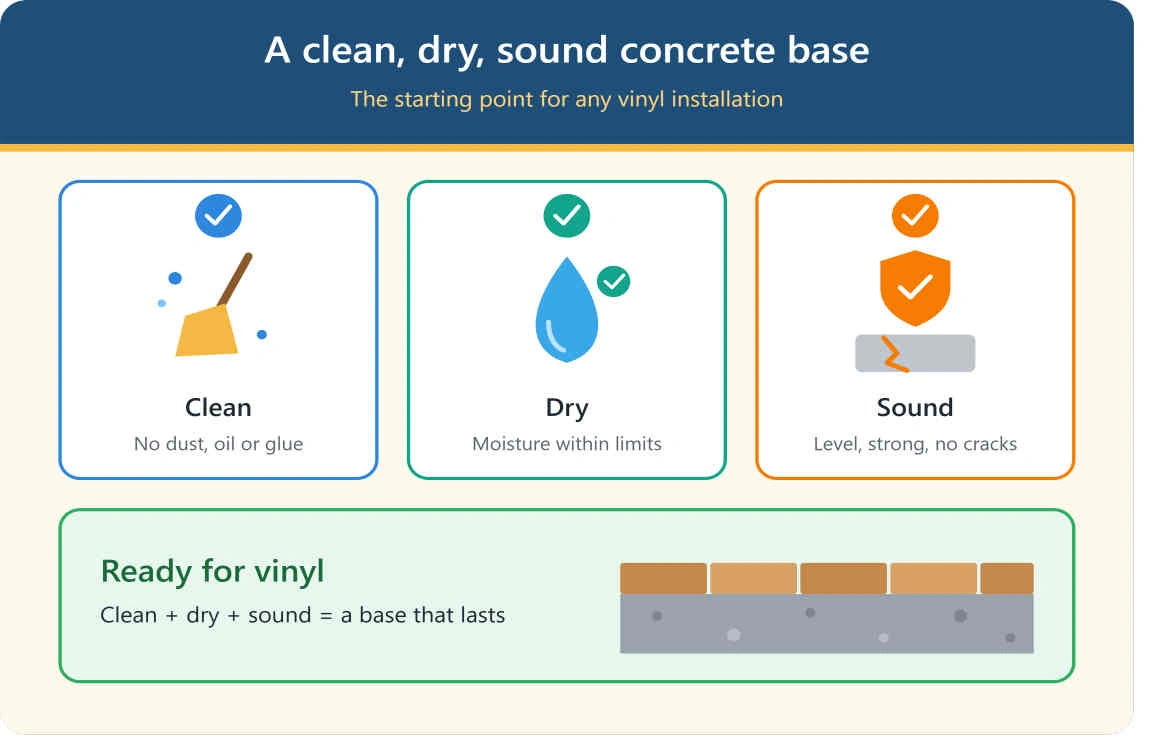
This is where most of the confusion comes from. In the UK, screed normally means a cement-and-sand layer laid to create or correct a floor’s structure and level, often tens of millimetres thick. A smoothing or self-levelling compound is a thin, free-flowing underlayment designed to sit under floor coverings. Some two-part compounds can be applied from feather edge up to about 10mm in a single application (Norcros technical datasheet).
| Situation | What you need |
|---|---|
| Concrete is sound, dry and within 3mm over 2m | Clean, prime, then a thin smoothing compound (3mm minimum) |
| Small dips, cracks or rough patches | Repair, prime, then smoothing compound over the whole floor |
| Moisture reading above 75% RH | Surface DPM first, then primer and smoothing compound |
| Badly uneven, crumbling or hollow-sounding concrete | New screed or specialist repair, then smoothing compound |
| Floor must be raised to match an adjoining room | Deeper levelling compound or screed, depending on the build-up |
Why Vinyl Needs a Smoother Surface Than Most Floors
Vinyl is thin and flexible, so it follows whatever is underneath it. Small ridges, trowel marks and hollows telegraph through the surface and become visible, especially under low-angle light. That is why major manufacturers insist on correct subfloor preparation: Karndean states that the success and longevity of a luxury vinyl installation depends on how well the subfloor is prepared (Karndean subfloor preparation guide). Amtico’s own adhesive datasheet requires subfloors to be sound, smooth, dry and free from contaminants that affect adhesion (Amtico SF adhesive datasheet).
How to Prepare a Concrete Floor for Vinyl Flooring: Step by Step
Clear, Clean and Inspect the Floor
Remove old flooring, adhesive residue, paint, plaster splashes and dust. Sweep, then vacuum thoroughly. Sound the floor design by tapping it: hollow areas suggest delamination and need repair. Look for cracks, crumbling edges, oil stains and damp patches.
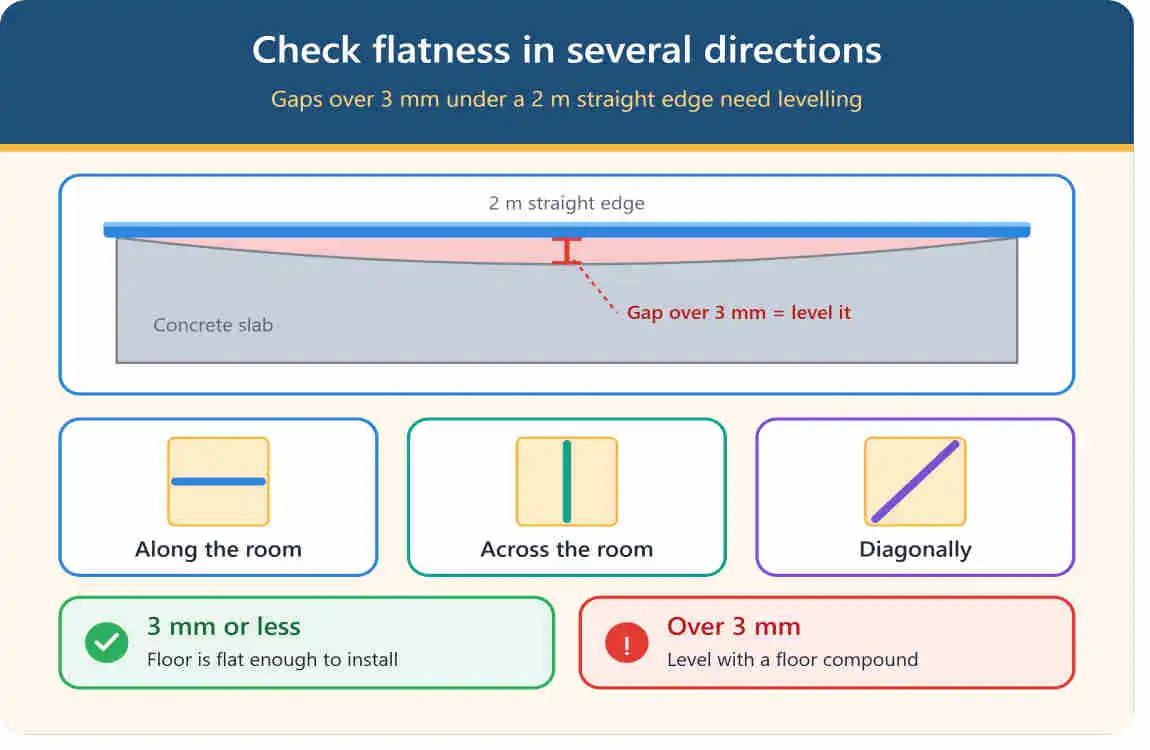
Test for Flatness With a 2m Straight Edge
Lay a 2m straight edge or long spirit level across the floor in several directions. The common standard for resilient floors is a surface regularity of less than 3mm under a 2m straight edge (Forbo installation guide, referencing BS 8203:2017). Amtico’s click-system guidance is tighter, advising no more than 2 to 3mm variation over a 2m length (Amtico installation guidelines). Mark any low spots in pencil.
Test the Moisture Level
Never skip this step. Concrete floor holds moisture for a long time, and trapped moisture can break the adhesive bond or damage the flooring. Use a hygrometer (relative humidity test) and take readings across the whole floor.
- Glue-down vinyl: readings must be below 75% RH.
- Loose-lay and rigid-core vinyl: Karndean allows readings up to 95% RH for these formats, but always follow your own product’s instructions (Karndean Commercial subfloor guidance).
- Above the limit: apply a surface damp-proof membrane suited to your floor build-up (Sika technical article).
Ground-level floors should also have an effective DPM within the slab (Forbo). If your house is old and you are unsure a DPM exists, test and ask a flooring professional.
Allow New Concrete Enough Drying Time
A new slab cannot be rushed. A widely used rule of thumb is roughly one day per millimetre of thickness up to 50mm, and about two days per millimetre beyond that, but the only reliable answer is a moisture test (Palace Chemicals technical datasheet). Using dehumidifiers and good ventilation helps, but they do not replace testing.
Repair Cracks, Holes and Weak Areas
Fill cracks and holes with a repair mortar suited to concrete. Remove laitance (the weak, dusty surface skin on new concrete) mechanically. Power-floated concrete usually needs abrading by scarifying or light shot blasting before priming (Karndean). Do not use surface hardeners or curing agents on concrete that will receive vinyl, as they can weaken adhesion (Polyflor subfloor guidance).
Prime the Surface
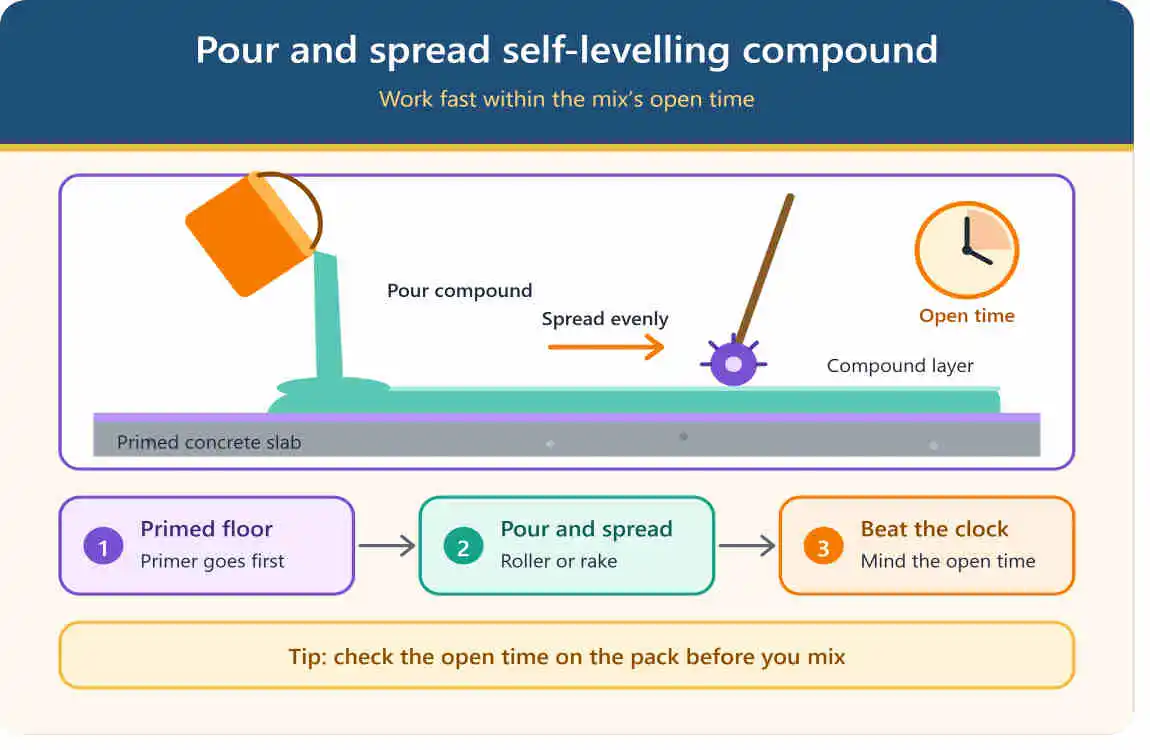
Apply the primer specified by your smoothing compound manufacturer, usually an acrylic water-based primer, and let it dry fully. Primer helps the compound bond and stops absorbent concrete from pulling water out of the mix too quickly. For a real-world example, F. Ball’s case studies describe contractors priming the concrete subfloor before applying a 3mm smoothing layer at Amtico’s training academy (NBS Source case studies).
Apply the Smoothing (Self-Levelling) Compound
Mix the compound exactly as the data sheet states, pour it in ribbons, and spread it with a gauging trowel or smoother. Karndean recommends at least 3mm of smoothing and levelling compound on solid subfloors, and Polyflor describes a cementitious smoothing compound of at least 3mm as essential (Polyflor). Keep the room warm, avoid draughts, and stay off the floor until it is cured.
Re-Check, Then Let the Vinyl Acclimatise
Once the compound has cured, check it again with the straight house edge and lightly sand any nibs. Vacuum thoroughly. Bring the vinyl into the room ahead of fitting so it reaches room temperature, following the manufacturer’s acclimatisation guidance.
When You Genuinely Do Need to Screed
Screeding becomes the right call in a few situations:
- The concrete is badly uneven, beyond what a self-levelling compound can economically correct.
- The slab is cracked, crumbling, or sounds hollow in places.
- You need to raise the floor level substantially, for example to match an adjoining room or a threshold.
- An independent report finds the sub-floor is not level enough. In one UK Financial Ombudsman decision, the adjudicator accepted that a kitchen’s uneven concrete sub-floor had to be screeded before vinyl could be laid (Financial Ombudsman Service, DRN-3979749).
Fresh screed also needs drying and moisture testing before vinyl goes down, so building it into your schedule matters.
Underfloor Heating and Vinyl Over Concrete
Vinyl can be laid over many underfloor heating systems, but you must confirm compatibility with both the heating and the flooring manufacturer. Sika notes that the presence of a suitable DPM and any underfloor heating should be established before starting (Sika). Follow the heating system’s commissioning and temperature-limit instructions during installation.
Common Mistakes to Avoid
- Skipping the moisture test because the floor “feels dry.”
- Laying vinyl straight onto rough or power-floated concrete without abrading and smoothing.
- Using a compound that isn’t compatible with your primer or adhesive.
- Applying compound over dust or laitance, which causes it to debond.
- Ignoring product-specific instructions. Always follow your vinyl and adhesive manufacturer’s guide, as warranty often depends on it.
Frequently Asked Questions
Do I need to screed a concrete floor for vinyl?
Usually no. If your concrete is sound, dry and flat to within about 3mm over 2m, you need only a primer and a smoothing compound at least 3mm thick. You need a full screed only when the floor is badly uneven, damaged, or must be raised.
Can you lay vinyl flooring directly on concrete?
Only if the concrete is clean, dry, smooth and sufficiently flat. In practice, most manufacturers still call for a smoothing compound on top, especially for glue-down vinyl, so imperfections don’t show through.
What is the maximum moisture level for vinyl on concrete?
For glued-down vinyl, below 75% relative humidity. Some loose-lay and rigid-core products allow readings up to 95% RH, according to Karndean’s guidance, so check your specific product.
How long should concrete dry before laying vinyl?
It depends on slab thickness and conditions. Rules of thumb exist, but only a moisture test confirms the floor is ready.
What is the difference between screed and self-levelling compound?
Screed is a thick cement-and-sand layer used to form or correct a floor’s level. Self-levelling compound is a thin, flowable underlayment, typically applied at a few millimetres, designed to give floor coverings a smooth finish.
Do I need a damp-proof membrane under vinyl on concrete?
Ground-level floors should have an effective DPM within the construction. If moisture tests exceed 75% RH, a surface DPM is needed before smoothing and fitting.
How thick should the levelling compound be under vinyl?
At least 3mm for solid subfloors, according to Karndean and Polyflor guidance. Follow the compound’s data sheet for maximum thickness.
Final Thoughts
If you’ve been asking, “do I need to screed a concrete floor for vinyl?”, the practical answer is that most homes need smoothing, not screeding. Test flatness, test moisture, repair, prime, smooth, then lay. If your readings are high or the slab is in poor condition, bring in a flooring professional before you spend money on the vinyl itself. This article is general guidance; always follow your flooring manufacturer’s written instructions and relevant standards such as BS 8203 for your project.
