

It is a Sunday morning. You wake up, walk into the kitchen to make a fresh cup of coffee, and step right into a puddle of water. Your heart sinks. You realize that the slow drip under the sink has turned into a full-blown leak. Now, you are standing in the aisle of your local hardware store, staring at a wall of tubes, fittings, and connectors, completely overwhelmed.
For most homeowners, the inner workings of their home’s plumbing system are a mystery until something goes wrong. But here is the good news: knowing your household plumbing pipe sizes can save you hundreds of dollars in emergency plumber calls and give you the confidence to handle repairs yourself.
When we talk about household plumbing pipe sizes, we aren’t just talking about fitting piece A into piece B. Understanding these sizes is crucial for maintaining proper water pressure, ensuring your drains flow smoothly, and improving the overall efficiency of your home. If you choose a pipe that is too small, you might end up with a shower that feels like a weak drizzle. Choose one that is too big, and you are wasting money on materials you don’t need.
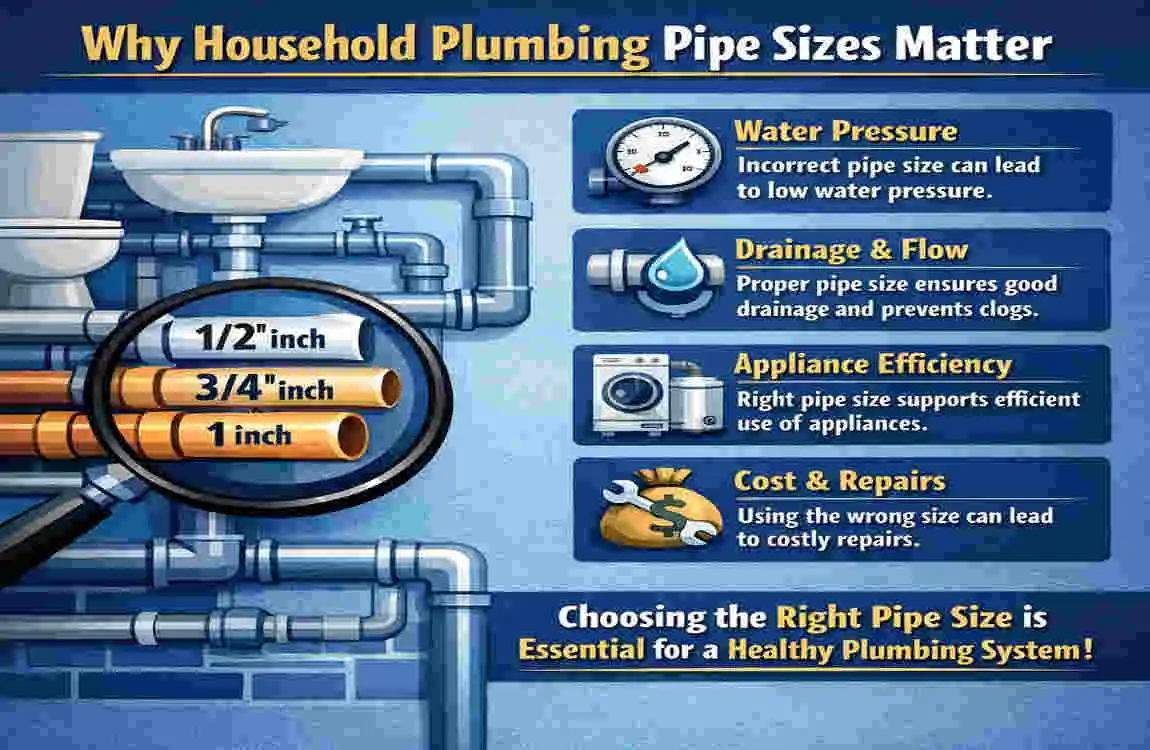
Why Household Plumbing Pipe Sizes Matter
You might be thinking, “As long as the water gets from point A to point B, does the size really matter?” The short answer is: Yes, absolutely.
The diameter of your pipes dictates how your entire plumbing system functions. It is not just about making things fit; it is about physics. The size of the pipe determines the flow rate (how much water comes out) and the pressure (how hard the water pushes).
Flow Rates and Pressure
Think of your plumbing pipes like a highway. If you have a five-lane highway (a large pipe), traffic (water) moves smoothly and in large volumes. If you suddenly merge that five-lane highway into a single lane (a small pipe), traffic slows and things back up.
In plumbing terms, if a pipe is too narrow for the application, you experience a significant pressure drop. This is why you cannot run a garden hose supply line with a tiny straw-sized tube. On the flip side, household plumbing pipes that are too large for the application can lead to sediment buildup in drain lines because the water isn’t moving fast enough to flush waste away.
Code Compliance and Safety
Building codes, such as the International Plumbing Code (IPC) or the Uniform Plumbing Code (UPC), exist for a reason. They dictate standard plumbing pipe sizes to ensure safety and sanitation. Using the wrong size isn’t just an annoyance; it can actually be a code violation. If you ever plan to sell your home, noncompliant plumbing can come back to haunt you during the inspection.
The Cost of Mistakes
One common mistake DIYers make is undersizing pipes to save a few dollars. While a 1/2-inch pipe is cheaper than a 3/4-inch pipe, using it for a main water supply line will result in poor performance throughout the house. Conversely, oversizing pipes wastes money on materials and makes installation more difficult because larger pipes are harder to route through walls.
Quick Stat: generally speaking, standard household plumbing pipe sizes range from 1/2-inch to 2 inches for the vast majority of residential applications. Staying within these standards ensures you are on the right track.
Standard Household Plumbing Pipe Sizes: A Complete Breakdown
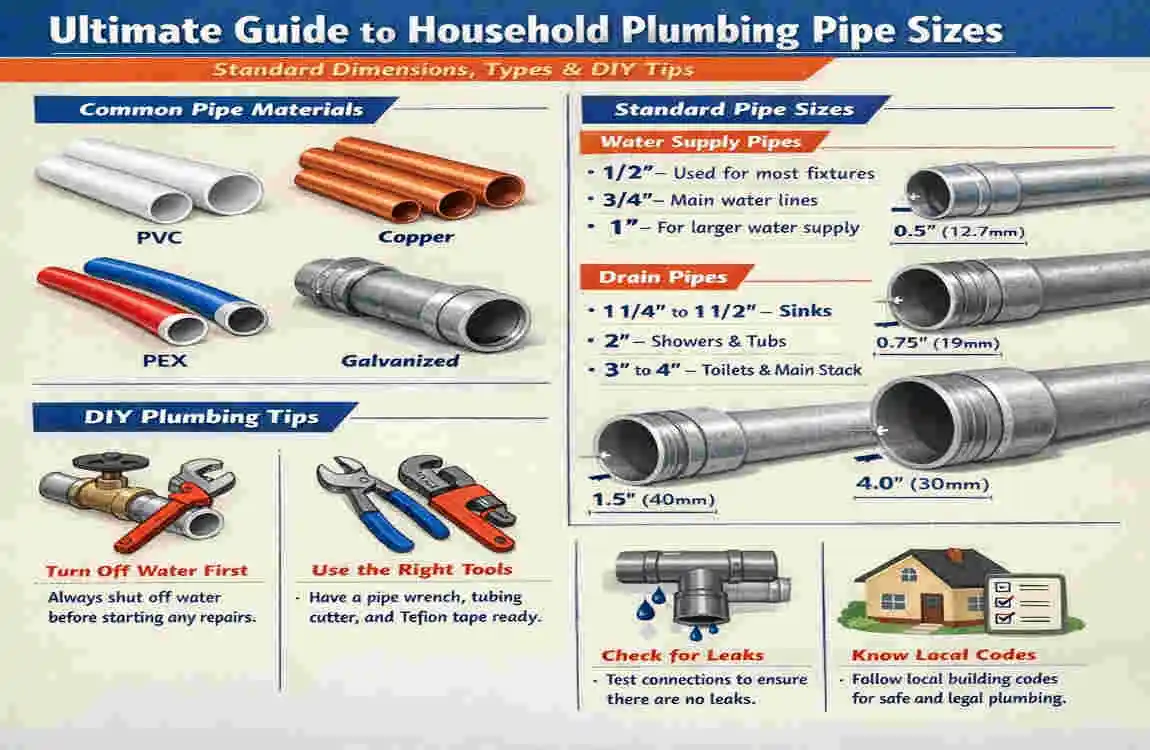
Here is where things get a little tricky, but stick with me. The most confusing part of plumbing is that the size written on the pipe (the label) is often not the pipe’s actual physical measurement.
Nominal vs. Actual Sizes
In the plumbing world, we use a system called “Nominal Pipe Size.” This means that a pipe labeled as “1/2-inch” doesn’t necessarily measure exactly 1/2-inch with a ruler.
Think of it like a “2×4” piece of lumber. If you measure a 2×4, it is actually 1.5 inches by 3.5 inches. Plumbing works the same way.
- Copper Pipe: A 1/2-inch nominal copper pipe has an outside diameter (OD) of 5/8 inch (0.625 inches).
- Plastic Pipe (PVC/ABS): These are sized by inner diameter, but the Schedule (wall thickness) changes the dynamic.
Understanding this distinction is vital so you don’t buy the wrong fittings. If you take a ruler to your copper pipe and it measures 5/8 inches across, you need to buy 1/2-inch fittings, not 5/8-inch fittings.
Plumbing Pipe Sizes Chart
To make this easier, we have compiled a table showing the most common household pipe sizes chart data you will encounter.
Pipe Material Common Household Sizes Typical Use (Inner Diameter) / OD (Outer Diameter) Notes
Copper 1/2″, 3/4″, 1″ Water supply lines (Hot & Cold) 1/2″ Nominal has an OD of 0.625″
PEX 3/8″, 1/2″, 3/4″, 1″ Flexible water supply lines 1/2″ Nominal has an OD of 0.625″ (Same as copper)
PVC (Sch 40) 1.5″, 2″, 3″, 4″ Drain, Waste, and Vent (DWV) 2″ Nominal has an OD of 2.375″
CPVC 1/2″, 3/4″ Hot water supply lines 1/2″ Nominal has an OD of 0.625″
ABS 1.5″, 2″, 3″, 4″ Drain, Waste, and Vent (DWV) 4″ Nominal has an OD of 4.5″
Regional Variations (Imperial vs. Metric)
While this guide focuses on the Imperial system (inches), predominantly used in the United States, it is worth noting that many countries, including parts of the UK and Pakistan, use a mix of systems. You might often hear “15mm” pipe, which is roughly equivalent to 1/2-inch pipe, or “22mm,” which is close to 3/4-inch pipe. However, they are not always perfectly interchangeable without special adapters.
When buying plumbing pipe locally, always check whether the store uses metric or imperial measurements to ensure your fittings match your pipes.
Types of Plumbing Pipes for Households: Sizes and Best Uses
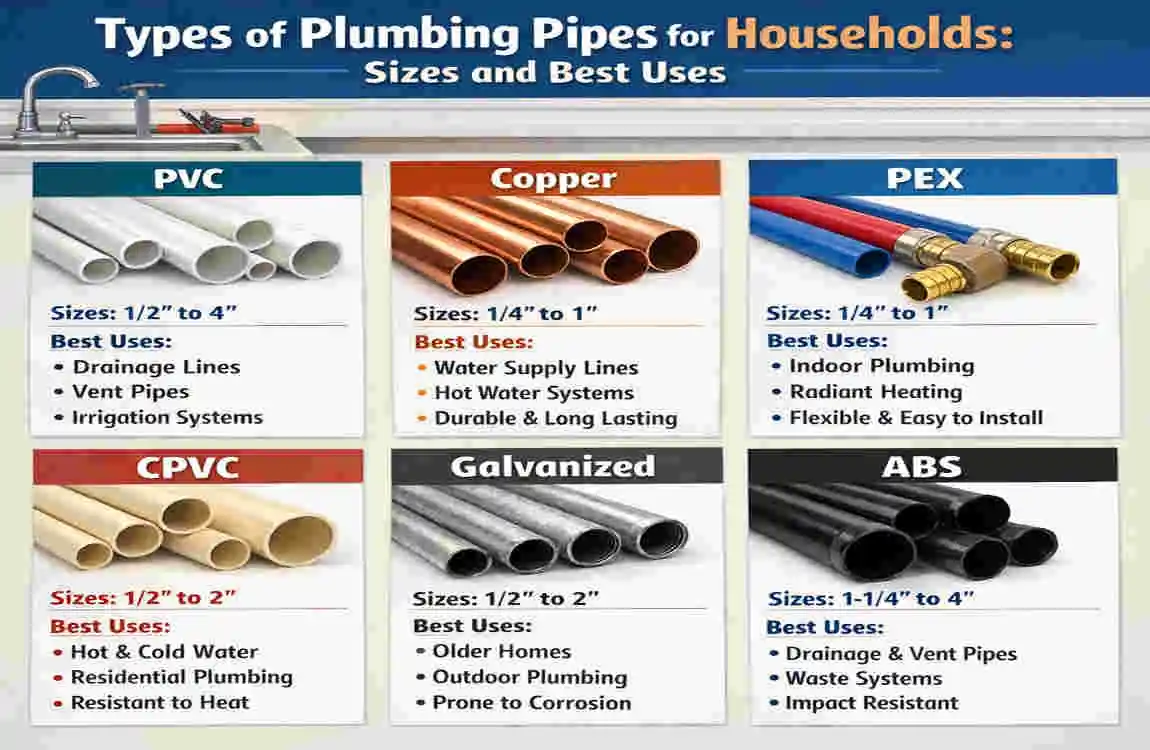
Now that we understand the numbers, let’s look at the materials. Not all pipes are created equal. You wouldn’t use a drain pipe to carry high-pressure drinking water, and you wouldn’t use a heavy metal pipe for a small sink drain today.
Copper Pipes: Sizes and Durability
Copper has been the gold standard for household plumbing pipe sizes for decades. It is incredibly durable, resists bacteria growth, and handles heat well.
- Common Sizes: You will mostly see 1/2-inch and 3/4-inch copper pipes in homes.
- Types:Type M (Red marking): Thinner walls. This is the most common for residential indoor water lines.
- Type L (Blue marking): Thicker walls. Used for high-pressure lines or outdoors.
- Pros: Long lifespan (50+ years), fire-resistant, increases home value.
- Cons: Expensive, requires soldering (unless using push-fit), and can burst if frozen.
PEX Pipes: Flexible Household Favorites
PEX (Cross-linked Polyethylene) has taken the DIY world by storm. It is flexible, color-coded (Red for hot, Blue for cold), and incredibly easy to install.
- Common Sizes: 1/2-inch and 3/4-inch are standard. 3/8-inch is sometimes used for small feeder lines to faucets.
- Connection Types:Crimp: Uses copper rings and a crimping tool.
- Expansion: Uses plastic rings and an expansion tool (common with Uponor/Wirsbo).
- Push-Fit: SharkBite style fittings that snap on.
- Pros: Cheaper than copper, freezes without bursting (usually), snakes through walls easily.
- Cons: Cannot be used outdoors (UV light damages it), tools can be pricey.
PVC and CPVC: Affordable Options
PVC (Polyvinyl Chloride) is the white plastic pipe used for drains. CPVC (Chlorinated PVC) is a cream-colored plastic used for supply lines.
- PVC Sizes: Usually found in larger sizes for drains—1.5-inch for sinks, 2-inch for showers/washing machines, and 3-inch or 4-inch for main sewer stacks.
- CPVC Sizes: Matches copper sizes (1/2-inch and 3/4-inch) and is used for hot and cold water.
- Schedule 40 vs. Schedule 80: Schedule 40 is the standard for households. Schedule 80 has thicker walls and is dark gray; it is rarely needed for standard home plumbing.
- Pros: Cheap, easy to cut, glues together.
- Cons: PVC cannot handle hot water (it melts/warps). CPVC can become brittle over time.
Cast Iron and ABS: Heavy-Duty Drains
- ABS (Acrylonitrile Butadiene Styrene): This is the black pipe you often see in older homes or specific regions. It is used strictly for drains (DWV). It connects with special cement and is generally easier to cut than PVC, but some local codes restrict it.
- Cast Iron: The old-school heavy metal pipe. While rare in new builds, many older homes still have it. It is incredibly quiet (you don’t hear water rushing), but it is heavy, hard to cut, and prone to rusting over time.
Plumbing Pipe Sizes by Room and Application
One of the most frequent questions homeowners ask is, “What size pipe do I need for my?”
The rule of thumb in plumbing is the “Trunk and Branch” method. You have a large main line (trunk) that feeds smaller lines (branches) to individual fixtures.
Kitchen and Bathroom Supply Lines
For water supply (pressure lines), standard household plumbing pipe sizes follow a predictable pattern:
- Main Water Service Line: The pipe that enters your home from the street or well. It should be at least 3/4-inch, though 1-inch is becoming common in modern homes to ensure great pressure.
- Branch Lines: The pipes running to your water heater or splitting off to a bathroom group are typically 3/4-inch in diameter.
- Fixture Lines: The final pipe connecting to your sink faucet, toilet, or shower valve is almost always 1/2-inch in diameter.
- Stop Valves: The flexible metal tube connecting the wall valve to the actual faucet is usually 3/8-inch in diameter.
Drain, Waste, and Vent (DWV) Sizes
Drains work on gravity, so size is critical to prevent clogging.
- Toilets: Require a minimum of 3-inch pipe. Ideally, the main stack should be 4-inch.
- Showers and Bathtubs: Usually require a 2-inch drain. Using a 1.5-inch drain for a shower is a recipe for standing water.
- Bathroom Sinks (Lavatories): A 1.25-inch pipe is the minimum, but 1.5-inch is standard and preferred.
- Kitchen Sinks: Always use 1.5-inch pipe. Kitchen sinks deal with food scraps and grease, so the extra space helps prevent clogs.
Outdoor and Laundry Applications
- Washing Machines: Modern washers pump water out fast. You need a 2-inch drain standpipe to handle the sudden volume.
- Outdoor Hose Bibs: A 1/2-inch supply is standard, but if you have a large garden or sprinkler system, running a 3/4-inch line to the hose bib will deliver much better water volume for watering.
Pro Tip: Flow Rate Math
You don’t need to be a mathematician, but remember this: volume increases significantly with diameter. A 3/4-inch pipe doesn’t just carry a little more water than a 1/2-inch pipe; it actually carries more than twice the volume of water due to the increased area of the circle ($A = \pi r^2$). If you have a bathroom with a shower, tub, and two sinks, feeding it with a single 1/2-inch pipe will result in terrible pressure. Always feed the room with 3/4-inch and branch off to 1/2-inch at the fixtures.
Essential Tools and Measurements for Checking Pipe Sizes
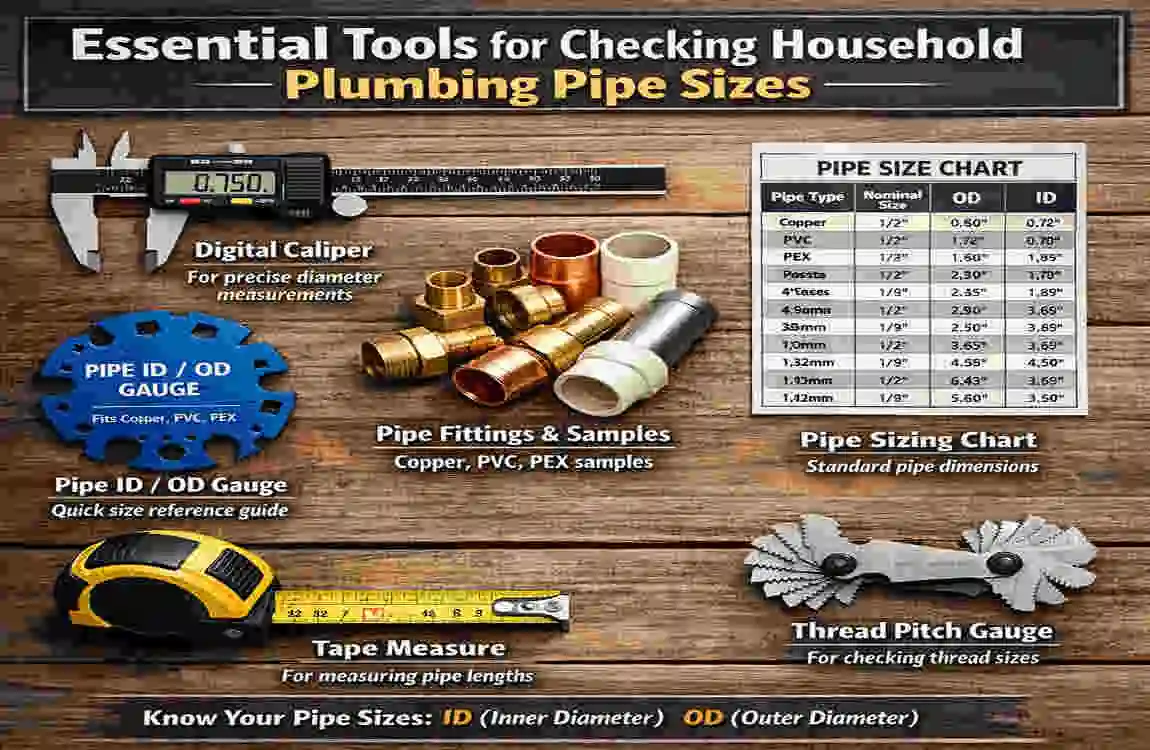
Okay, you are ready to fix that leak. But how do you know what size pipe you are staring at? Don’t eyeball it! 1/2-inch and 3/4-inch pipes look surprisingly similar when you are upside down under a dark cabinet.
The Tools You Need
- Digital Calipers: The most accurate tool. It clamps onto the pipe and gives you the exact decimal reading.
- OD Tape Measure: A special measuring tape that wraps around the pipe and reads the Diameter directly.
- A Piece of String: The low-tech, reliable DIY method.
Step-by-Step: The String Method
If you don’t have calipers, use the string method to determine your household plumbing pipe sizes:
- Clean the Pipe: Wipe off any grime or insulation so you are touching the bare pipe.
- Wrap the String: Wrap a piece of string (or a strip of paper) around the pipe once. Mark the point where the string overlaps.
- Measure the String: Lay the string flat against a ruler and measure the length. This is the Circumference.
- Do the Math: Divide that length by roughly 3.14 (Pi). This gives you the Outside Diameter (OD).
- Compare to the Chart:If your copper pipe OD is roughly 0.625 (5/8 inch), it is 1/2-inch nominal pipe.
- If your copper pipe OD is roughly 0.875 (7/8 inch), it is 3/4-inch nominal pipe.
Visual Identification
Sometimes the easiest way is to look for the print. Most modern pipes (PVC, PEX, Copper) have the size stamped or printed along the side. Look for “1/2 INCH”, “3/4”, or “SCH 40”. If the pipe is painted over, you might have to scratch a little paint away or use the string method.
DIY Tips for Working with Household Plumbing Pipe Sizes
Now that you are armed with knowledge, let’s talk about doing the work. Working with plumbing can be intimidating, but if you follow these tips, you will avoid the most common pitfalls.
Choosing the Right Size for Repairs
When replacing a section of pipe, always match the material and size exactly. Do not try to force a 1/2-inch PVC fitting onto a 1/2-inch Copper pipe without a specialized transition adapter. They have different outside diameters!
- Upgrade Tip: If you are renovating a bathroom and the walls are open, consider upgrading the main feed to that room from 1/2-inch to 3/4-inch. It will future-proof your home against pressure drops if you decide to add a fancy rainfall showerhead later.
Cutting, Fitting, and Soldering
- Cutting: Use a tubing cutter for copper and PEX. It spins around the pipe, creating a perfectly square, burr-free cut. Avoid using a hacksaw on copper unless necessary, as it leaves jagged edges that cause leaks.
- Cleaning: This is the most skipped step. You must clean copper pipes with emery cloth (sandpaper) until they shine like a new penny before soldering or using push-connect fittings. If the pipe is dirty, the seal will fail.
- Deburring: After cutting PEX or Copper, use a deburring tool to smooth the inside edge. Rough edges can create turbulence in the water flow, generating noise and eventually wearing out the pipe.
Common DIY Projects: Replacing a Section
Let’s say you have a burst copper pipe. Here is a simple, solder-free way to fix it:
- Shut off the Water: Turn off the main valve to the house. Open the lowest faucet in the house to drain the water out.
- Cut the Bad Section: Use your tubing cutter to cut out the damaged section.
- Measure the Gap: Measure the length of pipe you removed.
- Cut New Pipe: Cut a piece of PEX or Copper to the same length (minus the depth of the fittings).
- Use Push-Fit Connectors: Use fittings like SharkBite. Push one end onto the existing pipe, push your new repair piece into the other side, and repeat. No fire, no glue, no hassle.
When to Call a Pro
We love DIY, but know your limits. You should call a professional plumber if:
- The main sewer line is backed up.
- You are dealing with gas lines (never DIY gas!).
- You are unsure about local code requirements for a major remodel.
- You cannot locate the source of a leak inside a wall.
Maintenance and Troubleshooting Pipe Size Issues
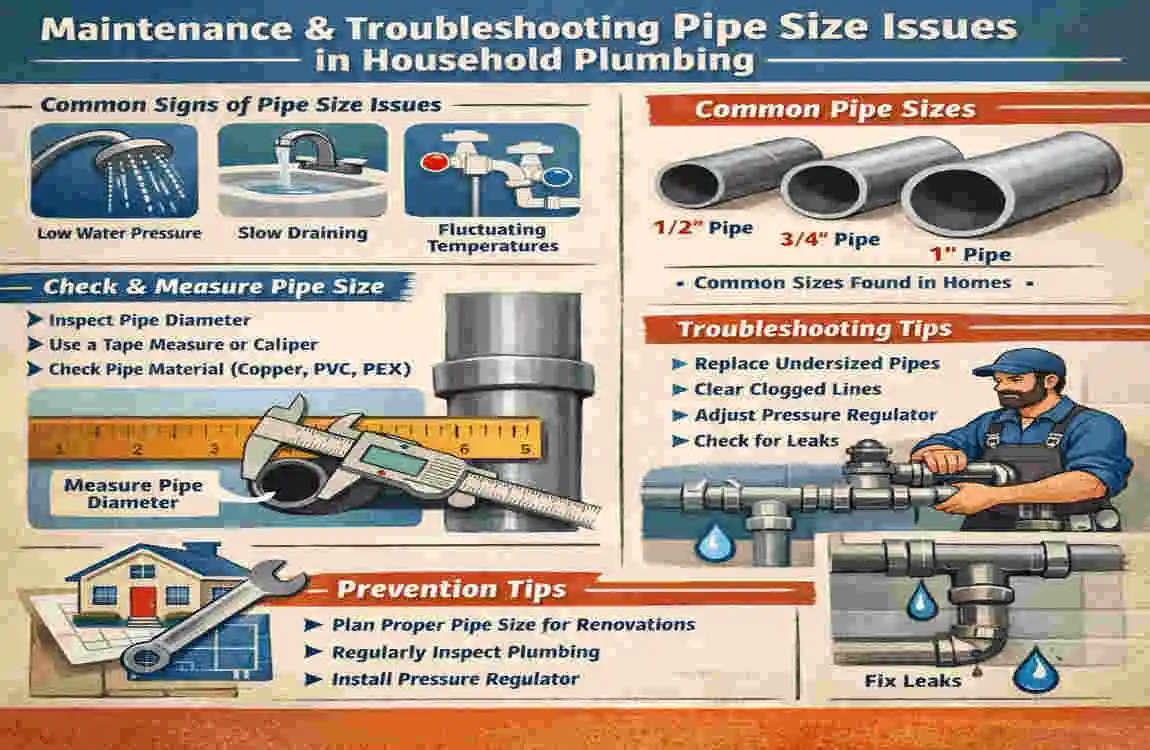
Sometimes, your pipes tell you they are the wrong size. Here is how to listen to them.
Gurgling Drains
If you hear a “glug-glug-glug” sound from your sink when you flush the toilet, it usually means your venting is blocked or your drain pipes are undersized. The water is trying to pull air from wherever it can, sucking the water out of your sink trap.
Low Water Pressure
If you turn on the shower and the pressure drops when someone flushes the toilet, your main trunk line is likely undersized. While replacing all your pipes is a big job, you can sometimes mitigate this by installing low-flow fixtures to reduce the demand on the system.
Noisy Pipes (Water Hammer)
A loud “BANG” when a valve closes is called water hammer. While this can happen with any size pipe, it is more common in smaller pipes where water velocity is high. Installing water hammer arrestors (small air chambers) can solve this instantly.
Winterizing for Cold Climates
In regions like Northern US or parts of Pakistan during winter, pipes can freeze. Since water expands when it freezes, it can split copper and rigid plastic.
- Insulate: Use foam pipe insulation on any pipes in unheated areas (attics, basements, garages).
- Drip: On extremely cold nights, leave a faucet dripping slightly. Moving water is harder to freeze.
FAQ Section
What are the most common household plumbing pipe sizes?
For water supply lines, the most common sizes are 1/2-inch and 3/4-inch. For drains, you will typically see 1.5-inch for sinks, 2-inch for showers/washers, and 3-inch or 4-inch for toilets and main stacks.
How do I identify pipe sizes without tools?
Use the String Method. Wrap a string around the pipe, mark the overlap, measure the length, and divide by 3.14. If the result is around 0.625 inches, it is a 1/2-inch pipe. If it is around 0.875 inches, it is a 3/4-inch pipe.
Copper vs. PEX: Which is better for household water lines?
For DIYers, PEX is generally better. It is cheaper, flexible, easier to install, and resists freezing better than copper. However, Copper is longer-lasting and naturally resists bacteria, making it a Premium choice if you have the budget and soldering skills.
What is the standard drain pipe size for a bathroom?
A bathroom uses mixed sizes. The toilet needs a 3-inch minimum. The shower usually needs 2-inch. The sink (lavatory) needs a 1.25-inch or 1.5-inch drain. Do not use anything smaller than these standards to avoid clogs.
Can I use different sizes in one plumbing system?
Yes, plumbing systems are designed to step down in size. You typically start with a large main line (3/4-inch or 1-inch) and reduce to smaller lines (1/2-inch) as you approach the faucets. However, you should never reduce a drain size downstream (e.g., from a 2-inch to a 1.5-inch drain) because it can cause clogs.
Are plumbing pipe sizes metric in Pakistan and other regions?
It depends. In Pakistan and many Commonwealth countries, you will find a mix. Steel pipes (GI) are often specified in Imperial inches (1/2″ , 3/4″). However, modern PPRC (plastic) pipes are usually metric (20mm, 25mm). roughly, 20mm is used where you would use 1/2-inch, and 25mm is used where you would use 3/4-inch, but they are not directly compatible without adapters.
