

Picture this: It is a freezing Tuesday evening in the middle of winter. The wind is howling outside, and you have just sat down with a hot cup of tea. Suddenly, the lights flicker, the television goes black, and the reassuring hum of your refrigerator stops. You are plunged into darkness.
If this scenario sounds familiar, you are not alone. As we navigate through 2026, UK power outages are becoming increasingly common. With rising energy costs, extreme weather events, and an ageing grid infrastructure, relying solely on the main power supply is no longer a guaranteed safety net.
This is exactly why having a reliable home backup generator in the UK has transformed from a luxury into an absolute necessity. Whether you are a busy family trying to keep the heating on, or a remote worker who cannot afford to lose internet connection during a crucial meeting, backup power is your ultimate insurance policy.
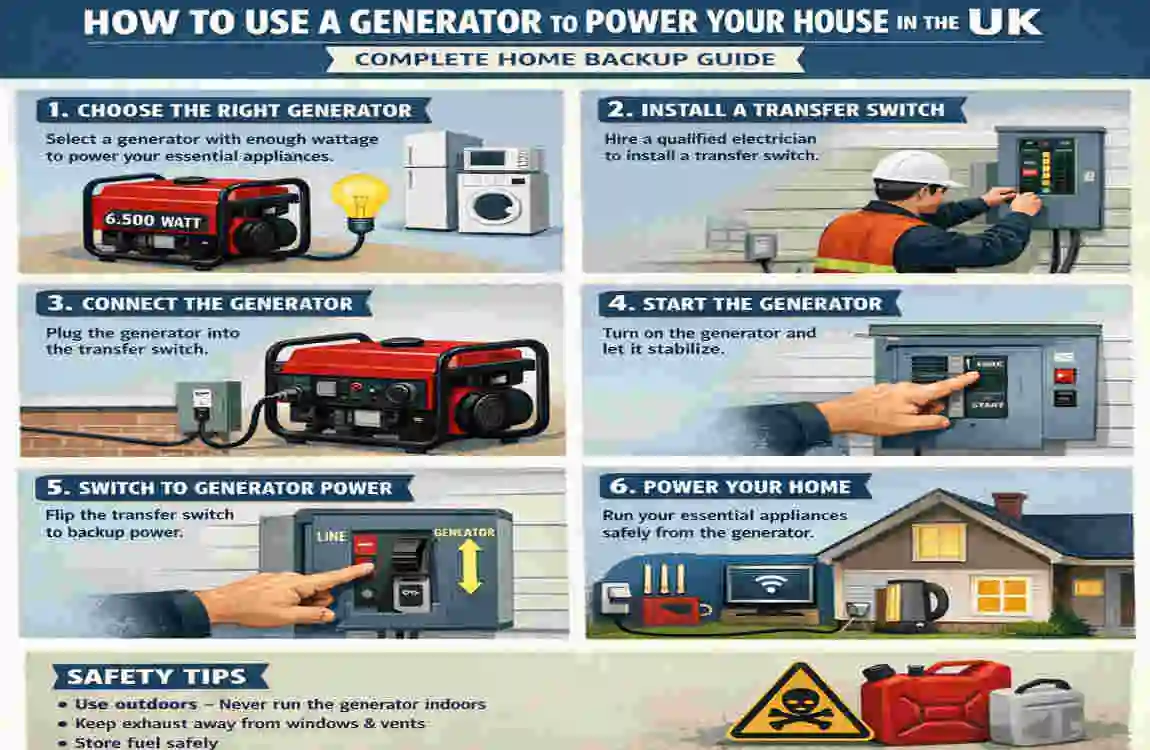
Discover exactly how to use a generator to power your house UK style, from choosing the perfect portable options to installing heavy-duty full standby systems.
| Step | Action | Key Details | Safety Notes |
|---|---|---|---|
| Choose Generator | Select portable or standby model sized for your needs (e.g., 5-10kW for average home). | Match wattage to essentials like fridge (700W), lights (500W), heating. Use diesel for longevity in UK climate. | Opt for AVR-stabilized units to protect electronics. |
| Site Preparation | Place outdoors on level, dry ground, 3-6m from house/windows/doors. | Ensure ventilation; use concrete pad for standby units. Minimum 1m from flammable materials. | Never indoors/garage—CO poisoning risk. Install CO detector nearby. |
| Install Transfer Switch | Hire NICEIC electrician for manual/automatic transfer switch (MTS/ATS). | Connects generator to consumer unit, isolates grid. Costs £500-£2000. Required to prevent backfeed. | Prevents utility worker electrocution; complies with Electricity at Work Regulations. |
| Grounding & Wiring | Earth generator with rod; use weatherproof inlet box. | Follow BS 7671: RCD protection, isolator switch, insulated cables. | Test earth resistance; pro install mandatory for fixed setups. |
| Fuel & Start | Check oil/fuel (petrol/diesel), prime if needed. Switch main breaker off, start generator. | Let warm 1-2 mins; connect loads gradually (50% max initially). | Refuel only when cool; store <500L fuel without permit. |
Why You Need a Backup Generator in the UK
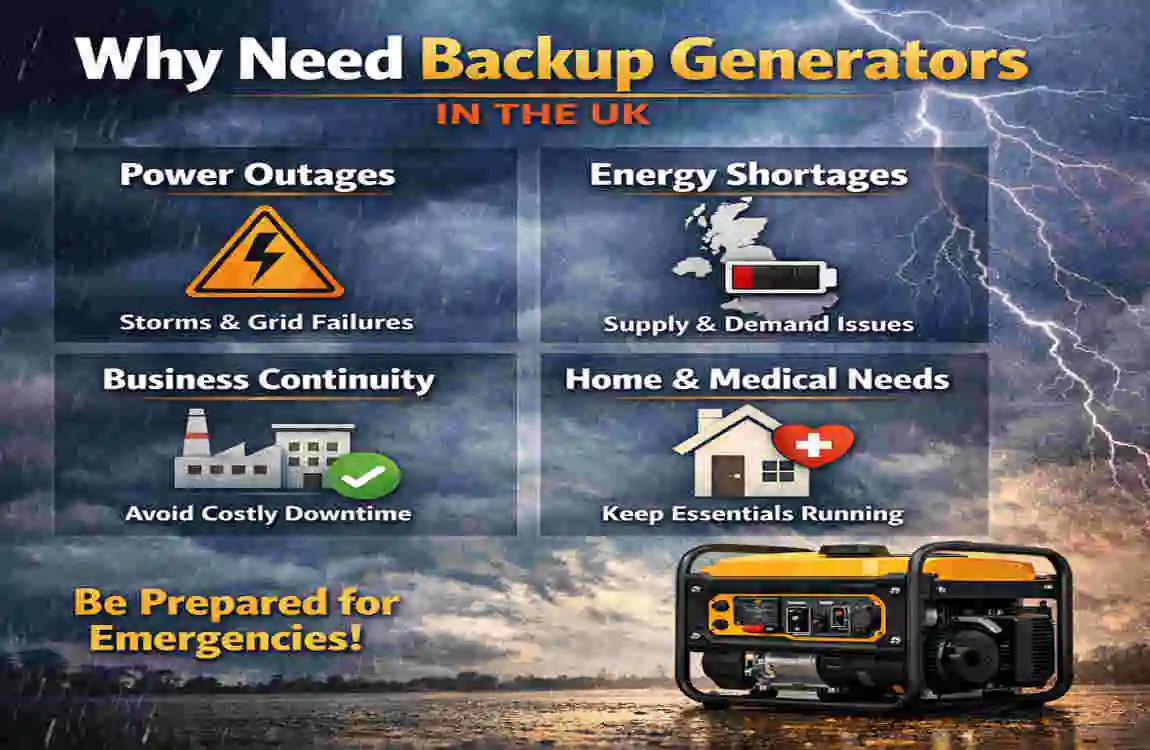
If you think power cuts are a thing of the past, recent history tells a different story. The UK faces a unique set of challenges that make sudden blackouts a reality for millions of households.
Remember the devastating impacts of Storm Isha? We saw fallen trees ripping down power lines across the country, leaving entire communities in the dark for days. Add to that the vulnerabilities of the National Grid and the widespread 2025 blackouts, and the picture becomes clear: the power supply is under immense pressure.
Currently, many UK households in vulnerable areas experience an average of 1 to 2 hours of power outages every single month. When you add up those hours, the disruption to your daily life is massive.
You might be wondering, “What about solar panels?” While solar energy is a fantastic, eco-friendly option, it relies heavily on weather conditions. If a winter storm knocks out the power, there is a good chance the sun isn’t shining either. Furthermore, unless you have heavily invested in expensive solar battery storage, your solar panels will automatically shut off during a grid blackout for safety reasons. A generator, on the other hand, provides reliable, on-demand power exactly when you need it, regardless of the weather outside.
Having a solid UK home generator backup during winter storms offers several massive benefits:
- Saving Your Essential Appliances: A generator keeps your refrigerator and freezer running, preventing hundreds of pounds worth of food from spoiling. It also keeps your boiler functioning, ensuring you have hot water and central heating during freezing weather.
- Massive Cost Savings: When the power goes out for an extended period, many families are forced to book expensive hotel rooms just to stay warm. A generator allows you to stay comfortably in your own home, saving you a fortune in emergency accommodation.
- Peace of Mind for Remote Workers: If you work from home, a dead laptop and a disconnected Wi-Fi router mean lost productivity and potentially lost income. A generator keeps your home office online, so you can seamlessly continue your workday.
- Security and Safety: Keeping your outdoor security lights, alarm systems, and medical devices powered up is non-negotiable for many families.
Investing in a generator is about investing in your family’s comfort, safety, and peace of mind.
Types of Generators for UK Homes
Before you rush out to buy a generator, you need to understand that not all machines are created equal. The market is flooded with different types, sizes, and fuel options.
Choosing the right generator depends entirely on what you want to power, where you live, and your budget. Let us break down the main options available to UK homeowners in 2026.
To make things simple, check out this easy-to-read comparison table:
TypePower OutputFuel SourceBest Used ForEstimated Price Range (2026)
Portable Petrol/Diesel 2kW – 8kW Petrol or Diesel Short outages, powering basic essential appliances £300 – £1,500
Inverter Generator 1kW – 5kW Petrol Quiet operation, safe for sensitive electronics (laptops, TVs) £400 – £1,200
Standby Diesel/Gas 10kW – 20kW Diesel or Natural Gas Whole house power, automatic switch-on £3,000 – £10,000
Solar Hybrid 1kW – 3kW Solar Energy and Battery Eco-friendly backup, zero fuel costs, silent £1,000 – £5,000
Portable Petrol and Diesel Generators
These are the most common and affordable options. You wheel them out of the garage when the power drops, pull a cord to start the engine, and plug your appliances directly into the machine using heavy-duty extension leads. They are robust, reliable, and perfect for powering a fridge, a few lights, and a heater.
Inverter Generators
If you want to plug your expensive laptop, smart TV, or mobile phone directly into a generator, you absolutely need an inverter. Standard generators produce “dirty” power with micro-surges that can fry delicate microchips. Inverter generators take that raw power and clean it up, providing a smooth, stable electrical current. They are also incredibly compact and significantly quieter than standard models.
Standby Generators
This is the ultimate hands-off solution. A standby generator is permanently installed outside your home, much like an air conditioning unit. It connects directly to your home’s electrical consumer unit (also known as your fuse box). When the grid fails, the standby generator automatically detects the outage, turns itself on within seconds, and powers your entire house.
UK Compliance and Noise Regulations
When shopping, it is crucial to look for UK-compliant models designed for our 230V electrical system, such as the popular Hyundai DHY8000SELR or the Pramac GA13000.
Furthermore, you must consider noise. The UK has strict local council noise regulations, especially in densely populated residential areas. Always look for “silent” or “suitcase”- type generators that operate at 70 decibels (dB) or less. For context, 70dB is about as loud as a normal conversation, ensuring you will not infuriate your neighbours during a late-night blackout!
Sizing Your Generator Correctly
Buying a generator that is too small is a recipe for disaster. If you try to draw too much power from a weak generator, the machine will overload, overheat, and automatically shut down—or, worse, damage your appliances.
Conversely, buying a massive industrial generator for a small terraced house is a massive waste of money and fuel. You need to find the right-sized generator to power your house in the UK.
The Golden Rule: Running Watts vs Starting Surge
To calculate your exact needs, you must understand two simple terms:
- Running Watts: The continuous power an appliance needs to stay on.
- Starting Surge: The massive, temporary spike of extra power an appliance needs just to turn on.
Appliances with electric motors—like refrigerators, freezers, and washing machines—require a massive “push” to get the motor spinning. For example, your fridge might only need 700W to run, but it requires a sudden surge of 2,200W for three seconds just to start up. Your generator must be big enough to handle that initial surge.
How to Calculate Your Needs
Grab a notepad and walk around your kitchen. Look at the silver manufacturer stickers on the back of your essential appliances to find their wattage. Add them all together using this simple formula:
Total Watts Needed = Total Running Watts + The Single Highest Starting Surge.
Here is a quick look at common UK appliance wattages to help you estimate:
- Standard Refrigerator: 700W running / 2,200W starting surge.
- Gas Boiler (for the pump and ignition): 150W running / 300W starting surge.
- LED Lights (per room): 20W – 50W.
- Wi-Fi Router: 15W.
- Electric Space Heater: 1,500W – 2,000W.
If you just want to keep the fridge cold, the boiler running, the internet on, and a few lights shining, a generator between 5,000W and 8,000W (5kW – 8kW) is usually perfect for the average UK home. If you want to power your entire house simultaneously, including an electric cooker and power showers, you will need a massive standby unit pushing 10kW to 15kW.
If math isn’t your strong suit, don’t panic! There are countless free online generator sizing calculators available. Just punch in the appliances you want to run, and they will tell you the exact size you need.
Legal Requirements in the UK
We cannot discuss heavy machinery without discussing the law. You cannot simply wire a petrol engine to your fuse box and hope for the best. The UK has strict safety regulations in place to protect you, your property, and the electrical workers out on the streets.
Planning Permissions
The good news is that for most standard household backup generators, you do not need formal planning permission. However, there are exceptions. If you live in a Grade-listed building, or if your home is situated in a designated conservation area, you must check with your local council before pouring a concrete base for a standby generator.
Wiring Regulations and Electricians
If you are planning a fixed generator installation in the UK (where the generator connects directly to your home’s wiring), it is legally mandatory to comply with BS 7671 wiring regulations.
This is not a weekend DIY project. You are legally required to hire a fully licensed electrician to carry out the installation. Do not hire a local handyman; ensure your electrician holds a valid NICEIC (National Inspection Council for Electrical Installation Contracting) certification.
Emissions, Noise, and Fuel Storage
Under the Environmental Protection Act, you must ensure your generator does not become a statutory nuisance. This means managing noise levels and ensuring toxic exhaust fumes (Carbon Monoxide) do not blow directly into your neighbour’s windows.
When it comes to fuel, the law dictates how much you can keep on your property. In the UK, you can legally store up to 500 litres of diesel or petrol at home without requiring a special petroleum storage certificate, provided it is kept in approved, secure containers away from living spaces.
Your Quick Compliance Checklist
Before you finalise your fixed installation, run through this quick table of checks:
- Electrician Certification: Have you verified your installer’s NICEIC credentials?
- Transfer Switch Compliance: Has a manual or automatic transfer switch been legally installed at your consumer unit?
- Council Approval: Have you checked for conservation area restrictions?
- Annual Servicing: Have you scheduled an annual “MOT-like” service to maintain your warranty and safety standards?
Step-by-Step: How to Use a Generator to Power Your House in the UK
This is the core of our guide. We are going to walk you through exactly how to set up and operate your machine safely and effectively. Pay close attention to these steps, as following them correctly will keep the lights on and keep your family safe.
Here is the ultimate process for using a generator to power your house in the UK.
Choose & Buy the Right Model
Start by purchasing a model that features an AVR (Automatic Voltage Regulator). As we mentioned earlier, an AVR stabilises the electrical current, acting as a built-in surge protector to prevent sudden power spikes from damaging your delicate home electronics.
Site Preparation
Location is everything. Your generator must be placed on a flat, level surface outdoors. Never place it on wet grass or mud; lay down concrete paving slabs if necessary.
Crucially, the generator must be positioned in a highly ventilated area at least 3 metres (10 feet) away from your house. Ensure the exhaust pipe points away from any open windows, doors, or vents to prevent deadly carbon monoxide from entering.
Manual Portable Setup (The Extension Cord Method)
If you are using a portable generator without a fixed home connection, you will use the manual setup. Simply run heavy-duty, outdoor-rated extension cords from the generator straight through an open window, directly into the appliances you want to power.
CRITICAL WARNING: Never, ever plug a generator directly into a standard wall socket inside your house. This is an illegal and highly dangerous practice known as “backfeeding.” It sends rogue electricity backwards through your home’s wires, out into the street grid, and can electrocute the utility workers who are actively trying to fix the power cut!
Safe Permanent Installation (The Transfer Switch)
If you want to power your ceiling lights and wall sockets directly, you must use a permanent install method.
- Hire an Electrician: Your NICEIC electrician will install an inlet box on the outside wall of your house, and wire it to a “Transfer Switch” next to your indoor fuse box.
- Isolate the Grid: When the power goes out, you flick the transfer switch. This physically disconnects your house from the National Grid, making it completely impossible to backfeed electricity into the street.
- Ground the System: Your electrician will also drive a long copper “earth rod” deep into the dirt next to the generator. This grounding wire ensures that if a short circuit occurs, excess electricity is safely discharged into the earth rather than shocking anyone who touches the machine.
The Startup Sequence
Never start a generator with your appliances already plugged in! First, check the engine oil level with the dipstick and fill the fuel tank. Turn the fuel valve to the “on” position, open the engine choke, and pull the starter cord (or push the electric start button). Let the engine run for 3 to 5 minutes to warm up and stabilise. Once it is humming smoothly, plug in your largest appliance first (like the fridge). Wait a moment for the generator to handle the surge, then plug in your smaller items one by one.
Safe Operation
To prolong your engine’s life and save fuel, try to run your generator at no more than 50% capacity. Do not push it to its absolute limits. If you run out of fuel, never refuel a hot generator. Turn the machine off and let it cool down for at least 15 minutes. Pouring cold petrol onto a boiling hot engine block is a massive fire hazard.
The Shutdown Process
When the street lights come back on, it is time to shut down. First, unplug all your appliances or flick the transfer switch back to grid power. Let the generator run for a few minutes with no electrical load to cool down the internal alternator. Finally, turn the engine switch off, allow the machine to cool, and store it in a dry, covered shed or garage.
Safety Tips & Common Mistakes
Using a generator is incredibly safe as long as you respect the machine and follow the rules. However, desperate people in dark, cold homes often make frantic mistakes. Let us help you avoid them.
The Silent Killer: Carbon Monoxide
Generators produce massive amounts of carbon monoxide (CO)—an invisible, odourless, and tasteless gas. Operating a generator inside a garage, a basement, or even an open shed attached to your house can be fatal within minutes. Always keep it outside, and ensure you have working, battery-powered CO detectors installed on every floor of your home.
Fire Risks and Electrocution
Petrol and diesel are highly flammable. Storing fuel in cheap plastic milk jugs is asking for trouble. Always use heavy-duty, approved Jerry cans, and store them far away from the generator’s hot exhaust pipe.
To keep your family safe, memorise this quick safety list:
- Ground Properly: Always ensure your fixed generator is properly grounded to avoid lethal shocks.
- Avoid Wet Conditions: Water and electricity do not mix. Do not operate a generator uncovered in a torrential downpour. Buy a specialised, breathable generator tent to keep the rain off while allowing exhaust fumes to escape.
- Test Monthly: Do not wait for a blackout to realise your machine is broken. Turn it on for ten minutes every month to keep the engine parts lubricated.
Common Homeowner Mistakes
The most frequent mistake UK homeowners make is overloading. Plugging a kettle, a microwave, and a massive electric heater into a small 2kW generator will instantly trip the breaker or melt the extension cords.
According to UK fire service statistics, improper fuel storage and refuelling hot engines are the leading causes of generator-related property fires. Always practice patience, let the machine cool down, and respect the fuel.
Maintenance for Longevity
A generator is basically a small car engine. If you do not maintain it, it will refuse to start on the exact day you need it most. Proper maintenance guarantees your machine will jump into action during the coldest, darkest winter nights.
Weekly and Monthly Checks
Get into the habit of performing quick visual inspections. Check the oil levels frequently; generator engines burn through oil much faster than car engines. Inspect your fuel lines for any cracks or leaks, and if you have an electric-start model, check the battery indicator to ensure it hasn’t gone flat.
Annual Professional Servicing
Just like your car needs an annual MOT, your fixed standby generator requires a professional service. A qualified technician will change the spark plugs, replace the air and fuel filters, and test the alternator voltage. This annual service typically costs between £100 and £200, but it is worth every penny.
Winterising and Fuel Shelf Life
Did you know that standard petrol goes “stale” in just three months? If you leave old petrol in the tank over the winter, it can turn into a thick, sticky varnish that can damage the carburettor.
To prevent this, you must “winterise” your machine. Add a chemical fuel stabiliser to your petrol can before you fill the generator. This keeps the fuel fresh for up to a year. If you use a diesel generator, you have a slight advantage, as diesel generally has a stable shelf life of about 12 months before it requires treatment.
With proper care, a high-quality generator can easily last 10 to 20 years.
Costs: Buying, Installing, Running
Let us talk numbers. Upgrading your home’s resilience requires a financial investment, but how much should you realistically expect to spend in 2026?
The costs vary wildly depending on whether you choose a manual portable setup or an automated standby system. Here is a clear breakdown of the expenses involved:
Financial Aspect: Portable Generator Setup, Standby Whole-House System
Initial Purchase Price ~ £500 (Mid-range 3kW) ~ £5,000 (10kW model)
Installation Fees £0 – £200 (For heavy-duty cables) £1,000 – £3,000 (Electrician & concrete base)
Fuel Costs (Per Hour) £2 – £5 (Depends on engine load) £3 – £10 (Depends on gas/diesel prices)
Running Cost (24h Outage) £50 – £120 £70 – £240
The Return on Investment (ROI)
While spending £500 on a portable machine or £8,000 on a full-standby system may seem steep, look at the big picture.
If a three-day power cut forces your family of four into a hotel, ruins £200 worth of groceries in your freezer, and causes frozen water pipes to burst in your walls, the financial damages will be catastrophic. A backup generator essentially pays for itself in just 2 to 3 major outages.
Top UK Generator Recommendations
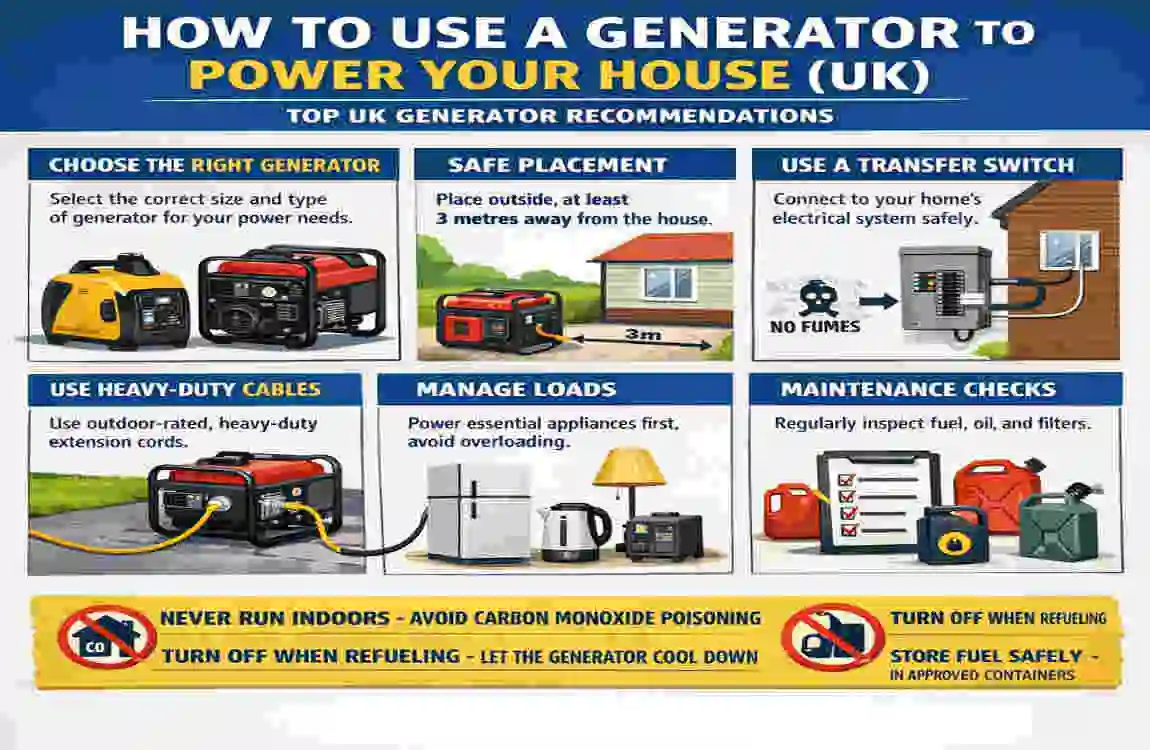
To save you hours of scrolling through endless product reviews, we have selected three of the very best generators available to UK consumers in 2026.
- The Best Budget Option: Warrior LDG6500SV Priced around £1,200, this silent diesel generator is a beast. It provides a massive 5kW of power, runs incredibly quietly, and features a rugged canopy to protect it from the British weather. It is perfect for homeowners who want serious power without a massive price tag.
- The Premium Standby Option: Senci SCD9000Q. If you want whole-house power, this 6kW standby diesel unit is phenomenal. It features top-tier soundproofing and an ultra-reliable engine that can easily integrate with an automatic transfer switch.
- The Eco-Friendly Option: Jackery Solar Generator 2000 Plus. If you live in a strict noise-controlled area or simply hate the smell of petrol, this solar hybrid is incredible. It runs silently, produces zero emissions, and can be charged purely by the sun or from your wall socket before the storm hits.
You can find all these models through reputable online dealers like Generators Direct or via Amazon UK for fast shipping.
FAQs
We know that dealing with high-voltage electricity can be intimidating. Here are the most frequently asked questions we receive from UK homeowners.
Can I simply plug my generator directly into my house wall socket? Absolutely not. This is called backfeeding. It is highly illegal, it bypasses your home’s safety fuses, and it can kill the utility workers repairing the power lines outside. Always use extension cords or a legally installed transfer switch.
How long can a generator run continuously? Most standard portable generators have fuel tanks that provide 8 to 24 hours of continuous running time at a 50% load. Standby units connected to a natural gas line can run indefinitely as long as the gas supply continues to flow.
Which is better for UK homes: Diesel or Petrol? Diesel generators are generally heavier and slightly more expensive upfront, but they are highly recommended for the UK climate. Diesel engines last significantly longer, fuel is safer to store, and they are much more fuel-efficient over long periods than petrol models.
