

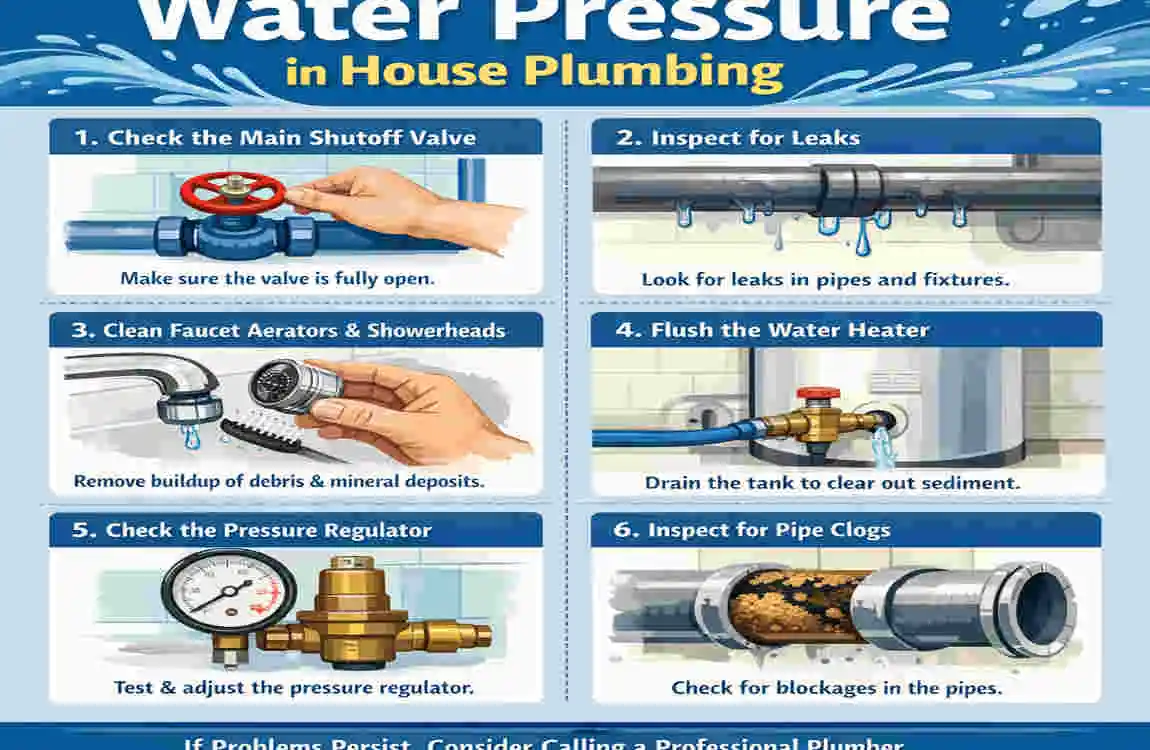
Low water pressure can turn simple daily tasks into small annoyances. A shower feels weak, the kitchen faucet takes forever to fill a pot, and the washing machine seems to drag through every cycle. If you have ever stood under a disappointing trickle of water, you already know how frustrating it can be.
The good news is that low water pressure is often fixable. In many homes, the issue comes from a valve that needs adjustment, a clogged fixture, or a simple maintenance problem rather than a major plumbing failure. That means you may be able to improve home water flow without a complete overhaul.
Understanding Your Home’s Water System
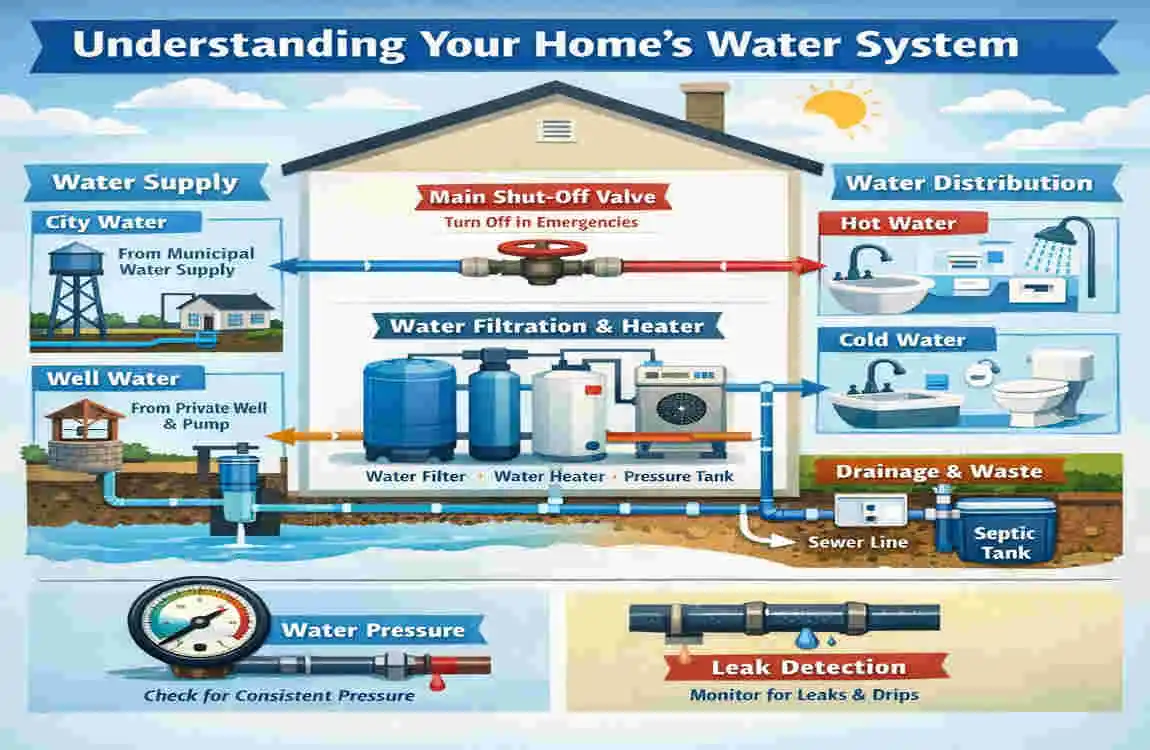
How water enters the home
Before you try to adjust anything, it helps to understand how water gets into your house in the first place. Most plumbing homes use one of two systems:
- Municipal water supply: Water comes from the city or town main and enters your home through the main service line.
- Well system: Water comes from a private well and is pumped into the house through a pressure tank and pressure switch.
These systems work differently, but both need balanced pressure to function well. If pressure is too low, fixtures feel weak. If pressure is too high, pipes, seals, and appliances can wear out faster.
In a typical home, the ideal water pressure usually falls around 40 to 60 PSI. PSI stands for pounds per square inch and is simply a unit of measurement for water pressure. A healthy pressure range provides enough flow for showers, sinks, dishwashers, and washing machines without straining plumbing parts.
The role of the pressure reducing valve
If your home uses city water, it may have a pressure reducing valve, often called a PRV. This valve lowers incoming water pressure to a safer level before it enters the rest of your plumbing. City water can sometimes arrive at a higher pressure than your home needs, so the PRV helps protect the system.
Think of the PRV like a traffic controller. It decides how much force is allowed through. If it is set too low, your home may feel sluggish. If it is set too high, you could risk leaks, noisy pipes, and damage to fixtures.
Not every home has a PRV, but many do. It is often located near the main water line where water enters the house. In some homes, especially older ones, the valve may be in a basement, utility room, crawl space, or near the water meter.
Signs of low pressure vs. clogged fixtures
Here is where many homeowners get confused. Not every weak faucet means the whole house has low pressure. Sometimes the problem is only at one fixture.
A few common signs of whole-house pressure issues include:
- Weak flow at multiple faucets
- Poor shower performance throughout the house
- Washing machines filling slowly
- Toilets refilling more slowly than usual
A few signs of localized fixture problems include:
- One sink has weak flow while others are fine
- One showerhead sprays unevenly
- Water pressure improves after cleaning an aerator
- Hot water pressure is weak but cold water is normal
This difference matters. If only one faucet is affected, adjusting the PRV will not solve the problem. You may need to clean the fixture or replace a worn part instead.
Step-by-Step: How to Adjust Water Pressure in House Plumbing
Before you begin: know what you are working with
If your home already has low water pressure, your first instinct may be to start turning valves right away. Hold on for a moment. The smartest approach is to measure first, then adjust.
That way, you know whether the pressure is truly too low or whether the problem is somewhere else. You also reduce the chance of overcorrecting and creating a new problem.
Tools you will need
You do not need a huge toolbox for this job. A few basic tools are usually enough.
Tools and supplies:
- Adjustable wrench
- Pliers
- Pressure gauge
- Flathead screwdriver
- Bucket or towel
- Flashlight
You may also want gloves and a notepad to record the pressure readings before and after changes.
Check your current water pressure
The first real step in how to adjust water pressure in house plumbing is to measure what you have now. The easiest way is to attach a pressure gauge to an outdoor hose bibb or laundry faucet if that is accessible.
Here is a simple process:
- Turn off all water inside and outside the home.
- Attach the pressure gauge tightly to a hose bibb.
- Open the valve fully.
- Read the PSI on the gauge.
This reading tells you the pressure entering the home at that point. If it is well below 40 PSI, the water may feel weak. If it is above 60 PSI, the system may be too strong. If it is much above 80 PSI, that is a sign of potential stress on the plumbing.
Try to take the reading when no one else is using water. If someone flushes a toilet or runs a faucet during the test, your reading may not be accurate.
Find the pressure reducing valve
If your home has a PRV, you need to locate it before making any changes. It is often installed on the main water line near where water enters the house. In many homes, it looks like a bell-shaped or round metal valve with an adjustment screw or bolt on top.
If you are not sure whether you have one, follow the main water line from where it enters the home. You may find the shut-off valve and PRV close together.
If your home uses a well system, the process is different. You will likely be working with the pressure tank and pressure switch rather than a PRV. In that case, the adjustment method differs, so you should be more careful before making changes.
Make sure the main shut-off valve is fully open
Before adjusting the PRV, check the main shut-off valve. Sometimes low pressure is caused by a partially closed valve.
A shut-off valve that is not fully open can reduce flow through the whole house. This is one of the easiest problems to fix, and it is often overlooked.
To check it:
- Find the main shut-off valve near the water entry point.
- Turn it gently to make sure it is fully open.
- Do not force it if it feels stuck.
If the valve is old or stiff, forcing it can damage the stem or cause a leak. If you are unsure, stop and inspect it carefully.
Loosen the locknut on the PRV
Once you have found the PRV, look for the locknut or locking piece that holds the adjustment screw in place. This part keeps the valve from moving on its own.
Use the proper wrench to loosen it slightly. You do not need to remove it completely. The goal is to free the adjustment screw so you can make a change.
Take your time here. Plumbing parts can be old and fragile. A small slip can round off a fitting or damage the valve.
Turn the adjustment screw clockwise
This is the part most people think of when they ask how to adjust water pressure in house plumbing. In many PRVs, turning the adjustment screw clockwise increases pressure. Turning it counterclockwise usually lowers pressure.
Make only a small turn at a time. A quarter-turn is often enough for one adjustment. After turning it, tighten the locknut again if needed, then test the pressure.
This slow approach matters because pressure changes can be stronger than they seem. A tiny adjustment can make a noticeable difference in flow.
Recheck the pressure
After each adjustment, go back to your pressure gauge and check the reading again. This is the only way to know whether the change worked.
If the pressure is still too low, make another small adjustment and test again. If it is now within the ideal range of 40 to 60 PSI, stop there.
Do not keep turning the screw just because you want “better” pressure. More pressure is not always better. It can lead to noisy pipes, leaks, and appliance wear.
Test the home fixtures
After the gauge shows a healthy reading, walk through the house and test several fixtures.
Check:
- Kitchen sink
- Bathroom sink
- Shower
- Outdoor hose bibb
- Toilet refill speed
This helps confirm that the pressure problem was truly system-wide and not isolated to one fixture.
The “slow and steady” rule
When adjusting pressure, small steps are safer than big jumps. It is very easy to overdo it. A pressure increase that feels helpful at first can become a problem later if it pushes the system too hard.
If you make one change and the water flow feels better, pause there. Let the system settle. Recheck it later in the day, especially during normal household use.
That approach protects your pipes and delivers better long-term results.
If your home does not have a PRV
Some homes do not have a PRV at all. If that is the case, the low pressure may come from another source, such as:
- A partially closed shut-off valve
- Mineral buildup in pipes
- Clogged aerators or showerheads
- A water heater issue
- Problems with the municipal supply
- A well pump or pressure tank issue
In other words, no PRV means the fix is likely somewhere else. You can still improve water flow, but the solution will come from diagnosis, not adjustment.
Common Culprits of Low Water Pressure
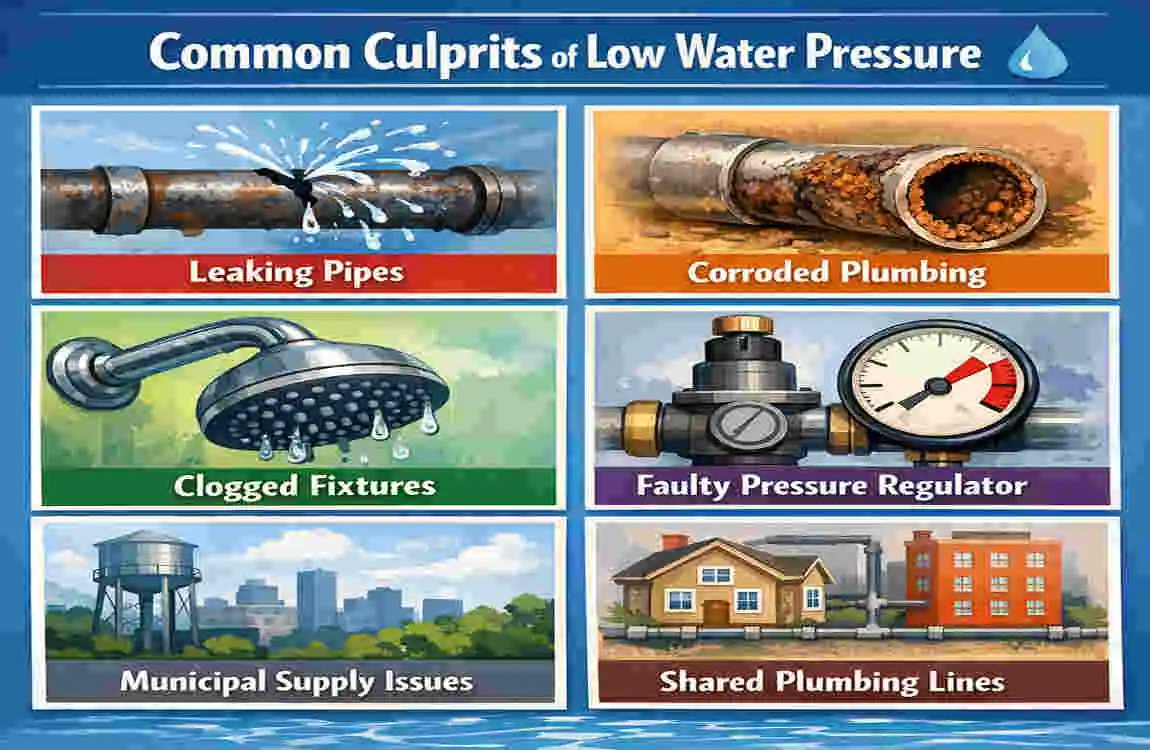
The main shut-off valve
One of the simplest causes of low water pressure is also one of the easiest to miss: the main shut-off valve may not be fully open.
This can happen after plumbing work, a leak repair, or even by accident. If the valve is only partly open, water has less room to move through the line.
A partially closed valve often creates a house-wide problem. You may notice that every faucet feels weak, not just one.
If this is the issue, opening the valve fully may solve the problem right away.
Clogged fixtures
If only one faucet or showerhead is weak, the cause may be something as small as buildup inside the fixture.
Over time, tiny mineral deposits, rust, and dirt can collect in:
- Faucet aerators
- Showerheads
- Faucet cartridges
- Small inlet screens
This buildup restricts flow, even when the water pressure entering the home is normal.
A simple cleaning can make a huge difference. In many cases, you can remove the aerator or showerhead and soak it in vinegar to loosen mineral buildup. Then rinse it, scrub it lightly if needed, and reinstall it.
This is one of the quickest ways to improve home water flow without touching the main plumbing.
Pipe condition
Old pipes can also reduce water pressure. This is especially true in homes with aging galvanized steel pipes or pipes with heavy mineral buildup inside.
As pipes age, the inside diameter can shrink. That means water has less space to move, which lowers flow. Corrosion can also create rough surfaces inside the pipe, making it harder for water to flow smoothly.
If your home has old plumbing, you may notice:
- Low pressure everywhere
- Rust-colored water at times
- Uneven flow from fixture to fixture
- Recurring clogs or buildup
In these cases, cleaning one faucet will not solve the bigger issue. The plumbing itself may need repair or replacement.
Water heater issues
Sometimes the problem isn’t the cold-water line at all. It is the water heater.
Sediment can collect inside the tank over time. When that happens, the heater may not deliver hot water as efficiently, and you might notice lower pressure or weaker flow on the hot side.
If cold water pressure seems normal but hot water feels weak, the water heater is a good place to look.
Flushing the tank can help remove sediment and improve performance. If the heater is very old or heavily clogged, though, a flush may not be enough.
Quick guide to common causes and fixes
Cause of Low Water PressureWhat You Might NoticeSimple FixWhen to Call a Plumber
Partially closed main shut-off valve Weak flow throughout the house Open the valve fully If the valve is stuck or damaged
Clogged aerator or showerhead Weak flow at one fixture Clean with vinegar and rinse If the fixture is broken or corroded
Pressure reducing valve set too low Whole-house pressure feels weak Adjust the PRV slowly If the valve will not hold adjustment
Old or corroded pipes Chronic low flow, rust, uneven pressure Inspect and plan for replacement If corrosion is widespread
Sediment in water heater Hot water pressure is weaker than cold Flush the water heater If the heater is old or malfunctioning
Leak in the system Pressure drops, water bill may rise Check for visible leaks If you suspect hidden leaks or main line damage
Advanced Solutions for Stubborn Flow Issues
Installing a booster pump
If you have checked the valves, cleaned the fixtures, and adjusted the PRV but still struggle with weak water flow, a booster pump may be worth considering.
A booster pump helps increase water pressure when the supply is consistently too low. It is often used in homes with:
- Naturally low municipal pressure
- Long plumbing runs
- Multi-story layouts
- Large homes with multiple fixtures in use at once
This is not usually the first fix, but it can make a big difference when pressure is chronically weak. A booster pump needs proper sizing and installation, though. If it is too strong or poorly installed, it can create more problems than it solves.
When to call a licensed plumber
Some pressure problems are too complex for simple DIY fixes. You should call a licensed plumber if you suspect:
- A hidden leak
- A broken underground water line
- Major pipe corrosion
- A failing PRV
- A problem with the pressure tank on a well system
- A water heater that is no longer performing properly
A plumber can test the system more accurately and find problems that are not visible. That matters because low pressure can sometimes signal a more serious issue behind the walls or underground.
If you have already made basic checks and the pressure still seems off, calling a pro can save time and prevent damage.
Upgrading old piping
If your home still has older galvanized steel pipes, pipe replacement may be the real long-term solution.
Over time, these pipes can rust from the inside, narrow the water path, and create repeated flow problems. Modern materials such as CPVC or UPVC are often used in upgrades because they are more efficient and corrosion-resistant.
This kind of upgrade is a larger project, but it can dramatically improve water flow and reduce future maintenance costs. If your plumbing is old enough to keep causing trouble, replacement may be more practical than repeated repairs.
Signs that point to a bigger system problem
Sometimes the issue is not just pressure. It is the whole delivery system.
Watch for these warning signs:
- Pressure changes throughout the day
- Water pressure drops when another fixture runs
- Hot and cold water behave differently
- You hear banging or knocking in the pipes
- Water pressure changes after heavy use
- Rust or debris appears in the water
These clues suggest the problem may involve pipe condition, supply issues, or internal plumbing wear.
Safety Precautions and Maintenance
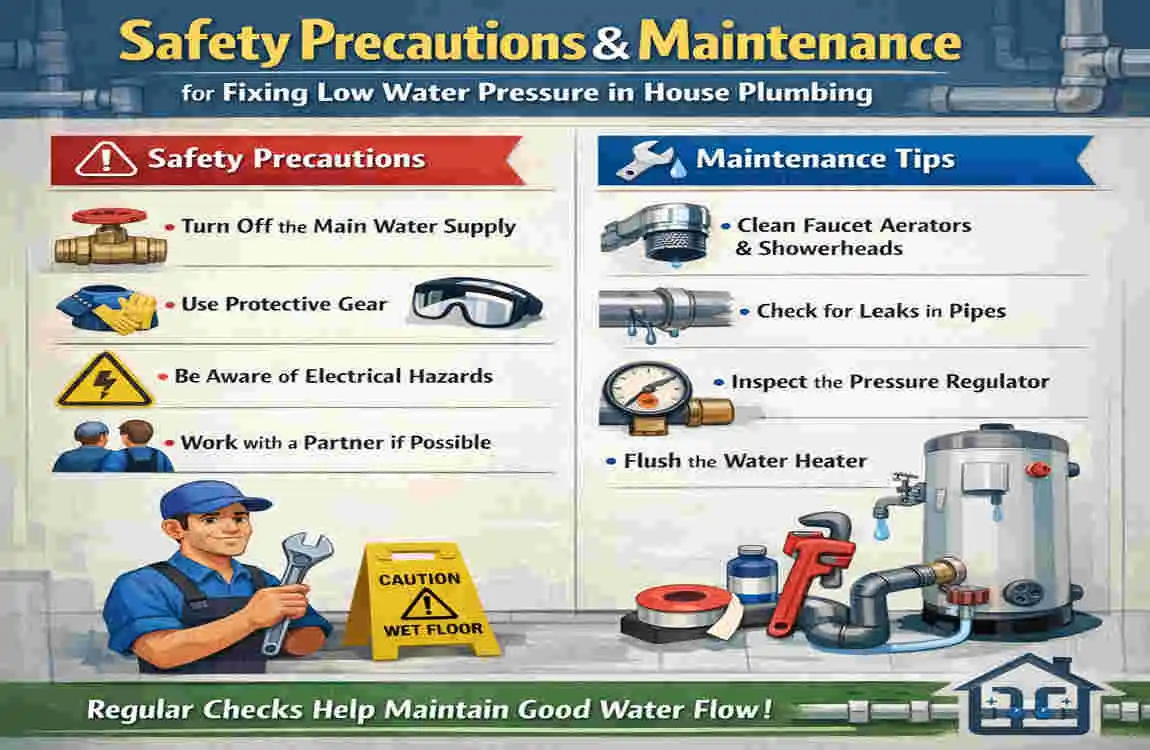
Why you should never over-pressurize your system
It is tempting to keep turning the valve until the shower feels powerful. But more pressure is not always a good thing.
If the system is over-pressurized, you can run into problems such as:
- Leaking joints
- Damaged appliance hoses
- Noisy pipes
- Worn-out seals
- Shorter fixture lifespan
A pressure range that is too high can stress every part of the plumbing system. That is why staying in the recommended range matters. Balanced pressure protects your home.
Simple maintenance habits
Good water pressure is not something you fix once and forget forever. It benefits from regular checks.
A smart routine includes:
- Testing water pressure once or twice a year
- Cleaning faucet aerators and showerheads as needed
- Checking the main shut-off valve
- Watching for leaks under sinks and around fixtures
- Flushing the water heater on a regular schedule
These small steps help you catch problems early before they become expensive.
Basic safety checklist
Before you make any plumbing adjustment, keep this checklist in mind:
- Turn off water where needed before disassembling parts
- Use the right tool for each fitting
- Do not force stuck valves or nuts
- Make small pressure adjustments only
- Recheck pressure after every change
- Stop if you see leaks or damaged parts
Safety does not have to be complicated. It just means moving carefully and avoiding shortcuts.
Protecting fixtures from sudden pressure changes
Sudden changes in pressure can be hard on fixtures. That is why it is best to avoid dramatic adjustments in one move.
If you raise pressure too quickly, you may create water hammer, which is a loud banging sound caused by sudden changes in water movement. It can be annoying, but it can also signal stress in the plumbing.
Small, steady changes help prevent that. You want a system that feels comfortable and stays reliable, not one that works hard for a day and fails later.
Frequently asked questions
What is the ideal PSI for a home?
Most homes do best at 40 to 60 PSI. This range delivers consistent water flow without putting undue stress on pipes and fixtures.
Can I adjust pressure myself without a plumber?
Yes, in many cases you can. If your home has a PRV and the issue is simple, you may be able to make a safe adjustment yourself. Just go slowly, test after each change, and stop if anything seems unusual.
Will increasing pressure increase my water bill?
Not always in a dramatic way, but it can affect usage patterns. Higher pressure can make water come out faster, leading to increased water use without realizing it. It can also increase wear on fixtures if the pressure is too high.
