

Imagine you are finally tackling that dream basement renovation. You have the studs up, the new pipes for the wet bar are in place, and you are ready to pull the electrical cables. You reach for your drill, prepared to run a line of Romex right alongside the new copper pipes. It seems efficient. They are both going to the same wall, so why not keep them together?
Stop right there! This is one of the most common mistakes homeowners make during a DIY project, and it can lead to failed inspections, dangerous electrical fires, or even life-threatening shocks. When you ask, “How far does electrical have to be from home plumbing?” you aren’t just asking about a number on a tape measure. You are asking about the fundamental safety of your home.
Why Separation Between Electrical Wiring and Plumbing Is Critical
You might be wondering why the code is so strict about keeping wires and pipes apart. After all, wires are insulated, and pipes are sealed. In a perfect world, they should be able to coexist peacefully. But our homes aren’t perfect. Pipes leak, basements flood, and insulation can wear down over time.
The Deadly Mix of Water and Electricity
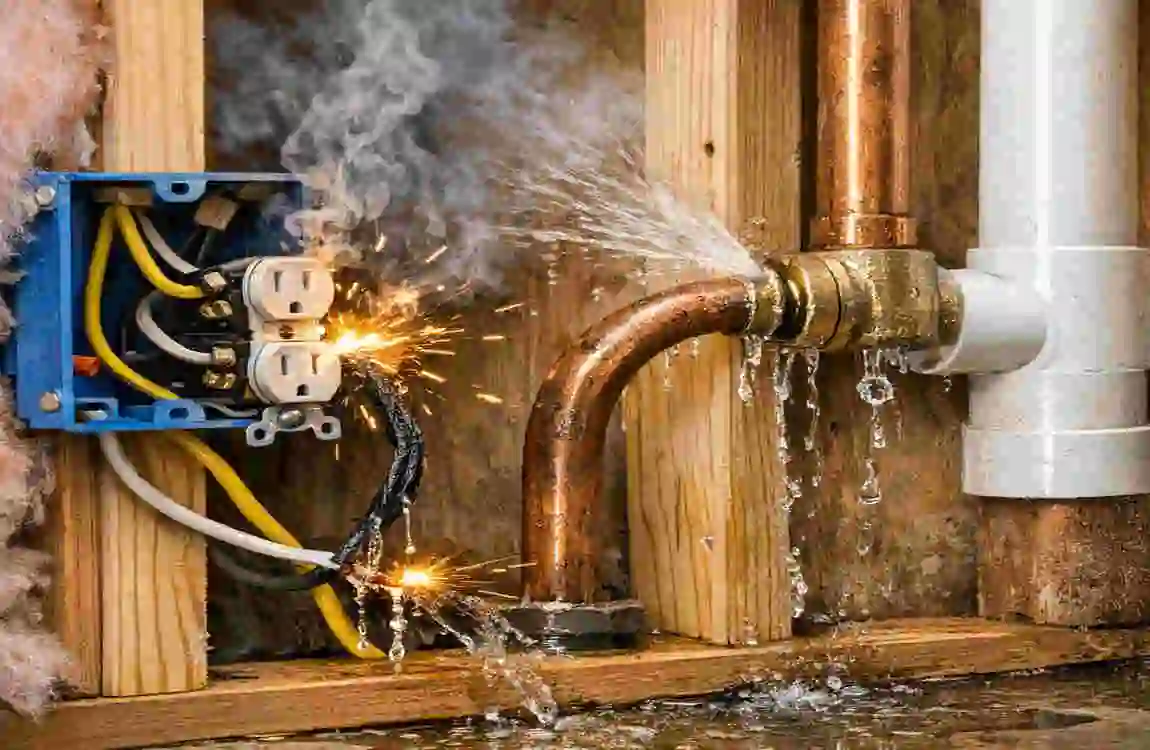
We all know that water and electricity don’t mix, but do you know why? Water is an excellent conductor of electricity, mainly when it contains minerals like those found in your home’s tap water. If a pipe develops a pinhole leak and sprays water onto a nearby electrical wire, the moisture can seep through the outer jacket.
If the wire’s insulation is even slightly nicked or aged, the electricity can “jump” from the wire to the water. This creates a short circuit, which can lead to a fire or energize the entire plumbing system. Imagine touching your kitchen faucet and getting a massive shock because a wire 10 feet away is leaking current into the pipes. This is precisely what the code requirements for wiring near pipes are designed to prevent.
Preventing Pipe Corrosion and Electrolysis
There is another hidden danger that many people don’t consider: electrolysis. When electrical wires are too close to metal pipes, especially copper ones, the electromagnetic field (EMF) generated by the electricity can cause a chemical reaction.
Over time, this stray current can cause the metal in your pipes to break down. This leads to premature corrosion, thinning of the pipe walls, and eventually, leaks. By maintaining the proper electrical wiring from plumbing, you are not just protecting yourself from shocks; you are also extending the life of your plumbing system.
Fire Prevention and Safety Statistics
According to fire safety data, thousands of residential fires are caused every year by electrical faults. A significant portion of these occur in “wet” areas like basements, kitchens, and bathrooms. When electricity arcs because of moisture or proximity to metal, it generates intense heat. This heat can ignite nearby wooden studs or insulation.
Key reasons to maintain separation include:
- Shock hazards: Preventing “hot” pipes that can electrocute you.
- Code compliance: Avoiding heavy fines or being forced to tear out walls during an inspection.
- Insurance protection: Many insurance companies will deny claims if they find a code violation caused the fire.
- System longevity: Reducing the risk of “pitting” in copper pipes due to electrical interference.
National Electrical Code (NEC) Minimum Distances Explained
When we talk about “the code,” we usually mean the National Electrical Code (NEC). This is the gold standard for electrical safety in the United States. While your local city might have its own specific tweaks, most of them follow the NEC as their foundation.
Understanding NEC 300.20B
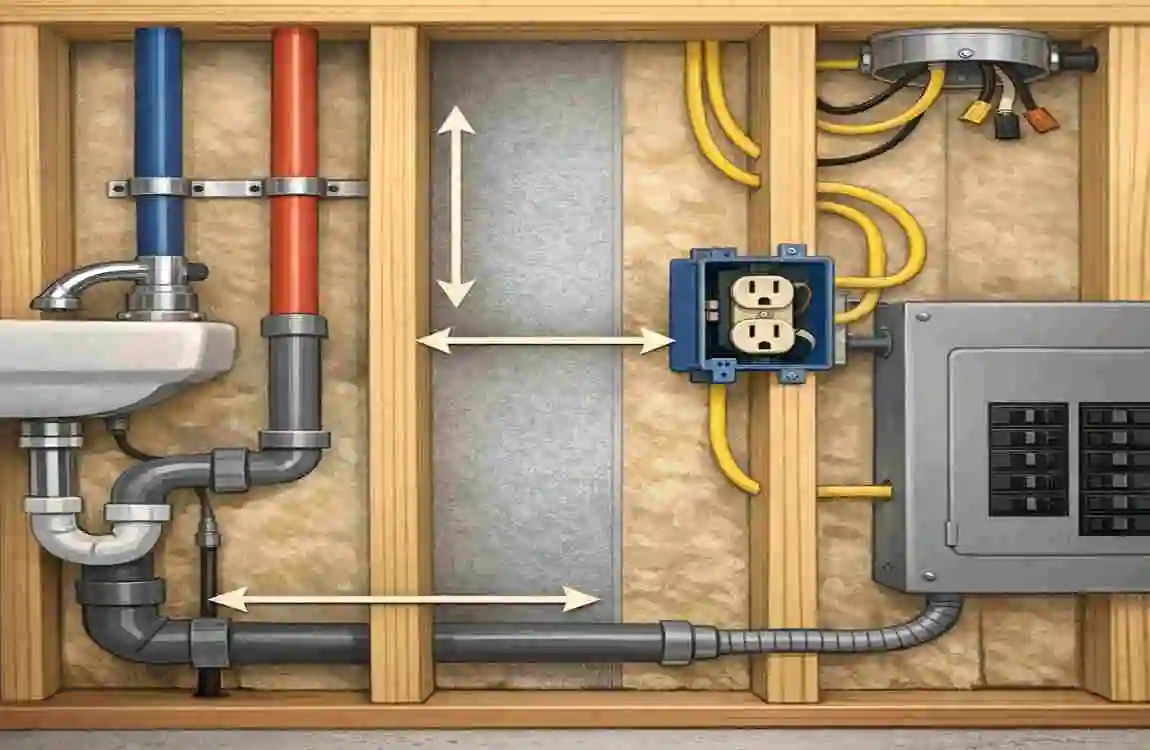
The most important rule to remember is NEC 300.20(B). This section generally suggests a minimum clearance of 18 inches between electrical cables or conduits and plumbing pipes. This distance is measured from the outer surface of the wire to the nearest edge of the pipe.
Why 18 inches? It provides a “buffer zone.” If a pipe sweats (condensation) or leaks, 18 inches is usually enough distance to prevent that moisture from reaching the electrical components. It also gives enough space for a plumber or electrician to work on one system without accidentally damaging the other.
Parallel Runs vs. Pipe Crossings
The rules change slightly depending on how the wires and pipes are oriented.
Parallel Runs: If you are running a wire and a pipe down the same wall for a long distance, you must maintain that 18-inch gap. This is where most people get caught. It is tempting to zip-tie a wire to a pipe to keep things neat, but that is a significant violation.
Pipe Crossings: Sometimes, a wire must cross over a pipe. In these cases, the distance can often be reduced to 12 inches, provided the wire is properly secured and doesn’t touch the pipe. Some local jurisdictions (and the International Residential Code or IRC) allow for even tighter clearances if a sleeve or conduit protects the wire, but 12 inches is the “safe” DIY rule of thumb.
Summary of Distance Requirements
To help you visualize these rules, here is a quick reference table for common residential scenarios.
ScenarioMinimum DistancePrimary Code Reference
Parallel Runs 18 Inches NEC 300.20(B)
Pipe Crossings 12 Inches Local / IRC Standards
Wiring in Same Wall Stud 6 Inches (with sleeve) NEC Exceptions
Basements / Exposed Pipes 12 – 18 Inches IRC R314 / NEC
Gas Lines 6 Inches Fuel Gas Code
Variations and the “Rule of Thumb”
While 18 inches is the standard, you might hear some contractors mention 12 inches or even 36 inches. Older references often suggested 3 feet of separation for parallel runs to eliminate EMF interference. However, modern wire insulation is much better than it was 50 years ago, so 18 inches has become the accepted modern standard for house code wiring rules.
Always remember: if you are unsure, go wider. There is no penalty for having your wires 24 inches from a pipe, but there is a significant penalty for having them only 5 inches from a pipe.
Local Building Codes and Regional Variations
Even though the NEC is the national standard, it isn’t the only word on the matter. Your local building department has the final say. Some cities, especially older ones with dense housing, might have stricter rules to prevent fires from spreading between units.
Stricter Rules in Certain Areas
For example, in parts of California or in major cities like Chicago, codes can be much more demanding. You might find that parallel runs require a full 5 feet of separation if the wires are not in a metal conduit. This is often due to seismic concerns or specific regional fire hazards.
In Canada, the rules are similar but can vary by province. Often, they stick to a 12-inch (30 cm) rule for crossings but are very strict about how wires are supported near plumbing fixtures.
How to Find Your Local Code
Don’t guess! Before you start drilling holes in your studs, do a little homework.
- Visit the ICC Website: The International Code Council (ICC) hosts many local codes online.
- Call Your Local Inspector: Most building inspectors are happy to answer a quick question. It’s much easier for them to answer a phone call than to fail you during an inspection later.
- Check the Permit Office: When you pull a permit for your work, they will often give you a handout summarizing the most common NEC plumbing separation rules for your area.
Exceptional Cases: Bathrooms, Kitchens, and Basements
Not every room in your house is treated the same. Areas where water is “active”—like the kitchen or bathroom—have specific requirements that go beyond simple distance.
Bathrooms: The High-Risk Zone
Bathrooms are the most dangerous rooms in the house when it comes to electricity. You have sinks, tubs, and showers all within reach of outlets and lights.
The most famous rule here is the 6-foot rule. Any outlet within 6 feet of a water source (sink, tub, or shower) must be GFCI-protected. But what about the wiring behind the wall? Even if the outlet is GFCI-protected, the electrical wiring distance from the plumbing inside the wall should still maintain that 18-inch gap from the drain and supply lines, wherever possible.
Kitchens: Dealing with Appliances
In the kitchen, you are dealing with dishwashers, garbage disposals, and refrigerators. These often require electrical lines to run very close to water lines.
For exposed pipes (like those under your sink), aim for at least 12 inches of clearance. If the wire must be closer to connect to a disposal, it should be housed in a flexible metal conduit (often called “Greenfield”) to provide a physical barrier between the water and the electricity.
Basements and Unfinished Areas
In an unfinished basement, wires and pipes are often exposed on the ceiling joists. This is where most violations happen because it is so easy to staple a wire next to a pipe.
The IRC R314 code generally suggests that in these unfinished spaces, you should maintain at least 12 to 18 inches of clearance. If you are running wires through the same joist holes as pipes, you are asking for trouble. Use separate paths for your “wet” and “dry” utilities.
A Note on Gas Lines
While not “plumbing” in the water sense, gas lines are often grouped with plumbing. The rule for gas lines is usually a minimum separation of 6 inches. You do not want an electrical arc near a gas pipe for apparent reasons.
How to Measure and install Compliant Wiring
Now that you know the numbers, let’s talk about the actual work. How do you ensure you are hitting these marks when you are working inside a dark, cramped wall?
Map Your Plumbing Paths First
Always let the plumber go first. Plumbing pipes are rigid and harder to move. Electrical wires are flexible. It is much easier to route a wire around a pipe than it is to reroute a 3-inch PVC drain line. Once the pipes are in, take a marker and draw a “no-fly zone” 18 inches around them.
Use the Right Tools
Don’t just eyeball it.
- Tape Measure: Use it for every hole you drill.
- Laser Measure: These are great for long runs in basements to ensure your parallel distance remains consistent.
- Stud Finder with AC Detection: If you are adding plumbing to an existing wall, use a stud finder that can “sense” live wires so you don’t accidentally plumb right next to them.
Use Protective Sleeves
If you absolutely must run a wire through a stud that also contains a pipe, you need protection. You can use an electrical conduit or a PVC sleeve to house the wire. This provides a physical barrier so that even if the pipe leaks, the water cannot directly touch the wire insulation.
Secure Your Wires Properly
A sagging wire is dangerous. Use “staples” or cable ties designed explicitly for electrical use to keep your wires taut and away from the plumbing. If a wire is allowed to sag over time, it might eventually rest against a hot water pipe, which can melt the insulation and cause a fire.
Common Mistakes and How to Avoid Them

Even with the best intentions, mistakes happen. Here are the “hall of shame” errors that home inspectors see most often.
The “Piggyback” Violation
This is when a homeowner uses a plumbing pipe as a support for their electrical wire. They zip-tie the Romex directly to the copper pipe. Never do this. It is a massive fire and shock hazard.
Ignoring the Attic and Crawlspace
Just because you don’t see it every day doesn’t mean the code doesn’t apply. Inspectors will crawl into the tightest spots to check your NEC plumbing separation. Make sure your attic wiring isn’t draped over your vent pipes.
Retrofit Oversights
When remodeling, people often unthinkingly “fish” wires through walls. If that wire ends up resting against a drain pipe, it’s a violation. If you are fishing wires, use a “fish tape” to ensure you stay in the correct stud bay, away from the plumbing pipes.
How to Fix a Violation
If you realize your wires are too close, you have two choices:
- Reroute: Pull the wire out and drill new holes further away.
- Shield: If you can’t move the wire, you may be able to install a permanent, grounded metal barrier or conduit, but check with your inspector first to see if they allow this “fix.”
FAQ Section
How far does electrical have to be from home plumbing?
According to the NEC 300.20(B), the standard distance is 18 inches for parallel runs. For crossings, 12 inches is generally accepted, though local codes may vary.
Can electrical wiring run alongside plumbing pipes in the same wall?
Yes, they can be on the same wall, but they should ideally be in different stud bays. If they must be in the same bay, they must maintain the required clearance, and the wire must be protected if it is within 6 inches of the pipe.
Does the type of pipe matter (PEX vs. Copper)?
Technically, the NEC rules apply regardless of the pipe material. While PEX doesn’t conduct electricity like copper, it can still leak, and moisture is the primary concern for electrical safety. Treat PEX the same as metal piping.
What happens if I fail an inspection because of this?
The inspector will issue a “correction notice.” You will have to move the wiring or the plumbing to meet the code before they will “sign off” on the permit. This often involves opening up drywall, which can be expensive.
Is it different for gas lines?
Yes, gas lines usually require a minimum of 6 inches of separation from electrical lines to prevent any potential sparks from causing an explosion.
