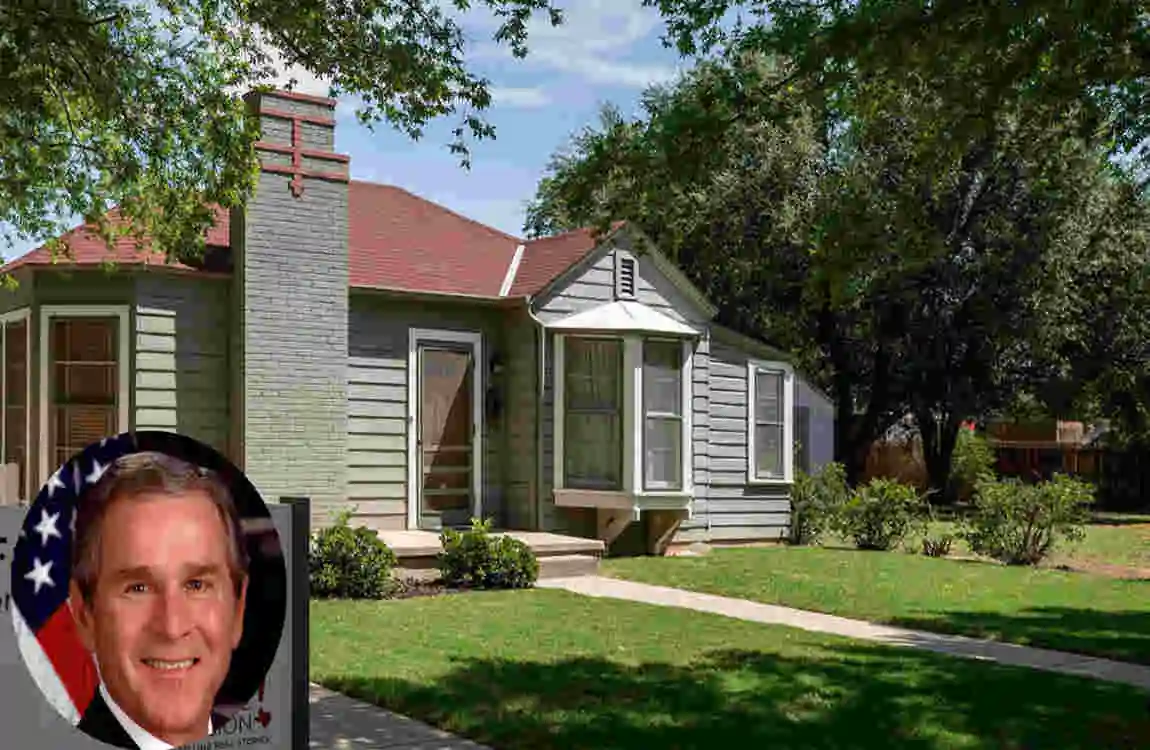

The George Bush House in Houston is most closely associated with George H. W. Bush, the 41st president of the United States, and his wife, Barbara Bush. Their Houston residence became an important part of Bush’s post-presidential life and his long connection with Texas.
One distinction is worth making up front. George H. W. Bush’s Houston residence is different from George W. Bush’s Prairie Chapel Ranch in Crawford, Texas. The Crawford property became famous as the “Western White House,” while the Houston home was associated with George H. W. Bush and Barbara Bush after their return from Washington.
The Houston residence is interesting not simply because a former president lived there, but because its history shows how architecture, privacy, security, family life, and Houston’s residential character can come together in one property.
| Personal Detail | Information |
|---|---|
| Full Name | George Walker Bush |
| Born | July 6, 1946 |
| Age | 80 (as of September 2026) |
| Birthplace | New Haven, Connecticut, USA |
| Profession | Politician, author, businessman and former U.S. president |
| Presidency | 43rd President of the United States, 2001–2009 |
| Political Party | Republican |
| Father | George H. W. Bush, 41st U.S. president |
| Mother | Barbara Bush |
| Spouse | Laura Bush |
| Marriage | 1977 |
| Children | Barbara Bush and Jenna Bush Hager |
| Education | Yale University; Harvard Business School |
| Military Service | Texas Air National Guard, 1968–1973 |
| Business Career | Worked in the Texas energy industry; later became an investor in the Texas Rangers |
History of George Bush House Houston
George H. W. Bush and Houston
Houston played an important role in Bush’s personal history long before his presidency.
The Bush family lived in the Houston area, and George H. W. Bush was associated with the Tanglewood community during his earlier years. He also maintained important connections to Houston institutions and organizations.
His political career eventually took him away from Houston for long periods.
He served as a U.S. representative, ambassador, director of the CIA, vice president, and eventually president. Yet Houston remained an important part of his Texas identity.
Planning the Retirement Home
The story of the Houston retirement house began before Bush actually left the presidency.
Historical accounts describe Bush’s ownership and plans for a Houston lot that would eventually become the site of his retirement residence. In 1992, the Bush family publicly announced plans to build a new house there.
The site was unusual because of its relatively compact dimensions.
This created an interesting architectural challenge. The designers needed to create a comfortable residence while also accommodating security requirements.
The project therefore demonstrates how site limitations and special functional requirements can influence residential architecture.
Architect Edwin A. Eubanks
Architect Edwin A. Eubanks was selected to design the residence.
Choosing an architect mattered because the house needed to serve multiple purposes.
It had to function as a family home while also meeting the security and logistical needs of a former president.
That combination makes the project different from a typical Houston luxury residence.
Security and Construction
Security was an important consideration from the beginning.
Historical accounts indicate that the planned Bush residence included separate structures connected with security operations. This allowed security personnel and equipment to operate without turning the entire house into an obviously institutional environment.
This is an important architectural lesson.
Security does not have to dominate a home’s visible design. It can be integrated into the property’s planning through controlled entrances, separate support areas, landscaping, gates, and carefully managed circulation.
The Bush Family’s Houston Legacy
The Houston house became part of the Bush family’s larger story.
George H. W. Bush and Barbara Bush spent their later years closely connected with Houston. At the same time, the wider Bush family maintained other important Texas properties.
The Houston residence therefore represented more than a place to live. It became part of the family’s long-standing relationship with Texas.
Architecture and Design of the George Bush House
Exterior Architecture
Detailed architectural information about the private residence is more limited than information about some famous presidential properties.
That means it is better to focus on documented characteristics rather than inventing an exact room count, square footage, or decorative style.
The house was designed as a private residential property in Houston’s West Oaks area, with the surrounding neighborhood providing a more traditional residential context.
Its architectural interest comes partly from the challenge of combining comfortable residential planning with presidential-level security requirements.
Residential Character
Unlike an official government building, the house was designed as a home.
That distinction matters.
A retirement residence needs comfortable spaces for family life, guests, meals, relaxation, and private activities. At the same time, the property needed to support security personnel and controlled access.
The resulting planning reflects the unusual circumstances of its occupants.
Landscaping and Property Setting
Landscaping can play an important role in a Houston residence because trees and greenery can provide shade, visual softness, and privacy.
For a high-profile homeowner, landscaping also offers another benefit: it can help separate the house from public areas.
Rather than using architecture alone to establish privacy, a property can combine walls, gates, trees, gardens, and controlled access.
Interior Planning
Detailed current information about the interior layout is not broadly available.
For that reason, treat claims about exact numbers of bedrooms, bathrooms, fireplaces, kitchens, or specialized rooms carefully unless a reliable property record supports them.
From the home’s history, we can reasonably infer that the residence was planned around the needs of a retired president and his family.
That means residential comfort and security had to work together.
Presidential-Era Security Features
Security can influence almost every aspect of a presidential residence.
It can affect:
- Entry points and gates
- Vehicle access
- Visitor movement
- Security personnel locations
- Landscaping and sightlines
- Service areas
- Emergency access
- Separation between private and controlled areas
In the Bush residence, historical accounts specifically mention separate facilities for security and Secret Service operations.
This offers an unusual example of how security requirements can shape residential planning.
Location and Houston Lifestyle
Why Houston Was Important to the Bush Family
Houston was not simply a convenient retirement location.
It held deep personal meaning for George H. W. Bush and his family.
His professional life, family connections, and political career were all connected to Houston at different times.
Returning to Houston after the presidency therefore allowed Bush to maintain a connection with a city that had played an important role throughout his life.
The West Oaks and Tanglewood Setting
The retirement residence was located in West Oaks, near the Tanglewood area.
Although West Oaks and Tanglewood are distinct subdivisions, historical accounts often discuss them together because of their geographic relationship. The Bush property lay outside the formal Tanglewood subdivision boundaries but remained within the broader Tanglewood area.
This part of Houston is associated with established residential neighborhoods and substantial private homes.
For a retired president, the setting offered an important combination of residential character and proximity to the city.
Privacy and Accessibility
The Bush residence also demonstrates the difficult balance between privacy and accessibility.
A public figure may need to stay connected to the city while limiting unwanted visitors.
Historical accounts show that public interest in the residence became noticeable after the Bush family moved into the area. This eventually contributed to additional access controls around the property.
The experience illustrates why privacy can become an architectural and neighborhood issue when a famous person moves into a residential community.
Houston Versus Other Bush Residences
The Bush family was associated with several important properties.
The Houston residence served as a retirement and family home for George H. W. Bush and Barbara Bush.
George W. Bush’s Prairie Chapel Ranch served a different purpose. Located near Crawford, Texas, architect David Heymann designed it, and it became widely known as the “Western White House.” The ranch house was built in 1999 and has a very different architectural relationship with its rural landscape.
This distinction is important when researching the keyword George Bush House Houston.
Do not confuse the Houston property with the Crawford ranch.
George Bush House Houston: Value, Privacy and Historical Significance
Property Value
Do not present an exact current market value for the Bush residence as fact without a recent verified transaction or reliable valuation.
Older property values can become outdated quickly, particularly in a changing luxury housing market.
A property’s value depends on factors such as:
- Location
- Lot size
- Building condition
- Renovations
- Privacy
- Security infrastructure
- Comparable nearby sales
- Current Houston real estate conditions
For this reason, treat online celebrity-home estimates cautiously.
Privacy and Public Interest
Presidential homes attract a unique level of public interest.
People naturally want to know where presidents lived, how their homes were designed, and how their family life was organized.
But an important difference exists between historical information and current private details.
The architectural history of the Houston residence can be discussed without publishing sensitive current information about access, security arrangements, or private living patterns.
This approach also makes the article more useful because readers can focus on the home’s historical and architectural importance.
Historical Legacy
The Houston house is connected to a major period in George H. W. Bush’s life.
After leaving the presidency, Bush returned to Houston and settled there for retirement.
The residence therefore represents the transition from national political leadership to private life.
It is also part of Houston’s broader history as a city with strong connections to American business, politics, and influential families.
A Home With Presidential History
Not every presidential residence becomes an official museum or public landmark.
Some remain private homes.
That does not make them historically unimportant.
A private residence can still provide valuable insight into how a major public figure lived outside the White House.
The Bush Houston home is interesting precisely because it represents private residential life after the presidency.
What Makes George Bush House Houston Interesting Today?
Architectural Interest
The home presents an interesting architectural challenge: how do you design a comfortable private residence for someone who requires unusually high levels of security?
That question makes the property different from an ordinary luxury home.
Its architecture must be understood together with its site, landscaping, neighborhood, and security requirements.
Presidential History
The house is also valuable from a historical perspective because it was associated with George H. W. Bush’s post-presidential years.
For readers researching presidential homes, this makes it an important part of the broader story of presidential residences in Texas.
Houston Real-Estate Significance
The property also illustrates the relationship between celebrity or political prominence and residential neighborhoods.
When a former president moves into a community, the effects can extend beyond the property itself.
Security, traffic, public curiosity, and neighborhood access can all become important considerations.
The Bush residence provides a historical example of this situation.
A Difference From the Western White House
It is useful to remember that the George Bush home in Houston and the George W. Bush Crawford ranch represent two very different residential environments.
The Houston home belongs to an established urban/suburban setting.
The Crawford ranch is a rural property with a more expansive landscape and a design specifically suited to the ranch environment. Architectural Record describes the Crawford house as a 1999 David Heymann design with limestone exterior walls and deep porches surrounding open living spaces.
The contrast demonstrates how architecture responds to location.
What Readers Can Learn
If you are interested in residential architecture, the Bush house offers several useful lessons.
First, design must respond to the people who use a property. A retired president has very different requirements from an ordinary homeowner.
Second, you can incorporate privacy into the plan. Gates, landscaping, separate support areas, and controlled circulation can all contribute.
Third, location matters. A home’s architecture cannot be separated from its neighborhood and surroundings.
Frequently Asked Questions About George Bush House Houston
Where was George Bush’s house in Houston?
The residence associated with George H. W. Bush and Barbara Bush was in the West Oaks area near Tanglewood in Houston, Texas. Historical accounts identify the property as their retirement home following Bush’s presidency.
Did George H. W. Bush live in Houston?
Yes. George H. W. Bush had a long history with Houston and returned to the city after his presidency. Historical accounts place the Bush family in their West Oaks retirement residence during the 1990s.
Is the George Bush house in Houston still standing?
The property was built as the Bush family’s Houston retirement residence, but verify current details through current property or historical records rather than older reports.
What architectural style was the Houston Bush residence?
Available historical material does not establish a single, widely recognized architectural style label comparable to the Spanish Colonial Revival style of some celebrity homes.
The residence is better understood as a custom Houston residential design created for the particular needs of George H. W. and Barbara Bush.
Did George W. Bush also live in Houston?
George W. Bush has strong Texas connections, including Houston. Still, his best-known private residence during his presidency was Prairie Chapel Ranch near Crawford, Texas.
David Heymann designed that ranch, and it became known as the “Western White House.”
Is George Bush’s Houston house open to the public?
The Houston residence is a private property rather than a regular public museum or tourist attraction.
It should therefore be distinguished from publicly accessible presidential libraries and museums.
How is the Houston residence different from Prairie Chapel Ranch?
The two properties served different purposes and occupy very different settings.
The Houston residence was George H. W. Bush’s retirement home in an established Houston residential area.
Prairie Chapel Ranch was George W. Bush’s rural Texas retreat near Crawford. Its architecture was designed around the surrounding ranch landscape, with limestone walls and deep porches as key design elements.
Why is the Bush family’s Houston home historically important?
The residence represents an important part of George H. W. Bush’s post-presidential life.
It also illustrates how a former president’s private residence can require special architectural and neighborhood considerations because of security and public interest.
| House / Property | Location | Architecture & Design | Size / Specs | Worth / Price | History |
|---|---|---|---|---|---|
| Prairie Chapel Ranch | Near Crawford, Texas | Modern Texas ranch architecture; designed by David Heymann; native Lueders limestone, standing-seam metal roof, wide overhangs and strong indoor-outdoor connection | Ranch about 1,580–1,600 acres; main house about 4,000 sq. ft.; single-story | Bush purchased the ranch in 1999 for about $1.3 million; current market value is not reliably established | Served as Bush’s “Western White House” during his presidency and hosted numerous foreign leaders. |
| Preston Hollow Dallas House | Dallas, Texas | One-story ranch-style brick house, built in 1959 and substantially renovated before the Bushes moved in | About 8,501 sq. ft., 4 bedrooms, about 4–4½ baths; approximately 1.13 acres | Contemporary 2008 reports put its assessed value around $2.08 million and reported a purchase price above $2 million | Purchased in 2008 for the Bushes’ post-presidential residence. The White House officially announced the purchase in December 2008. |
| Northwood Road Dallas Home | Dallas, Texas | Traditional Dallas residential architecture | Specific specifications not reliably documented in current authoritative sources | Not reliably documented | George W. and Laura Bush lived in Dallas before Bush became governor of Texas; the National Park Service records that they owned a home on Northwood Road from approximately 1989–1994. |
Where Does George Bush Currently Live?
If you mean George W. Bush, the 43rd U.S. president, he currently lives in Dallas, Texas, with his wife, Laura Bush. Recent reporting continues to identify Dallas as the Bush family’s home.
George Bush House Houston Photos