
You have finally found the listing for your dream home. The photos look incredible, the kitchen has that island you’ve always wanted, and the location is perfect. You start scrolling through the details, crunching the numbers in your head, when you spot a strange little acronym next to the square footage or lot size. It says “2,500 Sq Ft MOL.”
If you are confused, you are not alone. This is one of the most common questions potential homebuyers ask when scanning Multiple Listing Service (MLS) listings. So, to answer your question directly: What does MOL stand for in real estate home? It stands for “More or Less.”
It is a shorthand way of telling you that the numbers provided—whether they refer to the size of the house, the dimensions of the land, or the width of a bedroom—are approximate, not exact. It signals to the buyer that there is a margin of error.
What Does MOL Stand For? Breaking Down the Acronym

Let’s strip away the jargon and get right to the core of the matter. As we briefly mentioned, MOL in real estate homes stands for ‘More or Less.’
When you see this acronym, it acts as a disclaimer. It is the real estate agent’s way of saying, “To the best of our knowledge, this is the size, but we haven’t taken out a laser measure to verify every single inch.” It indicates that the figure presented is an estimate rather than a scientifically precise calculation.
The Etymology and History of MOL
Why do we use such a vague term in an industry that handles hundreds of thousands of dollars? The origin of this term actually traces back to 19th-century land deeds.
In the old days, land wasn’t measured with GPS satellites or laser devices. Surveyors used physical chains and rods. They would walk the perimeter of a property to determine the boundaries. Because the terrain could be uneven—filled with hills, creeks, or dense forests—getting a measurement down to the exact inch was nearly impossible.
Therefore, legal deeds began incorporating the phrase “more or less” to account for these natural discrepancies. If a deed said you owned “50 acres, more or less,” it meant you owned the chunk of land defined by the physical markers (like a stone wall or a specific oak tree), regardless of whether the actual math added up to exactly 50.00 acres.
Over time, as real estate modernized, this legal terminology entered the Multiple Listing Service (MLS). Agents adopted it as a standard abbreviation to protect themselves from liability.
Visual Aid: MOL vs. Other Acronyms
To help you understand where MOL fits in the hierarchy of real estate terms, let’s look at how it compares to other common descriptions you might see on a listing sheet.
Term Meaning Common Use Reliability Level
MOL More or Less Square footage, lot size, room dimensions Low/Medium (Expect variance)
Approx. Approximate General estimates for age of home or taxes Medium (Ballpark figure)
Exact Precise measurement Certified appraisals or surveys High (Legally binding)
Est. Estimated Utility costs or renovation potential Low (Prediction based)
Understanding the “Wiggle Room”
So, what does this look like in practice? If a listing states the home is 2,000 sq ft MOL, what are you actually buying?
In most real estate circles, “More or Less” implies a reasonable variance. It usually suggests the true size is somewhere between 1,900 and 2,100 square feet. The agent is confident it is around that size, but they may be pulling the number from tax records (which can be wrong) or an old builder’s plan (which might have changed during construction).
Why MOL Matters in Real Estate Listings
You might be thinking, “Why can’t they just measure the house and give me the exact number?” That is a fair question. However, MOL matters because it plays a critical role in the legal and financial ecosystem of home buying. It isn’t just laziness; it’s a shield.
The Legal Context: Protection for Sellers
The primary reason you see MOL plastered all over listings is liability. In the United States and many other property markets, misrepresentation is a serious legal offense.
If a real estate agent lists a home as exactly 2,500 square feet, and a buyer purchases it only to find out later that it is actually 2,400 square feet, that buyer could sue the seller and the agent for the value of that missing 100 square feet. In a hot market where homes sell for $300 per square foot, that is a $30,000 discrepancy.
By adding “MOL,” the agent is signaling that they are not guaranteeing the figure. It shifts the burden of verification onto the buyer (that’s you!). The National Association of Realtors (NAR) often advises agents to use approximate language when they haven’t personally verified the data to avoid such lawsuits.
Impact on Pricing and Valuations
MOL has a direct impact on a homeis valuation. When you are determining how much to offer for a house, you often look at the “Price Per Square Foot.”
- Scenario: A house is listed at $500,000.
- Listing Size: 2,500 sq ft MOL.
- Math: That looks like $200 per sq ft.
However, if the “More or Less” turns out to be “Less,” and the home is actually 2,250 sq ft, you are actually paying $222 per sq ft. That makes the home significantly more expensive relative to the market. Understanding MOL prevents you from overpaying based on “inflated” numbers.
Buyer Pitfalls: The Lahore Luxury Example
This isn’t just a US issue. In international markets, MOL is equally tricky. Let’s look at a real-world context in Lahore, Pakistan.
In high-end areas like DHA or Gulberg, older homes are often marketed with “MOL” regarding the covered area. A buyer might see a listing for a luxury home claiming a massive covered area. However, without verifying, the buyer might not realize that the “MOL” figure included a covered terrace or a guard room that isn’t technically “living space.” The buyer ends up paying a Premium for square footage that isn’t usable as they expected.
Seller Benefits: Flexibility for Unique Homes
On the flip side, MOL is a great tool for sellers with unique properties. If you are selling a historic farmhouse or a home with an irregular, octagon-shaped living room, calculating exact square footage is a nightmare.
Using MOL allows sellers to market the “feel” and utility of the space without getting bogged down in the impossible geometry of measuring a curved wall perfectly. It allows for greater flexibility in marketing older homes that don’t conform to modern, box-like standards.
MOL in Home Measurements: Square Footage, Lot Size, and More
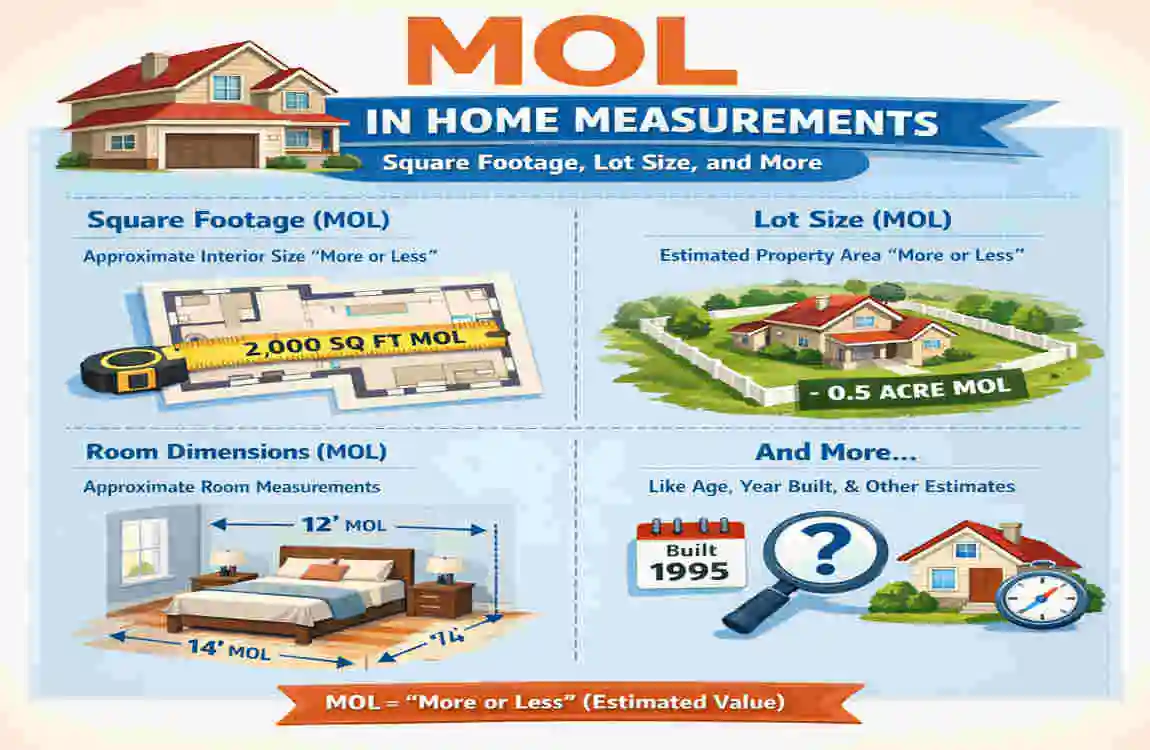
When we ask “What does MOL stand for in real estate home listings,” we are usually talking about three specific areas. Understanding where MOL is applied helps you know where to double-check the math.
Square Footage (Living Area MOL)
This is the most common use. It refers to the Gross Living Area (GLA). This usually includes heated, cooled, and finished above-grade space.
- The Confusion: Does MOL include the garage? The unfinished basement? The sunroom with no heat? Usually, it shouldn’t, but because of the “More or Less” tag, some agents might accidentally include these, inflating the number.
Lot Size (Acres MOL)
Land is tricky. Fences move over time, creeks shift their banks, and neighbors might encroach on boundaries.
- The Usage: You will often see “0.5 Acres MOL.”
- The Reality: Unless a fresh survey has been done, the lot lines are theoretical. That “MOL” protects the seller if the neighbor’s fence is actually three feet over the property line.
Room Dimensions
“Main Bedroom: 14×16 MOL.”
- The Usage: Agents often use laser measures quickly. They might measure wall-to-wall, ignoring that a built-in wardrobe takes up 2 feet of depth. The MOL accounts for this loss of usable floor space.
Measurement Methods: ANSI vs. The “Eyeball” Test
In the US, there is a standard called ANSI (American National Standards Institute) guidelines. This dictates exactly how to measure a home (e.g., measuring from the exterior siding).
However, not all agents strictly follow ANSI for listing descriptions. Many rely on:
- Public Tax Records: Often outdated or based on “drive-by” assessments.
- Builder Plans: Which represent the intent, not necessarily the result.
- Casual Appraisals: Quick measurements.
Regional Variations: In markets like Lahore or Karachi, the measurement standards differ. Homes are often measured in Marlas or Kanals for land, and square feet for covered areas. The definition of “covered area” in Pakistan can be quite liberal, sometimes including balconies, porches, and roof overhangs in the MOL figure. In contrast, US standards would strictly exclude those from the “living area.”
Infographic Idea: The MOL Tolerance Scale
- Homes under 2,000 sq ft: Expect ±5% variance.
- Homes over 4,000 sq ft: Expect ±8% variance (more complex layouts).
- Historic Homes: Expect ±10% or more (irregular shapes).
MOL vs. Other Real Estate Measurement Terms
To really master your home search, you need to understand how MOL compares to the “official” terms used by appraisers and banks. Think of MOL as the nickname, and these other terms as the full legal name.
MOL vs. GLA (Gross Living Area)
GLA is the gold standard for lenders. When you get a mortgage, the appraiser calculates the GLA.
- The Difference: GLA has strict rules (must be above grade, heated, finished). MOL is looser and might include that finished basement that the bank refuses to count.
- The Risk: If you offer based on the MOL size, but the bank appraises based on the smaller GLA, your loan might come up short.
MOL vs. ANSI (American National Standards Institute)
As mentioned, ANSI is a standardized measurement method.
- The Difference: ANSI is a method; MOL is a disclaimer. A measurement can be “ANSI certified,” meaning it is precise. If it says MOL, it explicitly means it is not certified to be precise.
MOL vs. “As Per Architect” / “Per Plans”
You will see this on new construction.
- The Difference: “Per Plans” means the house hasn’t been built or measured yet; the number comes from the drawing. MOL is used for existing homes. “Per Plans” is theoretical; MOL is an estimation of reality.
Comparison Table: When to Trust Which Term
Measurement Type Accuracy Best Used For
MOL Approximate (±10%) Quick listing scanning, getting a “feel” for size.
ANSI Z765 Precise Appraisals, official disputes, price-per-sq-ft calculations.
GLA Standardized Financing, Mortgage approvals.
Tax Record Low/Variable Preliminary research (but often wrong).
Investor Tip: If you are an investor eyeing properties, especially Pakistani properties, and looking at them remotely, never trust the MOL. Always insist on a “GLA” report or a current survey. The distance makes the “More or Less” risk too high to gamble on.
Real-World Examples of MOL in Action

Let’s bring this to life with some stories. These examples illustrate how MOL plays out in the wild.
The US Suburban Split-Level
A family in Ohio fell in love with a split-level home listed at 2,200 sq ft MOL. The layout felt spacious. They made an offer.
- The Surprise: During the inspection, they realized the lower level, which was “finished,” had a ceiling height just below 7 feet.
- The Result: Under strict ANSI rules, that lower level didn’t count as living space. The appraiser listed the home as 1,500 sq ft.
- The MOL Defense: Because the listing said “MOL,” the seller argued they weren’t lying; they just considered the lower level usable space. The buyers had to renegotiate the price significantly downwards.
The Lahore Real Estate Plot
In a posh locality in Lahore, a plot was sold as “1 Kanal MOL.” (1 Kanal is roughly 4,500 sq ft or 20 Marlas).
- The Variance: The buyer planned a massive villa that required exact compliance with setback requirements from the boundary wall.
- The Reality: Due to a road widening project years ago, the plot was actually 18 Marlas. The “MOL” legally covered the seller, but the buyer’s architectural plans had to be scrapped and redesigned to fit the smaller footprint. This shows how MOL impacts not just price, but usage.
The “Celebrity” Listing
Imagine a generic pop star listing their mega-mansion. The listing says 15,000 sq ft MOL.
- Why MOL? In houses that big, do you count the pool house? The 10-car garage? The indoor basketball court?
- The Lesson: Even at the highest price points, precision is difficult. The “MOL” allows the celebrity agent to market the estate’s grandeur without getting sued over the butler’s pantry’s square footage.
How Buyers and Sellers Should Handle MOL Listings
Now that you are an expert on what MOL stands for in real estate homes, let’s talk strategy. How do you use this information to win?
For Buyers: The “Trust but Verify” Approach
If you are a buyer, treat MOL as a red flag that says “Check Me!”
- Bring Your Own Tape: Do not be shy. Bring a laser measure to the showing. Measure the living room and main bedroom. If your numbers are way off from the listing, the whole house is likely smaller than advertised.
- Request Floor Plans: Ask the agent whether a floor plan is available. Visuals are harder to fake than numbers.
- Hire an Appraiser Early: If you are worried about the price-per-square-foot, you can hire an appraiser before you make a full offer (or make the offer contingent on measurements).
- Check Public Records: Compare the MLS listing “MOL” number against the county tax records. If the listing says 2,500 but tax records say 2,000, ask the agent to explain the 500 sq ft difference.
For Sellers: Honesty is the Best Policy
If you are selling, use MOL responsibly.
- Don’t Inflate: Do not use MOL to turn a 1,500 sq ft house into a 2,000 sq ft house. That is fraud, not estimation.
- Disclose the Source: In the listing notes, say “Square footage estimated per tax records.” This builds trust.
- Unique Homes: Use MOL to your advantage if you have a unique property (like a converted barn) where standard measurements don’t do the home justice.
Useful Tools
- Zillow / Redfin: Great for seeing history, but remember their data is often pulled from tax records.
- Graana / Zameen: For our readers interested in Pakistan real estate, these apps are essential for cross-referencing plot sizes and covered areas in cities like Lahore and Islamabad.
- Laser Measure App: Download a measurement app on your phone for quick estimates during a walk-through.
The Ultimate MOL Checklist
- Verify major room dimensions with a tape measure.
- Cross-check listing sq ft with county tax records.
- Ask the agent: “What is the source of this measurement?”
- Factor the potential variance into your offer price (bid 3-5% lower if the size seems doubtful).
MOL in Appraisals, Contracts, and Legal Disputes
This is the serious section. When money changes hands, definitions matter.
The Role of the Appraiser
The appraiser is the neutral third party. They do not care about “MOL.” They care about what they can measure and prove.
- Adjustment: If the listing was 2,500 MOL and the appraiser measures 2,300, they will value the home at 2,300. This often leads to an “Appraisal Gap,” where the bank won’t lend the full amount of the offer price.
Contract Clauses
Most standard real estate contracts have a “Due Diligence” clause. This is your safety net.
- The Language: It usually states that the buyer has X days to verify all information, including square footage.
- The Trap: If you sign a waiver of inspections or due diligence, you are accepting the house “As Is,” including that “More or Less” measurement. Never waive verification if the size is critical to you.
Legal Disputes
Can you sue over MOL? It is rare, but it happens.
- Win: Buyers usually win if the discrepancy is egregious (e.g., the listing said 3,000 sq ft, but the reality was 2,000 sq ft). That goes beyond “More or Less” and into “Misrepresentation.”
- Loss: Buyers usually lose if the difference is minor (e.g., <5%). Courts view small variances as expected in the term “MOL.”
Pakistan-Specific Context: In markets like Lahore, property disputes often center on land demarcation. Ensuring the “MOL” in your sale deed matches the physical boundary wall (“Kabza”) is critical. Always have a “Patwari” (land record official) or surveyor confirm boundaries before exchanging cash.
FAQs: Common Questions About MOL in Real Estate Homes
What does MOL stand for in real estate home? It stands for “More or Less.” It indicates that the measurements provided (square footage, lot size, dimensions) are approximate and not guaranteed to be 100% accurate.
Is MOL square footage reliable? It is reliable as a ballpark figure, but not for precise valuation. You should expect a variance of 5-10% in either direction. Always verify critical numbers yourself.
How much variance does MOL allow? There is no hard legal percentage, but generally, a discrepancy of up to 5% is considered acceptable “slop.” Anything over 10% could be considered misrepresentation depending on local laws.
Does MOL apply to lot size or home size? It applies to both! You will see it listed next to the Lot Size (acreage) and the Square Footage (living space). It can even apply to road frontage listings.
What is an alternative to MOL listings? If you want exact numbers, look for listings that provide a recent survey or a floor plan created by a licensed appraiser. These are far more accurate than standard MLS data.
