

Packing supplies are one of the first expenses people underestimate when they move. A few dozen boxes can turn into a surprising bill, and good sources of free boxes can be hard to find at short notice.
Free Places to Get Moving Boxes
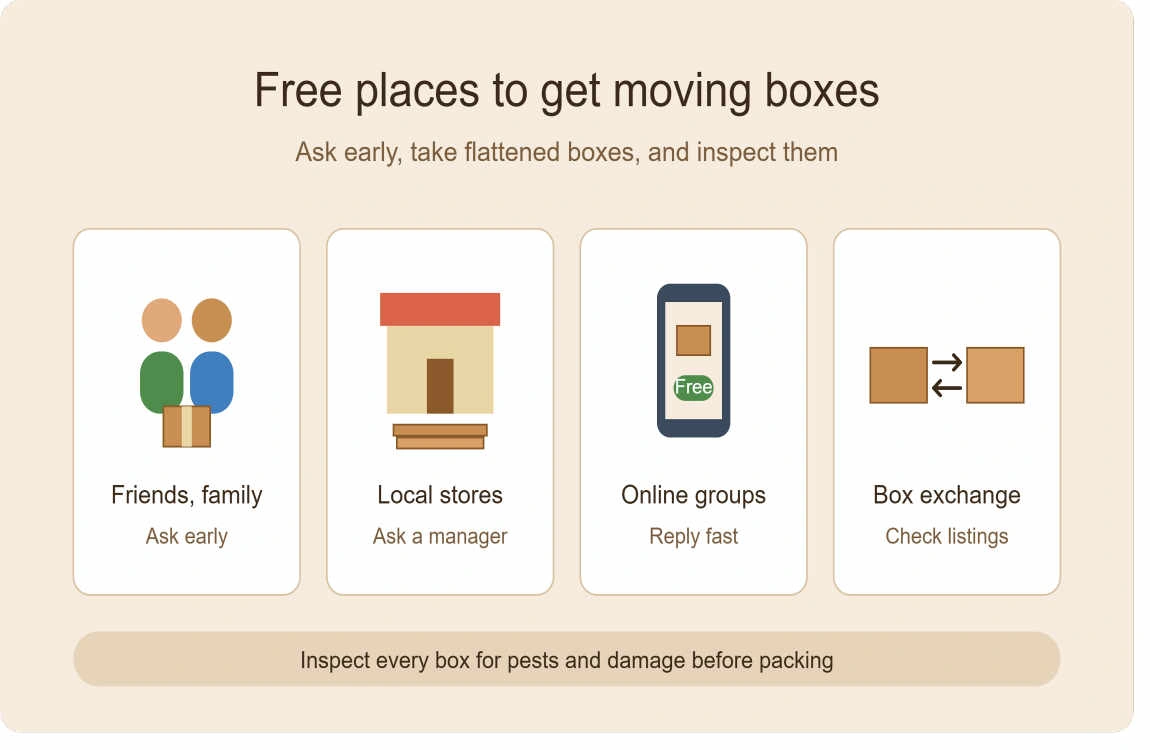
Friends, Family, and Coworkers
Start with people you already know. Someone who moved recently often has leftover boxes in a garage or closet. Ask early, since people can set aside boxes as they unpack.
Your workplace may also help. Offices receive deliveries all the time, and many are happy to hand over clean boxes. Ask facilities or the mailroom first, because some companies restrict taking items.
Grocery Stores, Bookstores, and Retail Shops
Businesses receive constant shipments and usually just recycle the cardboard. 1-800-GOT-JUNK notes that you can often find free moving boxes at local grocery stores and bookstores, and its tip points to the back of retail pharmacies and office supply stores.
How to ask:
- Visit during the week, not on a weekend.
- Ask a manager when the next delivery arrives and offer to come back.
- Request flattened boxes, which are easier to carry.
- Take only what you’ve been offered. Don’t pull boxes from dumpsters or recycling areas without permission.
Online Neighborhood Groups
Community platforms are useful if you have time to wait for a good listing. Online community groups such as Nextdoor and Facebook Marketplace are common places to find free boxes. Search “free moving boxes” or post a “wanted” request, and respond fast, because good listings go quickly.
Meet in a public place or a well-lit driveway, and don’t go inside a stranger’s home just to pick up boxes.
U-Haul Customer Connect and Box Exchange
U-Haul runs a box-sharing program that is useful for specialty boxes. U-Haul describes Customer Connect as a way for customers to share or exchange boxes, moving supplies, or rides, with a Box Exchange for finding or giving away boxes. U-Haul’s own customer-stories site says some locations also let you pick up free boxes left by other customers or leave used ones for reuse. Availability varies by location, so check the Box Exchange listings or call your nearest center first.
A Warning About Free USPS Boxes
You may see advice to order free boxes from the Postal Service. This rarely works for moving. USPS says its Priority Mail and Priority Mail Express packaging can only be used for the mail class printed on the box. These boxes are also small and thin, so they are not designed for a household move. Skip them unless you’re actually shipping something Priority Mail.
Low-Cost Places to Buy Moving Boxes
Sometimes buying is the better call. New boxes are uniform, so they stack well, and they’re less likely to carry pests or hidden damage.
Home Improvement Stores
1-800-GOT-JUNK says home improvement stores such as Home Depot and Lowe’s are among the cheapest places to buy new moving boxes. Many stores sell single boxes, bundles, and specialty kits, so you can buy what you need rather than a full kit. Compare per-box prices, since kits aren’t always cheaper.
Moving Companies and Truck Rental Centers
If you’re hiring movers or renting a truck, ask about packing supplies. Some companies sell boxes individually and others offer kits. Many will also buy back unused boxes, but policies vary, so ask before you buy. U-Haul advertises a buyback guarantee on its boxes, which can lower your real cost if you return what you don’t use.
Rental Plastic Bins
If you’re moving locally, rental bins are worth a look. The Hartford lists renting plastic moving boxes as a newer, greener alternative to cardboard. They stack neatly, don’t need tape, and are a good choice for kitchens and pantries. Compare rental fees, delivery fees, and late charges before booking.
Free vs. New Boxes: Pros and Cons
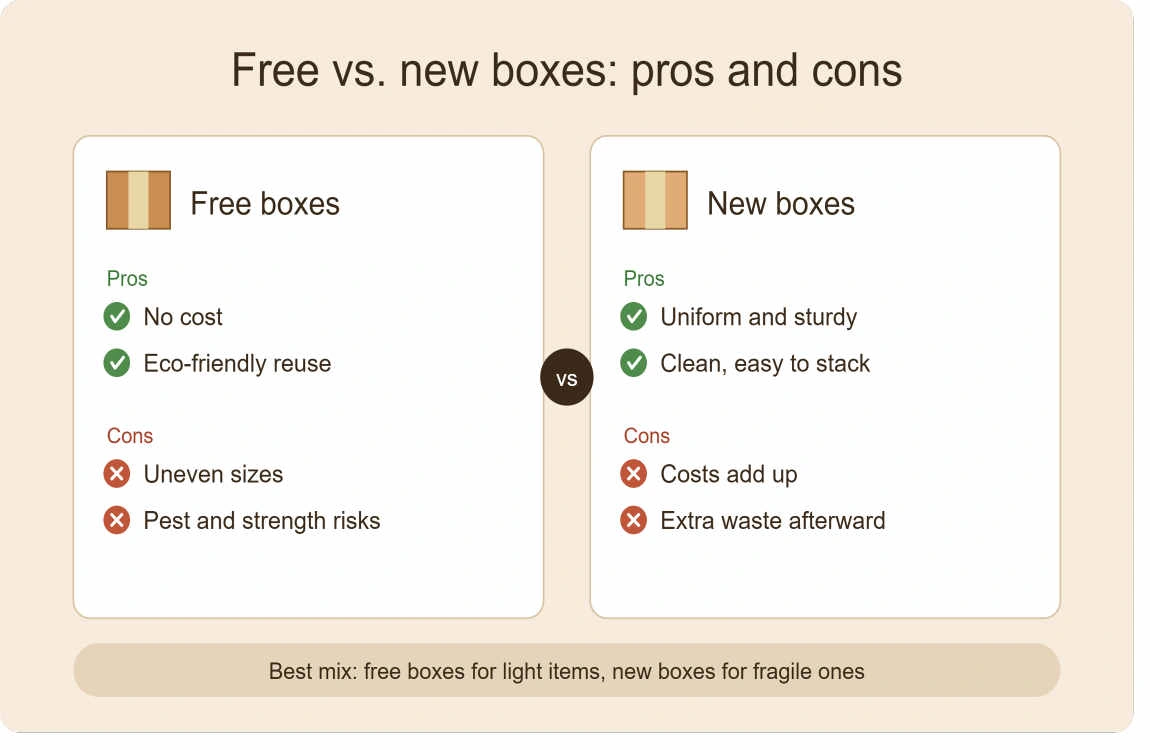
| Option | Pros | Cons |
|---|---|---|
| Free used boxes | No cost, eco-friendly, easy to find in bulk | Uneven sizes, variable strength, possible pests or odors |
| New cardboard boxes | Uniform, sturdy, clean | Costs add up quickly |
| Specialty boxes (wardrobe, TV, dish) | Protect items that need it | Higher price per box |
| Rental plastic bins | Reusable, stackable, tape-free | Rental fees, may need delivery and return |
How Much Do Moving Boxes Cost?
Prices vary by seller and size. NerdWallet reports that standard moving boxes typically cost about $1 to $3.75 each, while specialty boxes such as wardrobe or TV boxes usually run $10 to $25 each. These are general ranges, so check current prices at the retailer you plan to use.
A practical way to budget:
- Make a room-by-room list of what you’re packing.
- Decide which items need new or specialty boxes (TVs, mirrors, dishes, wardrobe items).
- Fill the rest with free boxes you’ve inspected.
- Add tape, paper, markers, and labels to your estimate.
How to Inspect Free Boxes Before You Pack
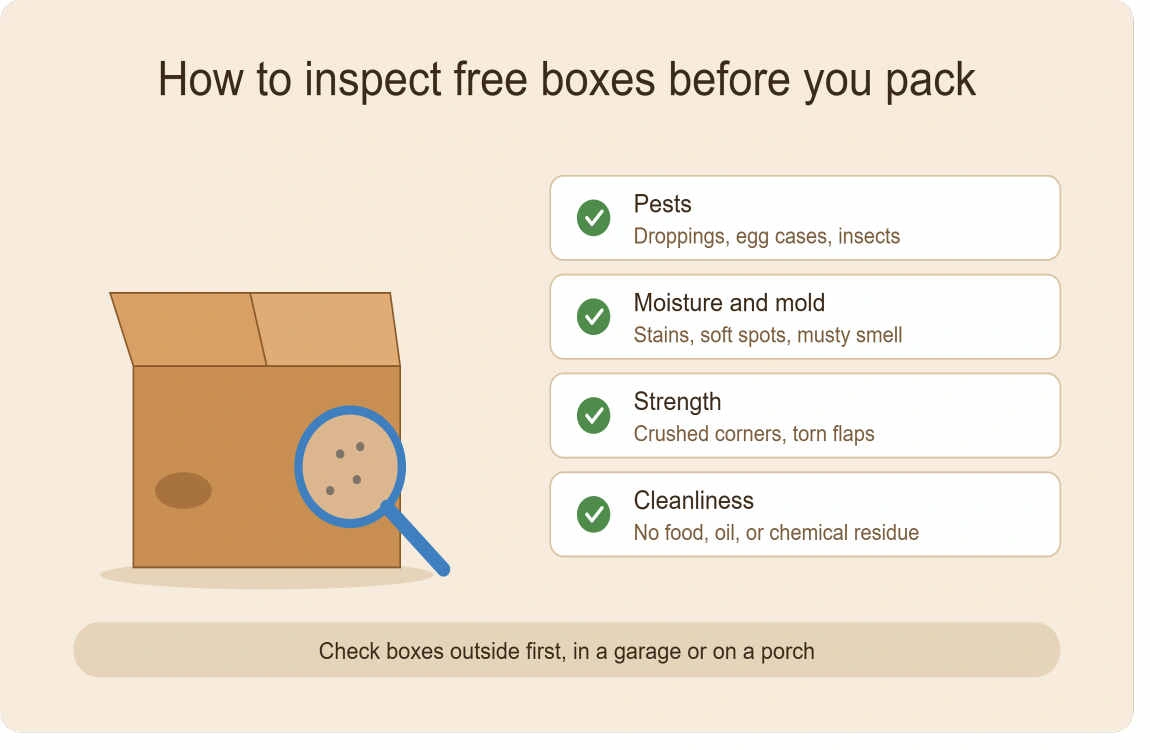
Free boxes save money but carry risks, so inspect them before they enter your home.
Check for Pests
Cornell’s Integrated Pest Management program points out that the ridged openings in corrugated cardboard give German cockroaches plenty of room to hide, especially if boxes smell like food. Bekins also advises checking used boxes for pest infestations and storing them in a clean space.
What to look for:
- Droppings that look like small dark specks
- Small brown egg cases or shed skins
- Live insects, especially when you open flaps or look inside creases
- Musty or food odors
- Chewed edges, which can suggest rodents
If a box shows any of these signs, don’t bring it inside. Boxes from grocery stores and warehouses deserve extra caution, and it’s usually best to unpack in a garage or on a porch first.
Check Strength and Cleanliness
- Avoid boxes that are soft, water-stained, or moldy.
- Skip boxes with crushed corners or torn flaps.
- Don’t reuse boxes that held chemicals, food spills, or anything oily.
- Check that the bottom can be taped securely.
Use the Right Box for the Right Item
| Item | Best box choice |
|---|---|
| Books and heavy items | Small sturdy boxes, filled partway |
| Dishes and glassware | New, double-walled or dish-specific boxes |
| Clothing | Wardrobe boxes or clean medium boxes |
| Electronics | Original packaging, or a new box with plenty of padding |
| Pantry items | Rental bins or new boxes |
| Mattresses | Mattress bags, not standard boxes |
Free boxes work well for linens, towels, toys, and decor. Save new boxes for items where a failure would be expensive.
How Many Boxes Do You Need?
Rather than guess, count by room:
- Walk through each room and note the main categories (kitchen, books, clothes, decor).
- Estimate how many boxes each category needs, then add about 10 percent as a buffer.
- Buy or collect that total, plus a few extras of the home sizes that fill up fastest.
Books and dishes consume more boxes than most people expect, while linens take fewer. If you want benchmark numbers, NerdWallet’s moving box guide includes a table of approximate box counts by home size, which is useful as a cross-check.
Packing Safety Tips
- Keep boxes liftable. A box you can’t lift comfortably is a back injury waiting to happen. Pack heavy items in small boxes and light items in large boxes.
- Tape the bottom well. Use packing tape, not masking tape, and reinforce the seams.
- Don’t overfill or underfill. Gaps cause shifting and bulging tops make stacking unstable.
- Label every box. Write the room and a short contents note on the top and at least one side.
- Mark fragile boxes clearly, and don’t stack heavy boxes on them.
- Keep walkways clear to avoid trips and falls on moving day.
- Don’t pack hazardous items such as propane, gasoline, or certain cleaning chemicals. Ask your mover or rental company what they refuse to transport.
After the Move: Reuse and Recycle
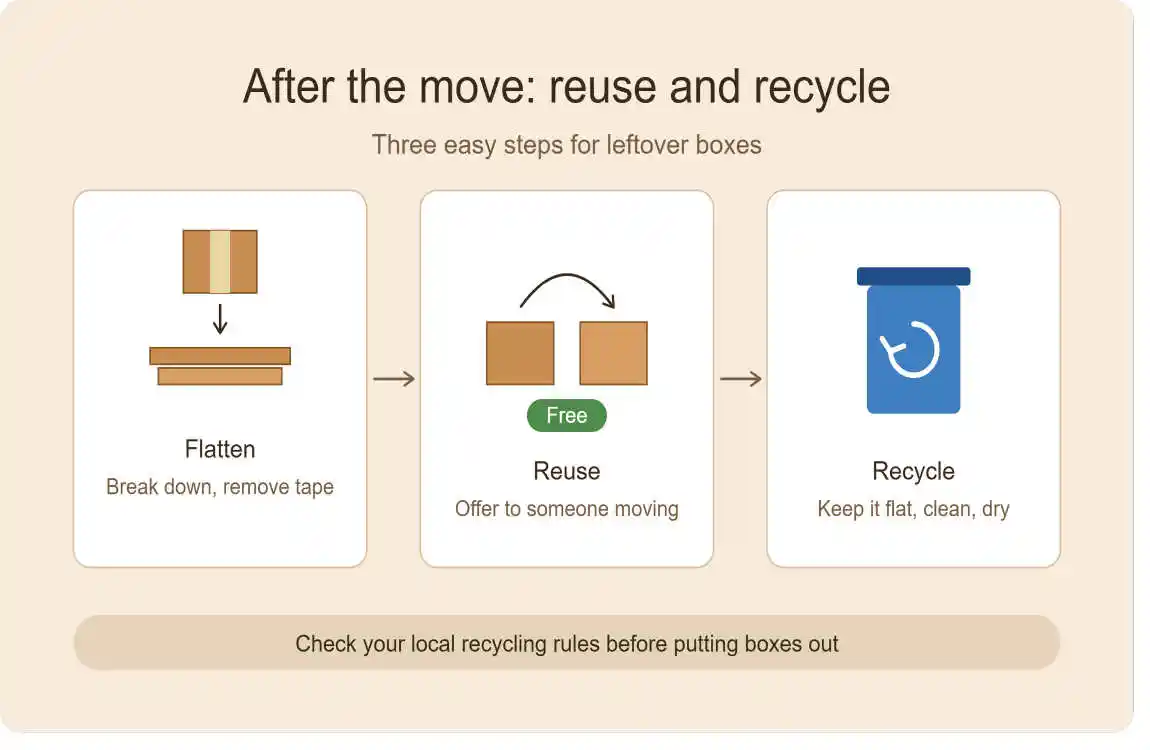
Don’t throw the boxes out right away. Offer them to a neighbor who is moving, or list them for free. If you’re done with them, recycling is easy. According to the EPA, corrugated boxes had a recycling rate of 96.5 percent in 2018, and flattening them makes pickup simpler. Check local rules, since some programs reject wet or greasy cardboard.
Frequently Asked Questions
Where can I get free boxes for moving house near me?
Start with friends, coworkers, and neighbors, then ask grocery stores, bookstores, and retailers about flattened boxes. Check local online groups and U-Haul’s Customer Connect listings.
Are free moving boxes safe to use?
They can be, if you inspect them. Look for pests, moisture, mold, and weak spots. For fragile or valuable items, new boxes are safer.
Can I use USPS Priority Mail boxes for moving?
USPS says its Priority Mail packaging can only be used for the mail class printed on it, and the boxes are small anyway. They aren’t a practical option for a household move.
What’s the cheapest way to get moving boxes?
Free boxes from people you know are the cheapest. After that, compare per-box prices at home improvement stores, and ask your mover or truck rental company about buyback policies.
Should I buy specialty boxes?
Only where needed. TVs, mirrors, wardrobe items, and dishes benefit from the right box. Everything else can often go in standard or free boxes.
When should I start collecting boxes?
Start two to four weeks before moving day if you’re relying on free sources, since collecting takes time. If you’re buying new, order a week or two ahead.
What should I do with leftover boxes?
Give them away, list them in a local group, or recycle them flat.
Conclusion
The best answer to “where can I get boxes for moving house?” is usually a mix. Collect free boxes from people you know and local businesses, check each one for pests and strength, and buy new boxes for the items that matter most. If you want less waste, rental bins are worth comparing.
Start early, pack smart, and check pricing before you buy, since box prices vary by seller and size.
References
- <a href=”https://www.uhaul.com/Exchange” rel=”nofollow”>U-Haul Customer Connect</a>
- <a href=”https://myuhaulstory.com/?p=3857″ rel=”nofollow”>U-Haul: box sharing and buyback information</a>
- <a href=”https://www.nerdwallet.com/home-ownership/moving/learn/moving-boxes-cheap-free” rel=”nofollow”>NerdWallet: 17 Places to Get Free or Cheap Moving Boxes</a>
- <a href=”https://1800gotjunk.com/index%2ephp/us_en/blog/moving/where-to-get-moving-boxes” rel=”nofollow”>1-800-GOT-JUNK?: Where to Get Moving Boxes</a>
- <a href=”https://www.thehartford.com/insights-center/home/free-moving-boxes” rel=”nofollow”>The Hartford: Where Can I Find Free Moving Boxes?</a>
- <a href=”https://faq.usps.com/s/article/Ordering-Free-Shipping-Supplies” rel=”nofollow”>USPS FAQ: Ordering Free Shipping Supplies</a>
- <a href=”https://blogs.cornell.edu/schoolchildcareipm/?p=1197″ rel=”nofollow”>Cornell IPM blog: cardboard and cockroaches</a>
- <a href=”https://www.epa.gov/facts-and-figures-about-materials-waste-and-recycling/paper-and-paperboard-material-specific-data” rel=”nofollow”>EPA: Paper and Paperboard Material-Specific Data</a>
(The Bekins moving blog was also used for the inspection advice: <a href=”https://www.bekins.com/?p=11664″ rel=”nofollow”>Bekins Blog</a>.)
Image Suggestions (Exactly 3)
Image 1
- Placement: Directly below the intro, above “Quick Answer.”
- AI prompt: “Bright, realistic photo of a stack of flattened cardboard boxes, packing tape, a marker, and a notepad on a hardwood floor in a sunlit living room, with a few packed boxes in the background, natural light, no text or logos.”
- Alt text: “Flattened cardboard boxes, packing tape, and a marker ready for packing in a bright living room”
- Rights: Generate it yourself, or use a licensed stock image or your own photo.
Image 2
- Placement: In the “Retail Stores” section.
- Search query: “person carrying flattened cardboard boxes from store” (royalty-free sites such as Unsplash, Pexels, or Pixabay), or AI prompt: “A person in a casual jacket carrying a stack of flattened cardboard boxes out of a small shop on a sunny street, no brand names visible.”
- Alt text: “Person carrying flattened cardboard boxes out of a local store”
- Rights: Check each image’s license and avoid visible brand logos.
Image 3
- Placement: In “How to Inspect Free Boxes Before You Pack.”
- AI prompt: “Close-up of hands inspecting the inside corners of a used cardboard box under a flashlight on a garage workbench, checking for stains and damage, realistic photo style, no insects.”
- Alt text: “Hands inspecting the inside of a used cardboard box with a flashlight before packing”
- Rights: AI-generated, licensed, or your own original photo.
Always use original, licensed, or properly permitted images. Don’t copy images from other sites.
Internal Link Suggestions
I couldn’t browse HomeComfortExperts.co.uk, so I can’t verify any existing pages and I haven’t invented URLs. Once you confirm real pages, consider linking to topics like a packing checklist, decluttering before a move, or moving-day safety. Every internal link should use rel="nofollow", for example:
<a href="[CONFIRMED-URL]" rel="nofollow">anchor text</a>
Limitations and Disclosure
- I researched using live search, but I mostly saw search excerpts rather than every full page. Please open each reference and confirm the claim before publishing.
- The USPS FAQ result was marked as older in search. Re-check the current USPS rules.
- NerdWallet’s price ranges and U-Haul’s program details can change. Recheck both close to publishing.
- Some sources are businesses (moving companies, junk removal), so their advice may have commercial interests. I used them for general practices, not for rankings or guarantees.
- I did not use Forbes Home or Wikipedia because I found no verified page that supported a specific claim here.
- I can’t promise any ranking position.
Final Checklist
Factual accuracy
- [ ] Re-confirm box price ranges on the NerdWallet page
- [ ] Re-confirm U-Haul Box Exchange and Customer Connect availability by location
- [ ] Re-confirm USPS Priority Mail packaging rule
- [ ] Re-confirm the EPA 96.5% corrugated figure (2018 data) and check for a newer year
Source verification
- [ ] Open all 8-9 reference links and confirm they load and match the claims
- [ ] Add
rel="nofollow"to every link, including references
Originality
- [ ] Run a plagiarism check
- [ ] Add your own team’s experience or photos where possible
Copyright
- [ ] No quotes copied from sources, only paraphrased claims
- [ ] Images are original, licensed, or AI-generated
Internal links
- [ ] Replace placeholder with confirmed URLs only, all nofollow
Image placement
- [ ] Exactly 3 images at the stated positions, with alt text
SEO quality
- [ ] Title under about 60 characters, meta description under about 155
- [ ] Primary keyword in title, H1, intro, and conclusion area, with no stuffing
- [ ] Add FAQ schema markup if your CMS supports it
- [ ] Word count: the article body is roughly 1,900 words
I can convert this to clean HTML with nofollow on every link, or produce a US-phrased variant targeting “where to get moving boxes.”
