

Ever wondered what material is laminate flooring that manages to mimic the rich, warm texture of authentic hardwood at a mere fraction of the cost? You aren’t alone. As we move through 2026, homeowners are increasingly turning away from high-maintenance traditional materials and embracing smart, engineered solutions that offer the best of both worlds. If you are renovating your kitchen, upgrading a rental property, or simply looking to refresh your living space, understanding the composition of your flooring is the first step toward making a wise investment.
Laminate flooring has surged in popularity within real estate trends this year, not just because it is budget-friendly, but because it is surprisingly robust. It is a chameleon of the interior design world, capable of looking like rustic oak, sleek slate, or polished marble. But what exactly lies beneath that photorealistic surface? Is it plastic? Is it wood? The answer is a fascinating blend of both.
Laminate Flooring Basics
To truly understand what laminate flooring is, we first need to clear up some common confusion. Many people mistakenly lump laminate in with “plastic flooring” or confuse it with vinyl. While they share some similarities in terms of convenience, laminate is a distinct, multi-layered synthetic product. It is not solid wood, but engineered to capture the aesthetic of wood while eliminating many of its natural weaknesses, such as susceptibility to dents and moisture fluctuations.
Laminate flooring traces its origins back to the 1970s in Europe, where it was developed as an affordable and durable alternative to real timber. Over the decades, it has exploded into a massive global market worth over $10 billion. Why? Because it democratized style. Suddenly, the look of exotic mahogany or antique pine was accessible to the average homeowner without the hefty price tag or the environmental guilt.
Despite its synthetic nature, the primary ingredient in laminate is actually wood—specifically, wood byproducts. It is an ingenious use of resources, turning wood fibers that might otherwise be discarded into a high-performance building material.
Here are a few key points to remember about what defines this material:
- Affordable Alternative: It offers the visual appeal of hardwood without the investment.
- High-Traffic Warrior: Engineered to withstand the chaos of busy households.
- Technological Marvel: It uses advanced printing and resin technology to achieve its look and feel.
- Water-Resistant Options: Modern laminates have evolved to resist spills better than ever before.
Core Layers Explained
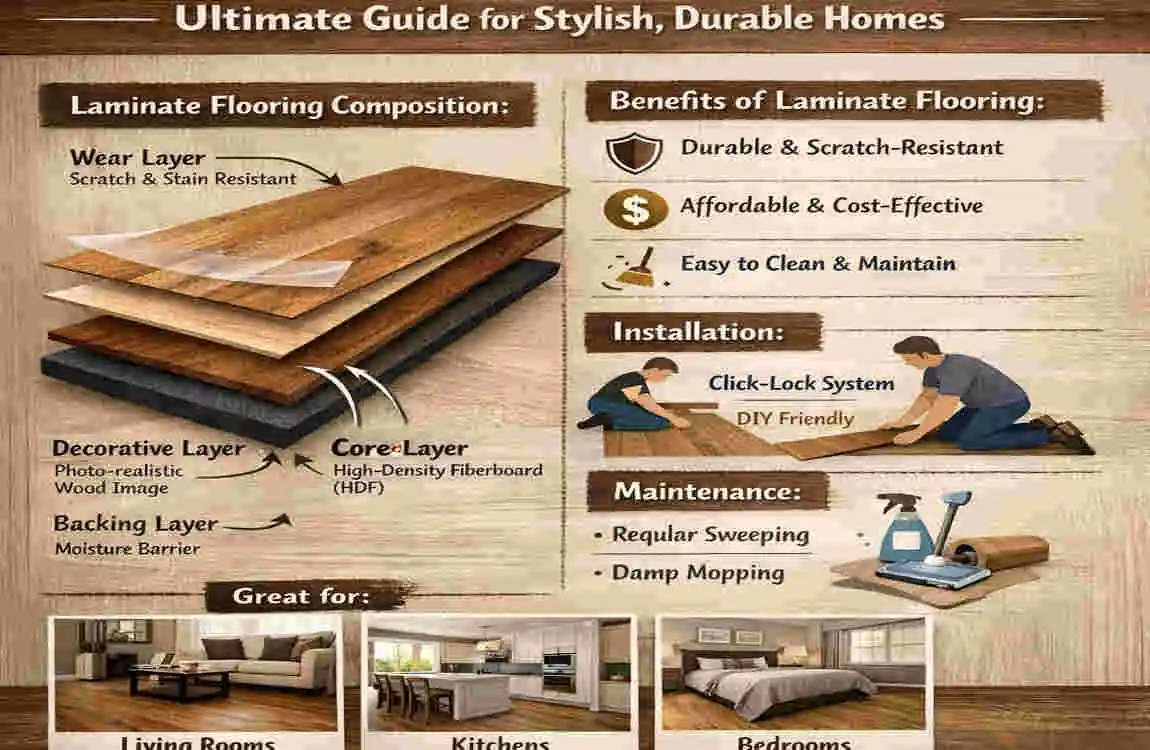
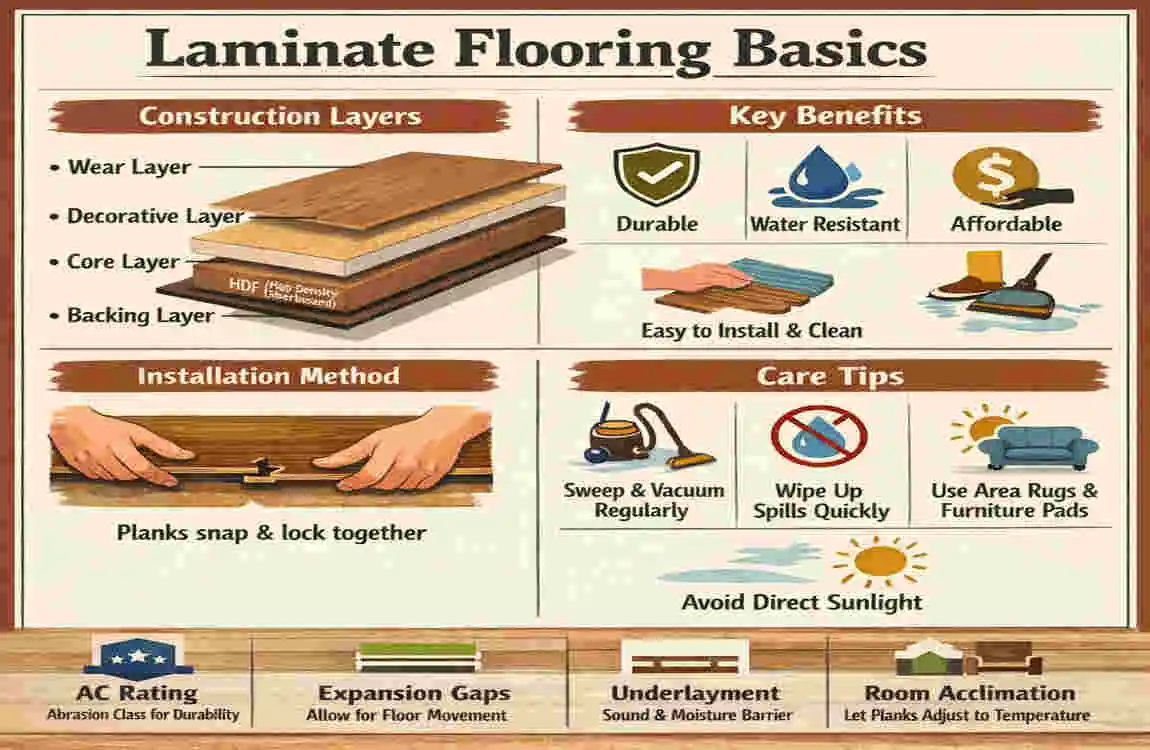
When you hold a plank of laminate flooring in your hand, you are holding a sandwich of four distinct, high-tech layers fused. Understanding what laminate flooring is composed of requires a deep dive into each of these strata. Each layer plays a critical role in the floor’s longevity, appearance, and stability.
Wear Layer
The top surface, known as the wear layer, is your floor’s bodyguard. This is the first line of defense against the daily assault of foot traffic, pet claws, dropped toys, and shifting furniture. But what is it made of?
This invisible shield is typically composed of a melamine resin topcoat reinforced with aluminum oxide. This combination creates an incredibly hard, transparent surface that is tough as nails. Aluminum oxide is the secret ingredient here; it is one of the hardest substances on Earth, second only to diamonds. This is why you can walk on laminate in high heels or drag a plastic chair across it without leaving an immediate mark.
The thickness of this wear layer, measured in mils, directly correlates to the flooring’s durability. For a standard residential home, a wear layer between 6 and 10 mils might suffice. However, for bustling homes with kids and dogs, or for light commercial spaces, you will want to look for higher ratings (often indicated by an AC rating, like AC3 or AC4), which imply a thicker, more robust melamine cap. This layer also typically includes UV inhibitors to prevent your beautiful floor from fading under the harsh glare of direct sunlight.
Design Layer
Directly beneath the protective wear layer sits the design layer. This is the “makeup” of the flooring—the part that gives it its personality.
The material here is surprisingly simple: high-quality, high-resolution photographic paper. Think of it like a photograph you might print, but with significantly higher fidelity. Manufacturers use advanced rotogravure printing technologies to stamp ultra-realistic images onto this paper.
Whether you want the look of hand-scraped hickory, weathered barn wood, or cool Travertine stone, this layer delivers it. The paper is impregnated with melamine resin during manufacturing. When heat and pressure are applied, the resin fuses the paper to the core and the wear layer, making it an integral part of the plank rather than just a sticker sitting on top. This fusion also allows for texturing techniques, such as “Embossed in Register” (EIR), where the surface texture perfectly matches the wood grain knots and swirls in the photograph, creating a tactile realism that can fool even the sharpest experts.
Core Layer: What Material Is Laminate Flooring’s Heart Made Of?
Now we reach the most critical component: the core. If you ask what material is laminate flooring mostly made of, the answer is High-Density Fiberboard (HDF).
The core layer typically accounts for about 80% of the plank’s total thickness and provides its structural integrity. HDF is an engineered wood product made by breaking down hardwood or softwood residuals into wood fibers. These fibers are then combined with wax and a resin binder and formed into panels by applying high temperature and pressure.
It is crucial to distinguish HDF from its softer cousins, Medium-Density Fiberboard (MDF) and regular particleboard.
- Density Matters: HDF has a density of roughly 800-1000 kg/m³. This high density is what makes laminate flooring resistant to impact. If you drop a can of soup on real wood, it dents. If you drop it on HDF-core laminate, the energy is absorbed better, often leaving no mark.
- Stability: The compressed nature of HDF means it doesn’t expand and contract as drastically as solid wood does when humidity levels change. This makes it a safer bet for basements or regions with variable climates.
- The Locking Mechanism: The intricate click-lock tongues and grooves are cut directly into this HDF core. A strong, dense core ensures these clicking systems don’t break off during installation or separate over time.
Core Layer Snapshot:
Layer PropertyHDF Core DetailsBenefits
Material: Recycled wood fibers + resin binder. Eco-friendly use of byproducts; highly stable structure.
Density 800-1000 kg/m³ Impact-resistant; feels solid underfoot; reduces hollow sounds.
Thickness: Typically 6-12mm. Secure Locking: Thicker planks bridge subfloor imperfections better.
Backing Layer
The final component is the backing layer, also known as the balancing layer. You might not see it once the floor is down, but you would certainly notice if it were missing.
This bottom layer is usually made of paper reinforced with melamine resin, similar to the wear layer but without the abrasive aluminum oxide. Its primary function is balance.
When the manufacturing process applies heat and resin to the top layers, it creates tension that could cause the plank to bow or cup upwards (think of a potato chip). The backing layer provides a counter-tension on the bottom, keeping the plank perfectly flat and stable. Additionally, this melamine-infused backing acts as a moisture barrier, protecting the vulnerable HDF core from humidity rising from the subfloor, such as from a concrete slab.
Manufacturing Process
So, how do we get from a pile of wood chips and resin to the sleek planks in your hallway? The manufacturing process is a marvel of industrial efficiency, primarily utilizing a method called Direct Pressure Laminate (DPL).
Here is a step-by-step look at how it comes together:
- Core Preparation: The process begins with creating the HDF core. Wood fibers are mixed with glue and pressed into large, dense sheets. These sheets are cooled and sanded to a precise thickness.
- Layer Assembly: The four layers are stacked like a sandwich. The backing layer goes on the bottom, followed by the HDF core, the design paper, and finally the resin-saturated wear layer on top.
- The Press: This stack is moved into a massive hydraulic press. Under intense heat (around 400°F) and pressure (over 300 psi), the resins in the layers liquefy and permeate the adjacent materials.
- Fusion: As the press cools, the layers fuse into a single, monolithic sheet. The melamine resin cures, hardening into the durable surface we recognize.
- Finishing: The large sheets are cut into individual planks. This is also when the tongue-and-groove profiles are cut into the edges using extremely precise milling machinery. These “click-lock” edges are what make laminate so famous for DIY installation.
Some Premium laminates use High Pressure Laminate (HPL) technology, where the top decorative and wear layers are pressed and hardened separately before being glued to the core. This creates an even tougher surface, though DPL is the standard for most residential needs.
Benefits for Stylish Homes
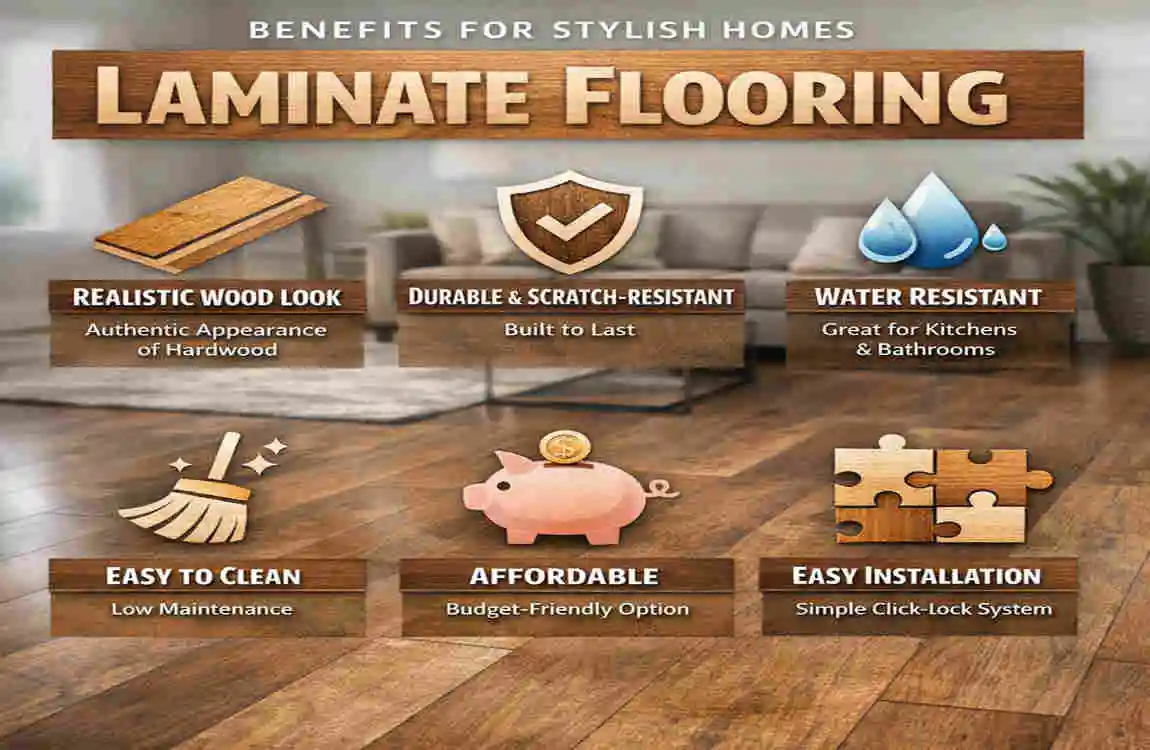
Choosing the right flooring is a balancing act between aesthetics, performance, and budget. When you analyze what material laminate flooring offers, the value proposition becomes clear.
Unbeatable Cost Efficiency. The most obvious benefit is the price. Hardwood flooring can easily run between $8 and $15 per square foot, excluding installation labor. Laminate, by contrast, typically costs between $1 and $5 per square foot. Because it utilizes a photo layer rather than expensive raw timber, you can have the look of rare, endangered exotic woods for the price of a standard domestic species.
Durability for Real Life Laminate is built for the “oops” moments.
- Scratch Resistance: Thanks to that aluminum oxide wear layer, the laminate is far more resistant to dog claws and scooting chairs than solid hardwood.
- Fade Resistance: If you have a room with floor-to-ceiling windows, hardwood will eventually bleach out or darken. Laminate’s UV-protected wear layer keeps the color vibrant for decades.
Aesthetic Versatility Because the design layer is a print, the possibilities are infinite. Modern digital printing has eliminated the “pixellated” look of early laminates. You can now find planks with varied grain patterns, “hand-scraped” textures, and even options that mimic ceramic tile or stone.
Pros & Cons at a Glance:
ProsCons
Scratch-Resistant: The melamine wear layer is incredibly tough against everyday wear and tear. Moisture Sensitivity: While water-resistant, it is not waterproof. Standing water can swell the HDF core.
Easy Maintenance: No waxing or oiling required; sweep and damp mop. Repair Limits: Unlike wood, you cannot sand and refinish it. Damaged planks must be replaced.
Pet/Kid-Friendly: Resists stains and impacts better than most surfaces. Sound: Can sound “hollow” or clicky without a proper sound-absorbing underlayment.
Comparisons
To really grasp the value of laminate, it helps to compare it directly against its main competitors: Hardwood and Vinyl. This comparison often centers on the keyword “laminate vs hardwood materials.”
Laminate vs. Hardwood: The primary difference is the material composition. Hardwood is a natural, organic material through and through. Laminate is a composite. Hardwood adds real estate value and can be refinished, but it is temperamental. It shrinks in winter and swells in summer. Laminate is the “set it and forget it” alternative. It mimics the look but removes the maintenance headache.
Laminate vs. Vinyl (LVP) This is the battle of the synthetics. Vinyl flooring is made primarily of PVC (plastic). The main advantage of vinyl is that it is 100% waterproof. You can flood a vinyl floor, and it will be fine. However, vinyl is softer. It can be gouged more easily by sharp objects than the hard surface of laminate. Laminate also tends to look more like real wood because the rigid HDF core allows for deeper, more realistic embossing than the softer vinyl core.
Comparison Table:
Feature: Laminate Flooring, Hardwood, Vinyl (LVP)
Main Material HDF Core + Melamine Resin Solid Timber PVC (Plastic)
Cost / sq ft $1 – $5 (Budget-Friendly) $8 – $15+ (Premium) $2 – $7 (Mid-Range)
Durability Excellent scratch/dent resistance; high-traffic warrior. Prone to dents/scratches; lasts lifetimes if maintained. Waterproof; prone to tearing and gouging.
Installation Floating / Click-Lock (DIY Dream) Nail / Glue / Staple (Pro required) Click / Glue (DIY Friendly)
Installation Tips
One of the reasons laminate flooring has taken over the DIY market is its ease of installation. You do not need to be a master carpenter to lay down a beautiful floor.
Acclimation is Key. Before you start, the HDF core needs to adjust to your home’s humidity. Leave the boxes of planks in the room where they will be installed for at least 48 hours. This prevents the planks from expanding or shrinking after you lock them in place.
The Magic of Underlayment. Since laminate is a “floating floor” (it isn’t glued to the subfloor), it needs a cushion. A good foam or cork underlayment is essential. It smooths out minor subfloor imperfections, provides moisture protection, and most importantly, dampens sound to make the floor sound more like solid wood when you walk on it.
Click-and-Go Modern laminates use a click-lock system. You angle one plank into the other and snap it down—no glue, no nails, no mess. Just be sure to leave a small expansion gap (usually about 1/4 inch) around the perimeter of the room to allow the floor to “breathe” with seasonal changes.
Pro Tip for Humid Climates: If you live in an area with high humidity (like Lahore or Florida), ensure your moisture barrier is perfectly sealed. Excessive moisture rising from a concrete slab is the kryptonite of the HDF core.
Maintenance Guide
Maintaining laminate is refreshingly simple, which is a major selling point for busy families.
Daily Care: The best way to keep your laminate looking new is to keep it free of grit. Dust, dirt, and sand can act like sandpaper over time, slowly dulling the wear layer. A daily sweep or a quick run with a vacuum (hard floor setting, no beater bar) is all you need.
Cleaning Spills When it comes to washing, remember: Water is the enemy. Never use a wet mop that leaves standing water on the floor. Instead, use a damp microfiber mop. If you spill a drink, wipe it up immediately.
Chemicals to Avoid: Skip the harsh chemicals, bleach, or wax-based cleaners. These can damage the melamine resin or leave a cloudy film that is hard to remove. A simple solution of water and a drop of mild dish soap, or a dedicated laminate floor cleaner, is perfect.
FAQ Section
What material is laminate flooring exactly? Laminate flooring is a synthetic product made of four fused layers: a moisture-resistant backing, a rigid High-Density Fiberboard (HDF) core, a photographic design layer mimicking wood or stone, and a clear, protective melamine resin wear layer.
Is laminate flooring real wood? No, it is not solid wood. It is an engineered product that uses wood byproducts (fibers) in its core. However, the surface you see is a high-resolution photograph designed to look exactly like real wood.
What is the best laminate material for busy homes? Look for laminate with a high-density HDF core and a thick wear layer (AC4 rating or higher). The core’s density prevents dents from dropped objects, while the thick wear layer resists scratches from high foot traffic.
Is laminate flooring eco-friendly? Generally, yes. The HDF core is often made from recycled wood fibers and byproducts from other timber processes, saving trees. Additionally, many modern laminates are recyclable and emit low levels of VOCs.
