
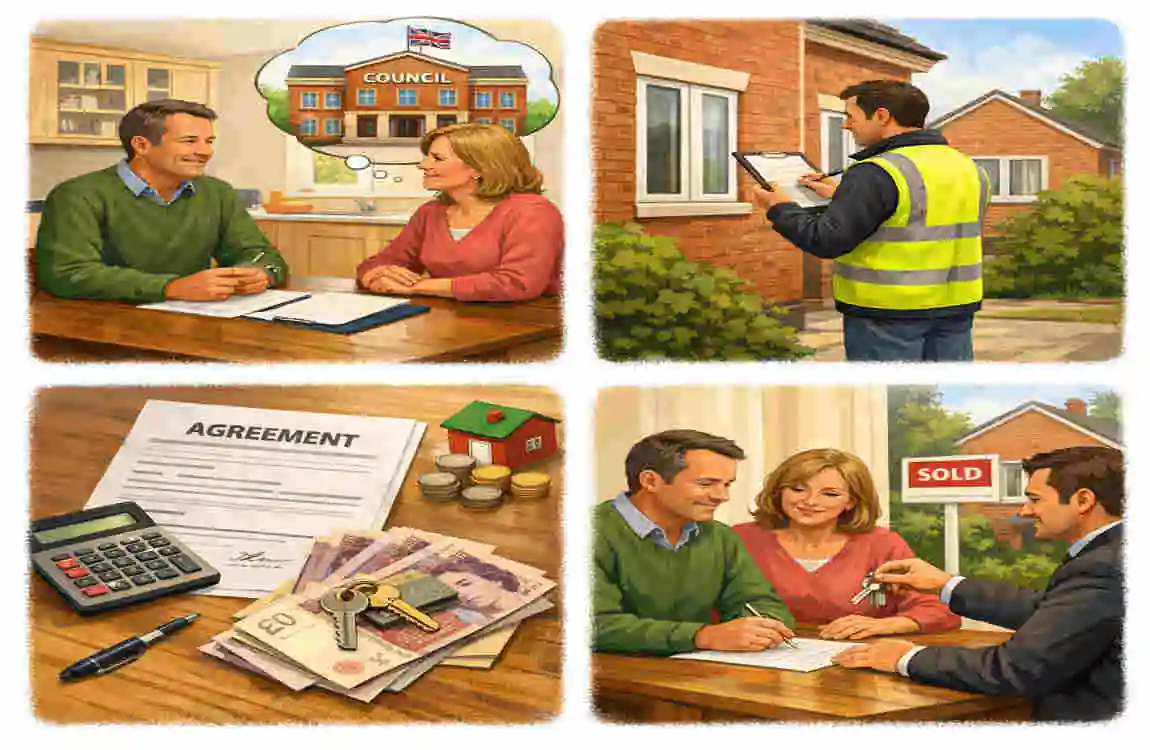
Imagine this: You are sitting at your kitchen table, looking over your monthly budget, and realizing that things are getting a little too tight. You may have just been offered a dream job in another city and need to relocate quickly. Suddenly, the house that has been your haven feels like a heavy anchor tying you down. You need to sell and get quick cash, but the thought of dealing with estate agents, staging your home for endless viewings, and navigating the unpredictable property market makes your head spin.
If you are facing financial strain, going through a major life transition, or simply needing a fast and reliable way out of your property, you might be looking for a lifeline. This is where your local council might step in to save the day. Selling your home back to the council is a fantastic, often-overlooked option that can take the stress out of the traditional property market.
Why is this option so appealing? For starters, it means you can enjoy surprisingly fast transactions. There are absolutely no estate agent fees to eat into your profits, and you skip the dreaded property chains that so often collapse and break hearts. Plus, many councils are highly motivated to buy back ex-council homes, often offering very fair, market-value prices or special incentives to get the deal done.
What Does Selling a House Back to the Council Mean?
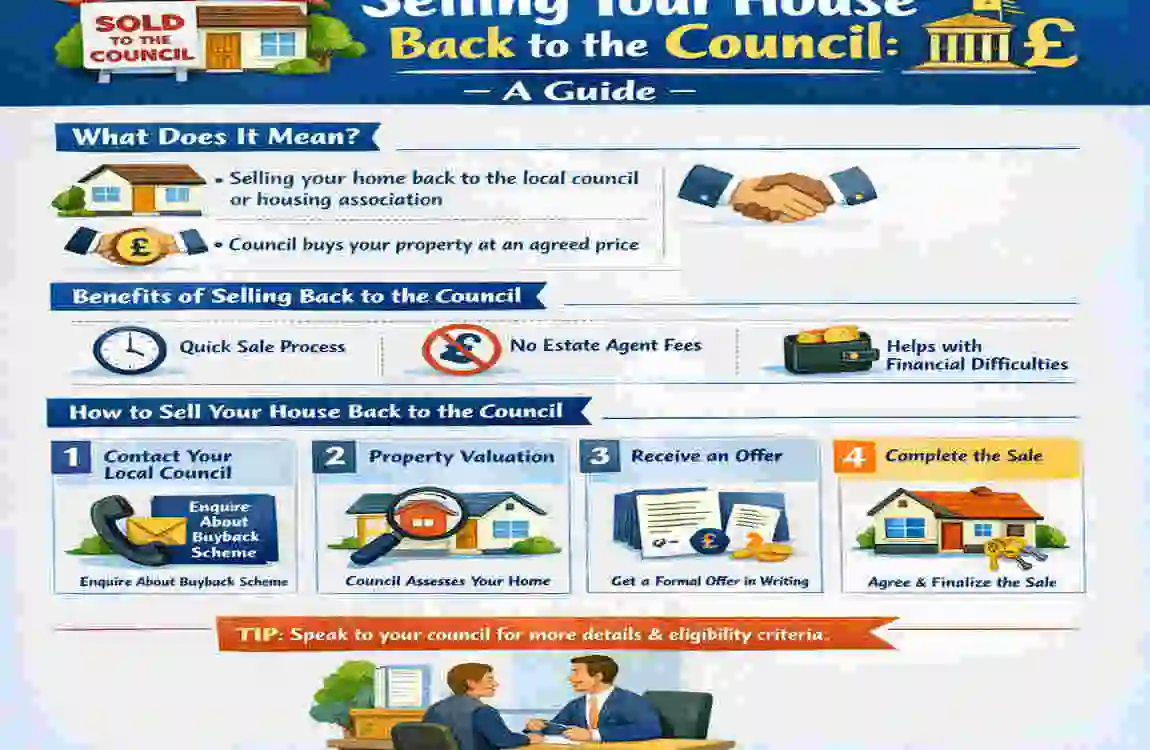
Let us break down exactly what this process actually involves. In simple terms, selling your house back to the council means that your local housing authority acts as the direct buyer for your property. Instead of listing your home online and waiting for a private family or investor to make an offer, the government steps in to repurchase the home.
Why do councils do this? Across many regions, there is a massive shortage of affordable social housing. To combat this crisis, local authorities actively look to expand their housing stock. One of the easiest ways for them to do this is to repurchase properties that were originally built as council homes.
Typically, this process applies to people who bought their luxury homes through schemes like the Right to Buy. In many cases, if you purchased your home through one of these programs, there are actually rules written into your contract that require you to offer the property back to the council before you can sell it to anyone else.
Here are a few key terms you should know:
- Right to Buy resale clauses: This is a legal condition stating that if you sell your ex-council home within a certain timeframe (usually 10 years), you must offer it to the council first. This is known as the “right of first refusal.”
- Council buyback schemes: These are dedicated funds and programs set up by local authorities specifically designed to repurchase former social housing and return it to the public rental pool.
The advantages of taking this route are incredible. You get speed, simplicity, and the peace of mind that your buyer won’t pull out at the last minute because they failed to get a mortgage. However, you also have to weigh this against the potential downsides. Councils have strict budgets, meaning their offer might sit slightly below what you could fetch on the open market. But when you factor in current trends—like massive housing shortages driving up council interest—you might find their offers are much more competitive than you think.
Eligibility Criteria for Selling Back
Before you get too far ahead of yourself, you need to figure out if your home actually qualifies for a council buyback. Not every home on the street is going to be eligible. Councils have very specific wish lists, and your property needs to tick the right boxes.
Here are the absolute must-haves you need to meet:
- Property type: Your home usually needs to be an ex-council property, purchased under the Right to Buy scheme, or a leasehold property where the council still owns the freehold. Councils prioritize these because they already know the layout, build quality, and neighborhood.
- Ownership duration: If you bought the home under Right to Buy, the timeline is crucial. If you are selling within 10 years of your original purchase, you are legally obligated to offer it to them. If you sell within the first 5 years, be aware that you usually have to repay a portion of the discount you originally received.
- Condition of the home: Your house does not need to look like a palace, but it must be structurally sound and habitable. Councils will generally shy away from properties locked in major boundary disputes or those requiring massive, foundational rebuilding.
It is also important to note that rules change depending on where you live. For example, local councils in the UK operate under specific national housing acts. If you are reading this from an international context—for instance, dealing with bodies like Development Authority (LDA) or similar municipal equivalents in other countries—the specific paperwork and approval steps will vary. However, the core concept of selling back to the state remains the same.
To make things crystal clear, here is a simple table showing what usually makes a property eligible versus ineligible:
Eligible Properties Ineligible Properties
Ex-council houses and flats , privately built homes with no council history
Right to Buy homes within the 10-year window , Homes with severe structural failure (subsidence)
Leasehold flats where the council is the freeholder , properties locked in complex legal or boundary disputes
Homes located in areas with high social housing demand , Homes extensively modified without proper planning permission
Step-by-Step Guide to Sell Your House Back
If you have confirmed that your property is eligible, you are ready to start the journey. Selling a house can feel overwhelming, but we will break this complex process into bite-sized, easy-to-understand segments. Follow these eight steps, and you will navigate the sale like a seasoned pro.
Research Your Local Council Policy
The very first thing you need to do is put on your detective hat. Every single council operates a little differently. You need to identify your specific council’s housing department and review their unique buyback guidelines online.
Go to your local authority’s website and use their search bar. Look for terms like “selling Right to Buy property,” “right of first refusal,” or “council repurchase.” You want to find out whether they currently have an active buyback budget. Some councils are aggressively buying, while others might currently have frozen budgets. Spending thirty minutes researching upfront will save you weeks of frustration down the line. Find the direct phone number and email address for the housing or homeownership team.
Gather Essential Documents
Before you make contact, you want to have all your paperwork in order. Being organized shows the council you are serious and ready to move quickly. Dig into your filing cabinet and pull out the following essentials:
- Proof of Identity: A valid passport or driver’s license.
- Title Deeds: You can download a copy from the Land Registry if you do not have the physical documents. This proves you legally own the home.
- Original Purchase Paperwork: Especially your Right to Buy documentation, showing when you bought it and the discount you received.
- Mortgage Statements: You need to know exactly how much you still owe your lender to ensure the sale covers your debt.
Contact the Council
Now it is time to raise your hand and say, “I want to sell!” You can usually do this via phone or email, but putting it in writing is always the safest bet, so you have a paper trail.
Keep your communication simple, friendly, and direct. Here is a quick example of what you might write:
“Hello Housing Team, I am the owner of [Your Address], which is an ex-council property purchased under the Right to Buy scheme. I am planning to sell the property and, in accordance with my contract, I am offering it back to the council first. Could you please let me know your current buyback process and if you would be interested in arranging a valuation?”
Once you send this, the ball is in their court. Expect them to reply within a few days to a couple of weeks, either accepting your offer in principle and requesting a valuation, or politely declining.
Get a Professional Valuation
If the council is interested, they need to figure out how much your home is worth. They will not just guess; they rely on hard data. Usually, the council will send out its own surveyor to inspect your property.
They are looking to establish the current market value—what the house would reasonably sell for if it were listed on the open market today. They will look at the size, condition, and recent sales of similar homes on your street.
If you feel the council’s surveyor returns an unfairly low number, you are not trapped. You have the right to hire an independent RICS (Royal Institution of Chartered Surveyors) assessor to provide a second opinion. While you have to pay for this independent valuation, it can be a powerful tool to negotiate a fairer price if the council’s initial offer feels too low.
Submit Formal Application
Once the valuation is done and an initial price is floated, you will move into the formal application stage. The council will send you a stack of forms to fill out. These forms will ask for detailed information about your property, any alterations you have made (such as adding a conservatory or new windows), and your legal representation.
Take your time with these forms. Rushing and making a mistake can cause annoying delays. Once you submit the formal application, you enter a waiting period. Depending on how busy the council is, formal approval and the issuance of a concrete, legally binding offer can take 4 to 12 weeks. Be patient, but do not be afraid to call them every couple of weeks for a friendly update.
Negotiate the Offer
Eventually, the official offer letter will drop through your letterbox. Now comes the big question: do you have to accept it?
Councils generally offer market value, but they are also looking after taxpayer money. If the offer is lower than you expected, you can push back. However, you cannot just say, “I want more money.” You need evidence. This is where your independent RICS valuation comes into play. You can also present recent sales data from popular property websites showing that identical houses on your road sold for a higher price. Be polite but firm. Remind them that buying your home saves them the cost of building a new one from scratch.
Legal Conveyancing
Once you and the council agree on a price, the process becomes identical to a normal house sale. You need a solicitor or a conveyancer.
Conveyancing is just the legal term for transferring the ownership of a property from one person to another. Your solicitor will draft the contracts, answer the council’s legal questions, and organize the dates. Because you are selling to a government body with no property chain, this legal process is usually incredibly smooth. You do not have to worry about a buyer at the bottom of a chain suddenly losing their job and ruining the whole deal. Expect to pay standard conveyancing fees, which your solicitor will outline upfront.
Complete the Sale
You have made it to the finish line! The final step is broken into two parts: exchange and completion.
First, your solicitor and the council’s solicitor will “exchange contracts.” At this exact moment, the sale becomes legally binding. Neither of you can back out without facing massive financial penalties.
A week or two later comes “completion day.” This is moving day. You hand over your keys, the council transfers the funds to your solicitor, your solicitor pays off your remaining mortgage, takes their fee, and deposits the remaining cash directly into your bank account. You are officially free!
Pros and Cons of Selling to the Council
Like any major financial decision, selling your house back to the local authority has two sides to the coin. It is vital to look at the whole picture so you can make an empowered choice.
Let us break down the advantages and disadvantages in a simple, easy-to-read format:
Aspect Pros of Selling to the Council Cons of Selling to the Council
Speed Extremely fast. Sales often complete in 8-12 weeks, compared to 6+ months on the open market. Bureaucratic delays can occasionally happen if the council is understaffed.
Costs: Incredible savings. You pay absolutely zero estate agent fees, keeping more money in your pocket. You still have to pay your own legal (solicitor) fees and independent valuation fees.
Certainty Guaranteed buyer. No property chains, no last-minute mortgage rejections. Absolute peace of mind. Strict eligibility. If your home does not meet their criteria, they will not buy it.
Financials: Quick access to equity and cash to help you move on with your life, with limited negotiation room. Offers might be slightly below private market potential.
When we analyze this with real-world examples, the value becomes obvious. Imagine an open-market sale where you sell for £200,000 but have to pay £3,000 in estate agent fees, deal with six months of stressful viewings, and endure a buyer pulling out halfway through. Contrast this with the council offering you £195,000. While the gross number is slightly lower, the absence of agent fees, the saved time, and the complete elimination of stress often make the council route the more profitable and emotionally safe choice.
Common Challenges and How to Overcome Them
Even with a guaranteed buyer like the council, the road to selling your home can have a few bumps. Let us look at the most common hurdles and exactly how you can jump over them.
- Mortgage complications: If you still owe money on your house, you need to clear that debt. If the council’s offer is lower than your outstanding mortgage (known as negative equity), you cannot sell without making up the difference. Alternatively, if you are buying a new home, talk to your lender about “porting” your mortgage. This means taking your current mortgage with you to your new house, which can save you from paying hefty early repayment charges.
- Dealing with low offers: As mentioned earlier, councils are looking for a fair deal. If their offer shocks you, do not panic. Do not reject it outright. Instead, politely counter the offer by providing solid, written evidence of recent, higher sales of similar homes in your neighborhood. Data is your best friend here.
- Bureaucratic Delays: Councils are massive organizations, and sometimes paperwork gets stuck on someone’s desk. The best strategy here is polite persistence. Keep a log of who you speak to, and follow up with each person every single week by phone and email.
If we look at this from a broader, international perspective—such as dealing with Development Authority (LDA) or similar housing bodies or India—the challenges often lean heavily toward proving a clear chain of title. In these contexts, ensuring all your NOCs (No Objection Certificates) and clearance documents are perfectly stamped is the best way to overcome administrative roadblocks.
Alternatives If the Council Declines
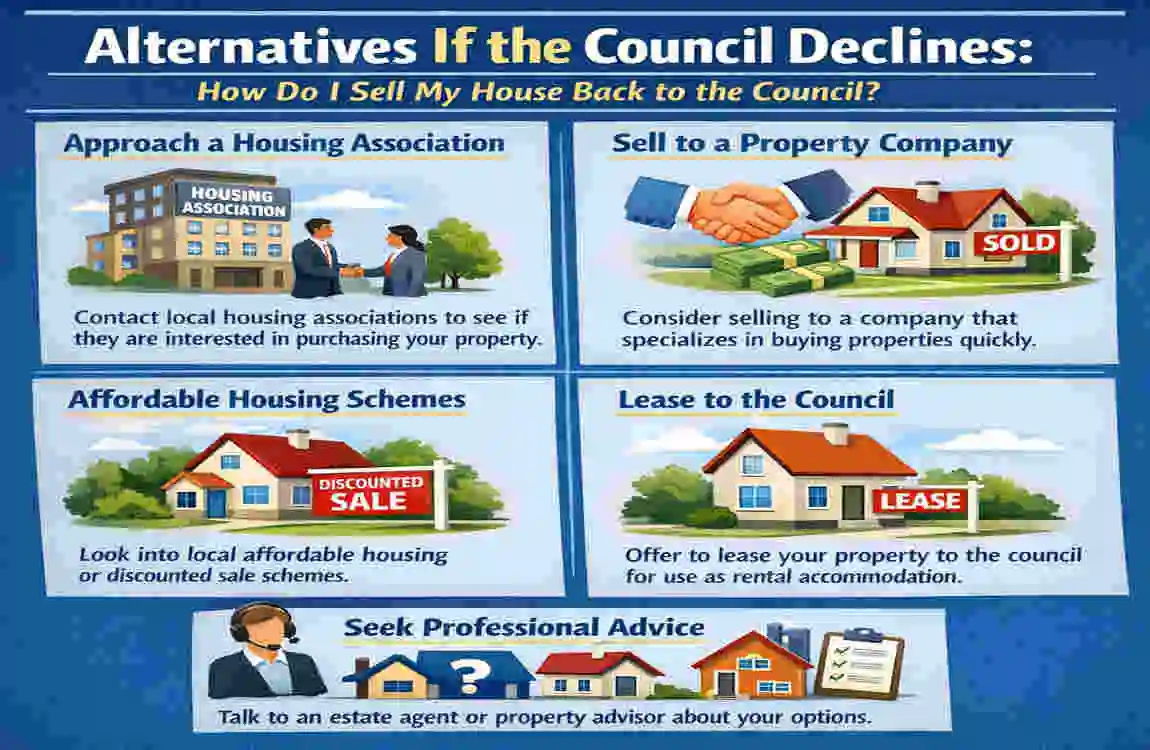
What happens if you go through the early steps but the council writes back, “No, thank you”? Do not worry. You are not trapped. You have several other fast and reliable options to sell your property.
- Quick Cash Buyers or Property Auctions: If speed is your ultimate goal, there are private companies that buy houses for cash within 7 to 14 days. Alternatively, putting your home in an auction guarantees a sale on the day the hammer falls. The catch? You will usually sell for 75% to 85% of the market value.
- Private Sales via Estate Agents: This is the traditional route. You will get the highest possible price for your home by listing it on the open market. However, you trade speed for money. It can take many months, you will have to pay agent commissions, and you will have to deal with public viewings.
- Rent-Back Schemes: Sometimes known as “sell and rent back.” A private firm buys your home, giving you a lump sum of cash, but allows you to continue living in the property as a tenant. This is highly regulated, so proceed with caution, but it prevents you from having to pack up and move.
Alternative Option: Speed of Sale, Expected Price Achieved, Best For…
Cash Buyers Very Fast (1-3 weeks) Low (75-85% Market Value) Urgent financial emergencies
Estate Agents Slow (4-6+ months) High (100% Market Value) Maximizing profit, no time rush
Property Auction Fast (4-6 weeks) Medium (80-90% Market Value) Fixer-uppers, secure sales
Frequently Asked Questions
You may still have a few lingering questions. Let us tackle the most common queries homeowners have when considering this process.
Can I sell my Right to Buy house back to the council? Yes, absolutely. In fact, if you are within the first 10 years of your Right to Buy purchase, you are legally required to offer it back to them first.
Do I have to pay back my Right to Buy discount? If you sell within the first five years of buying the property, yes. You will have to repay a percentage of the discount, which decreases for every year you have owned the home.
Will the council definitely buy my house? No. While they have the right of first refusal, they are not legally forced to buy it. If they do not have the budget or do not need properties in your area, they will decline.
How long does the council have to reply to my offer? Usually, they have 8 weeks to respond to a freehold property and 12 weeks to respond to a leasehold property.
What if the council rejects my offer? If they reject your offer or fail to reply within the legal timeframe, you are completely free to sell your home on the open market to anyone you choose.
Do I need an estate agent to sell to the council? No! This is one of the biggest benefits. Because you are dealing directly with the buyer, you do not need an agent, saving you thousands in fees.
Can I negotiate the council’s buyback price? Yes. If you believe their valuation is too low, you can hire an independent RICS surveyor to provide a counter-valuation and negotiate the price.
Who pays the legal fees? You will be responsible for paying your own solicitor’s conveyancing fees, just as you would in a traditional private home sale.
Do I have to move out immediately? You will move out on the agreed “completion day.” You and the council will agree on this date through your solicitors, giving you plenty of time to pack.
Can I sell a house back to the council with mortgage arrears? Yes, but the sale price must be high enough to clear your outstanding mortgage and the arrears. If it isn’t, you will need to find the cash to make up the shortfall.
