

You have just bought a charming, slightly older bungalow. It could be in a classic American suburb, or in one of those solid, spacious homes built in the upscale neighborhoods of Lahore, Pakistan, during the construction boom of the early 90s. You decide to renovate the bathroom. You take a sledgehammer to the drywall, expecting to see pristine pipes. Still, instead, you are greeted by a maze of rusty, corroded metal and odd-looking plastic.
If you are a homeowner, a DIY enthusiast, or a real estate professional dealing with retro homes, you need to know the answer. The short version? It was a transitional era. Mostly, builders used galvanized steel for water lines, heavy cast iron for drains, and we began to see the emergence of copper and early PVC.
By 1990, the plumbing world was shifting. The industry had moved away from dangerous lead pipes—stats suggest that by 1990, nearly 70% of homes globally had shifted to safer materials—but the “perfect” modern plumbing system hadn’t yet been invented. We were stuck in between the heavy metal of the past and the high-tech plastics of the future.
Historical Context of 1990s Plumbing Evolution
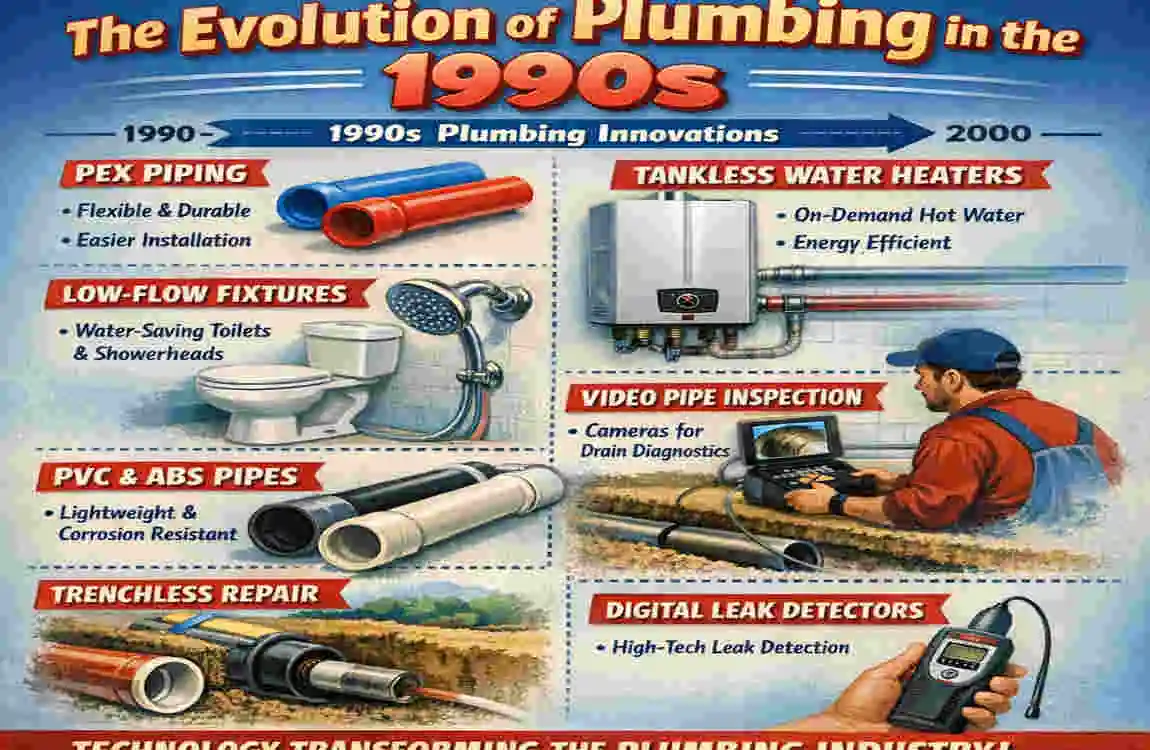
To truly understand the type of plumbing used in 1990, we have to look at the timeline. The plumbing in a 1990 home didn’t just appear out of nowhere; it was the result of decades of trial and error and regulatory changes.
Pre-1990 Shifts: The Death of Lead
The most significant factor influencing 1990s plumbing actually happened a few years prior. In the United States, the Safe Drinking Water Act Amendments of 1986 effectively banned the use of lead pipes and lead solder. Before this, lead was a common component because it was malleable and easy to work with.
However, once the health risks (like brain damage and developmental issues in children) became undeniable, the industry had to pivot hard. By the time 1990 rolled around, builders were strictly using “lead-free” materials. This meant that if you walked onto a construction site in 1990, you wouldn’t see lead pipes. Still, you would see a massive phase-out of asbestos insulation, which had been used to wrap hot water pipes for decades.
1990 Global Trends: East Meets West
The year 1990 was also a time of globalization in construction standards. The Uniform Plumbing Code (UPC) began to exert greater influence on international building codes.
In developing nations and growing urban centers like Pakistan and India, the 1990s marked a shift from traditional, often improvised plumbing to the adoption of Western technologies. As urbanization spiked, people wanted modern amenities. They wanted high-pressure showers and reliable flushing toilets. This demand forced builders in places like Lahore and Karachi to move away from purely galvanized steel (which was locally abundant but problematic) toward mixing in newer technologies like PVC for drainage, mirroring trends in the U.S. and Europe.
Key Regulations and the Rise of Plastics
Regulations were the driving force. With lead gone, manufacturers scrambled for alternatives. This led to the rapid rise of CPVC (Chlorinated Polyvinyl Chloride) as a viable, lead-free alternative for hot water distribution. It was cheaper than copper and easier to install than steel.
If we looked at a timeline, the 1970s were dominated by heavy steel. The 1980s saw the transition. By 1990, we entered the “Plastic Surge,” setting the stage for the plumbing systems we use today.
Common Pipes Used in 1990 Homes
Now, let’s get into the walls. If you are asking, “what type of house plumbing was used in 1990,” you are likely dealing with one of three main categories: Water Supply, Drains, and Gas. Let’s break these down in detail so you know exactly what you are looking at.
Water Supply Lines: The Arteries of the Home
The water supply lines are the pipes that bring clean, pressurized water to your taps, toilets, and showers. In 1990, this was a mixed bag of materials.
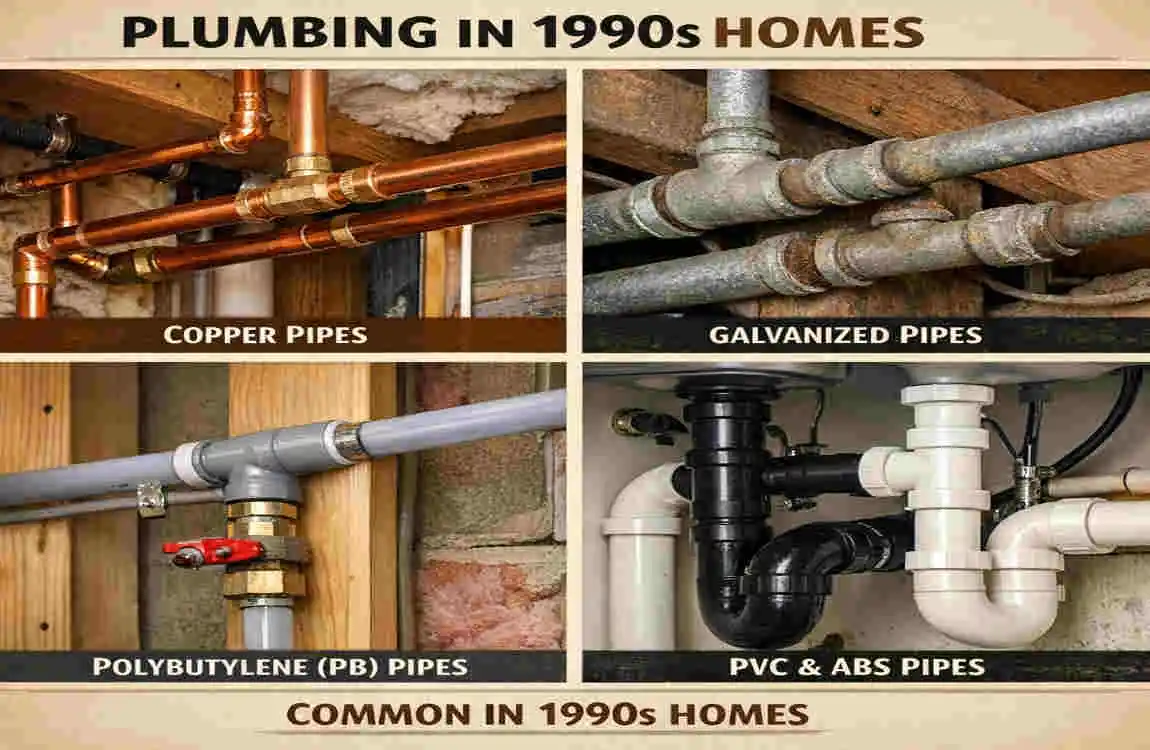
Galvanized Steel
This was the heavyweight champion for decades, and in 1990, it was still found in about 50-60% of existing homes and new builds in many regions.
- What it is: Steel pipes dipped in a protective zinc coating to prevent rust.
- The Look: They are silver-grey when new but turn a dull greyish-brown over time. They are threaded at the ends and screwed together.
- The Pros: They are incredibly strong. You could practically hang from a galvanized pipe.
- The Cons: They rust from the inside out. Over time, mineral deposits build up inside the pipe, restricting water flow. It’s like “arteriosclerosis” for your house. By the time a galvanized pipe is 30 or 40 years old (which is right now for a 1990 home), the internal diameter might be the size of a drinking straw.
Copper Pipes
By 1990, copper was the premium choice, gaining serious traction with about 30% adoption in new luxury builds.
- The Standards: You usually found Type M (thinner walls, used for residential) or Type L (thicker walls, higher quality).
- Why it replaced steel: Copper doesn’t rust like steel. It is biostatic (inhibiting bacterial growth), lightweight, and heat-resistant.
- The Look: Distinctive bronze/gold color when new, turning into a dark brown or greenish patina over decades.
Early Plastic (CPVC/PVC)
This was the newcomer. In 1990, plastics were the “budget-friendly” option that developers loved.
- The Tech: CPVC (cream-colored) was used for hot and cold water because it could withstand higher temperatures than standard white PVC.
- The Vibe: It was revolutionary because you didn’t need a welding torch or heavy threading tools to install it. You just used glue (solvent cement). This marked the beginning of the DIY plumbing era.
Drain, Waste, and Vent (DWV) Systems
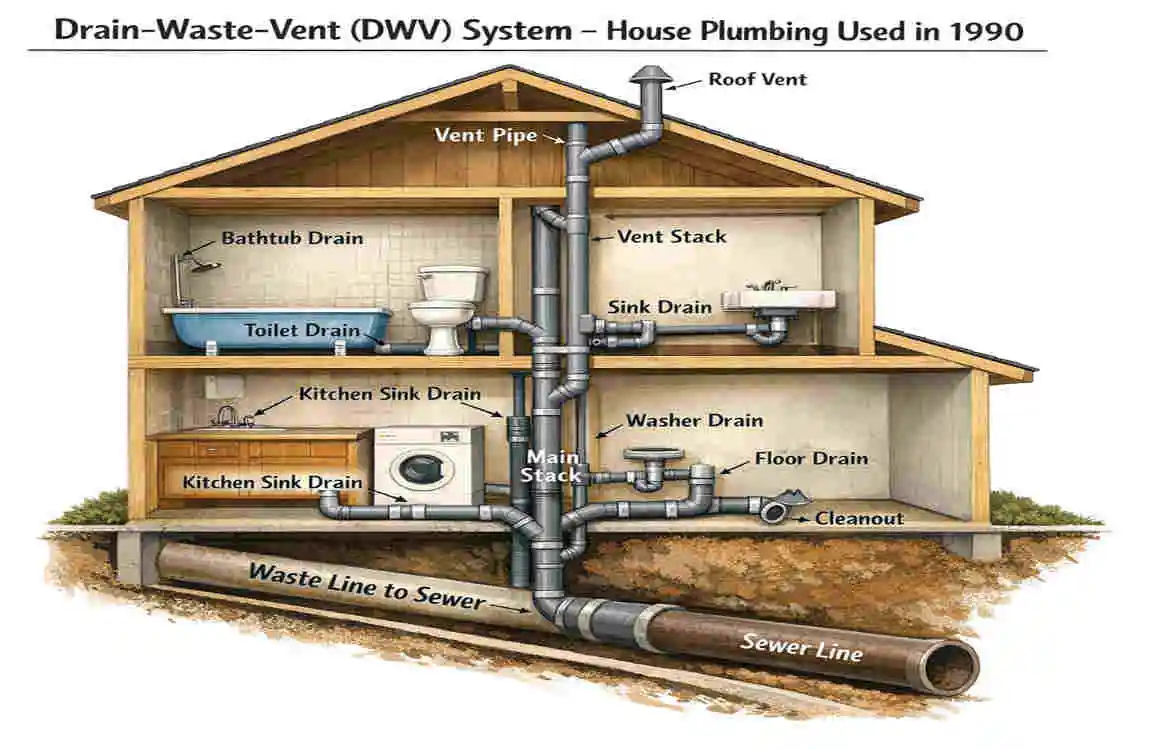
Once the water is used, it has to go somewhere. The “DWV” system is responsible for moving sewage out of your house.
Cast Iron
If you live in a multi-story home built in 1990, especially in urban areas, your main sewer stack is likely Cast Iron.
- Why it was used: It is incredibly heavy-duty and, crucially, it is quiet. When you flush a toilet upstairs, you don’t hear the “whoosh” of water rushing down the walls like you do with thin plastic pipes.
- The Downside: Like galvanized steel, cast iron eventually rusts. However, it usually lasts 50-80 years, so 1990s cast iron is often still in decent shape today.
PVC and ABS Plastics
The post-1980s era saw an explosive rise in plastic drains. By 1990, lighter plastics were taking over.
- PVC (Polyvinyl Chloride): Usually white. It became the standard in warmer climates (like Pakistan or the Southern U.S.) because it is chemical resistant and lasts forever.
- ABS (Acrylonitrile Butadiene Styrene): usually black. Common in colder climates.
- The Impact: These pipes were lightweight, corrosion-resistant, and smooth, reducing clogging compared to rough-iron pipes.
Orangeburg (The Warning Sign)
While mostly phased out by the 70s, you sometimes find Orangeburg pipe in 1990 renovations where a new house was tied into an older main sewer line.
- What it is: Bituminized fiber pipe. Essentially, it is layers of wood pulp sealed with hot pitch.
- The Verdict: If you find this, replace it immediately. It collapses and deforms under the weight of the soil.
Gas Lines: Powering the Furnace
We often forget that plumbers also handle gas lines.
- Black Iron/Steel: This was the primary material for gas in 1990. It looks like galvanized steel but is black (uncoated) because gas doesn’t cause rust the way water does. It relies on threaded joints and is incredibly durable.
- Emerging CSST: Toward the very late 1990s, we started seeing Corrugated Stainless Steel Tubing (CSST). This is a flexible, yellow-coated metal tube that snakes through walls like an electrical wire. If your 1990 home was renovated in the late 90s, you might see this.
Visual Comparison: 1990 Plumbing Materials
Pipe MaterialPrimary Use1990 Lifespan Est.Cost in 1990Main Vulnerability
Galvanized Steel Water Supply 40-50 Years Medium Internal Rust/Clogging
Copper (Type M/L) Water Supply 50-70 Years High Pin-hole Leaks/Theft
CPVC Plastic Water Supply 25-40 Years Low Brittleness over time
Cast Iron Drains (DWV) 75-100 Years High Heavy/Rust
PVC / ABS Drains (DWV) Indefinite Low Cracking/Poor Joints
Materials and Fittings in 1990 Plumbing
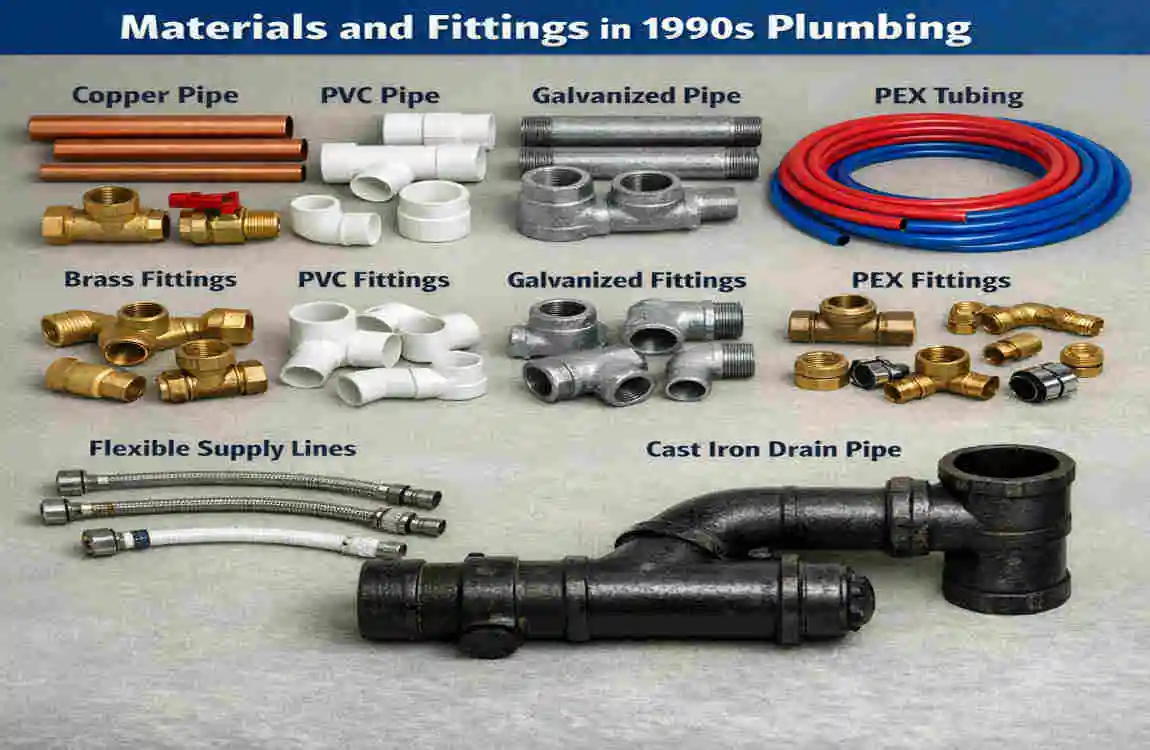
It wasn’t just about the pipes themselves; the fittings, glues, and insulation used in 1990 tell a story of a world trying to become safer and more efficient.
Pipe Insulation: The Shift from Asbestos
For decades, pipes were wrapped in materials containing asbestos. By 1990, this was a major no-no. In a 1990 home, you will likely find fiberglass wraps or the emerging black foam noodles (polyethylene foam) clamped around hot water pipes.
If you are inspecting a home from this era and see white, chalky wrapping on pipes, be careful—it might be leftover insulation from an older install, but 1990 builds should be safe.
Joints and Sealants
How were these pipes connected?
- Soldered Copper: In 1990, plumbing codes strictly enforced lead-free solder. This solder requires a slightly higher melting point, so plumbers had to adapt their torch techniques.
- Threaded Galvanized: Steel pipes were screwed together using pipe dope or Teflon tape to seal the threads.
- Solvent Welding: For PVC and CPVC, plumbers used a two-step process: a purple primer (which softens the plastic) and a cement glue. You can often spot 1990s DIY work by the messy purple stains on the pipes!
Regional Variations: A Tale of Two Worlds
It is fascinating to see how geography dictated plumbing choices in 1990.
- United States: The U.S. was heavily invested in copper. It was seen as the mark of a quality home. If a builder used plastic supply lines, it was considered “cheap.”
- Europe: Europe was quicker to adopt advanced plastics and flexible piping systems earlier than the U.S.
- Pakistan/Asia: In places like the Lahore suburbs mentioned earlier, Galvanized Steel was still the king due to availability and the ruggedness needed for inconsistent water pressure. However, it was often paired with cheaper, locally manufactured PVC for drains. It wasn’t uncommon to see a high-end bungalow with steel water pipes but budget-friendly plastic drains—a mix of durability and cost-saving.
Identifying 1990s Plumbing in Retro Homes Today
So, you are standing in your basement or looking under the sink. How do you know if you are looking at “vintage” 1990 plumbing? Here is your visual inspection guide.
Visual Inspection Guide
- Galvanized Steel: Look for silver or grey pipes. They look metallic and heavy. If you see orange rust streaks at the joints (where the threads are), that is a tell-tale sign of galvanized steel nearing the end of its life.
- Copper: Look for the penny-colored metal. If it has greenish-white crusty stuff on the joints, that is oxidation, indicating a slow leak.
- Polybutylene (The “Grey Ghost”): Critical Warning. Between the late 70s and mid-90s, a grey plastic pipe called Polybutylene was used. It was prone to bursting from the inside due to chlorine in the water. If you see grey, flexible plastic pipes labeled “PB2110,” you need a plumber immediately.
DIY Tests
You don’t need to be a pro to identify materials. Try these simple tests:
- The Magnet Test: Take a strong magnet and stick it to the pipe.
- If it sticks: It is Steel (Galvanized or Black Iron).
- If it doesn’t stick: It is Copper, Lead, or Plastic.
- The Scratch Test: (Do this gently on a hidden area). Use a coin to scratch the outside of the pipe.
- If it shines like a new penny: It’s Copper.
- If it shines silver/grey: It’s Lead (very soft) or Steel (hard).
- If it flakes or feels plastic: It’s PVC/CPVC.
Common Issues to Watch For
If your house was built in 1990, your plumbing is now over 30 years old.
- Low Water Pressure: If you turn on the shower and it feels like a weak drizzle, and you have galvanized pipes, the pipes are likely clogged with rust.
- Discolored Water: If the water comes out brown or yellow after the house has sat for a few days, that is rust from inside steel pipes.
- Stats: Studies show that 40% of galvanized pipes fail or significantly clog by the 30-year mark. You are right in that danger zone.
Pros, Cons & Modern Comparisons
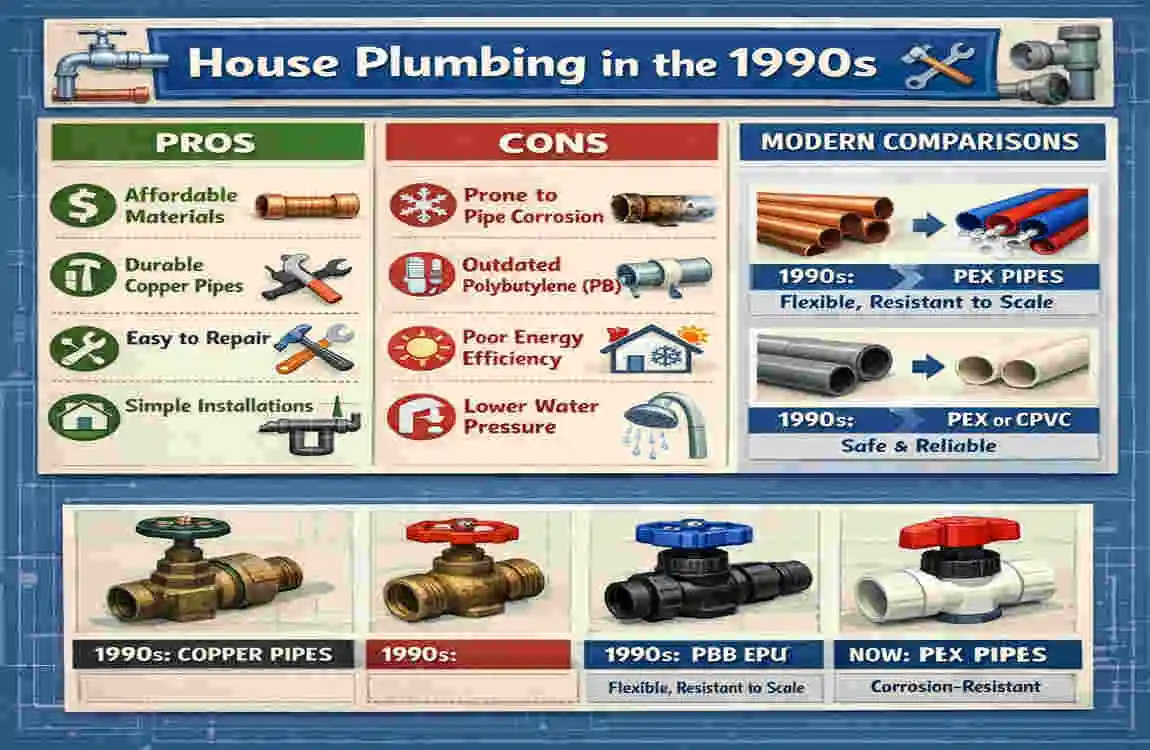
How does the plumbing of 1990 stack up against what we use today (mostly PEX and advanced PVC)?
Aspect1990 Plumbing (Galvanized/Copper)Modern Equivalent (PEX/PVC)
Durability Good initially, but steel rusts fast. PEX: 50+ years, zero corrosion.
Installation Difficult. Required threading or soldering. Easy. Push-to-connect or crimp rings.
Cost (Then vs Now) : Galvanized was approx. $2/ft (adjusted). PEX is cheaper and faster to install.
Freeze Resistance Poor. Rigid pipes burst when frozen. Excellent. PEX expands with ice.
Safety Lead-free (mostly), but rust collects bacteria—hygienic and smooth flow.
The Verdict:
- Pros of 1990 Plumbing: It was solid. The materials were heavy and felt substantial. Copper installed in 1990 is likely still good today.
- Cons: The galvanized steel is a ticking time bomb. The early plastics (like Polybutylene) were disastrous. The labor cost to repair these systems is high because working with threaded steel is difficult.
Upgrade Tips for 1990 Plumbing in Your Home
If you have confirmed that your home has 1990-era plumbing, don’t panic. You don’t necessarily need to rip down every wall tomorrow. Here is a strategic approach to upgrading.
When to Replace?
You should consider a repipe (replacing old pipes with new ones) if:
- You have Galvanized Steel water lines. They will fail; it is just a matter of when.
- You experience frequent leaks.
- You see visible rust on the outside of pipes.
- You find Polybutylene (grey plastic) pipes.
DIY vs. Pro: The Repiping Reality
Can you do this yourself?
- Small Fixes: Changing a faucet or a P-trap under the sink? Yes, DIY.
- Whole House Repipe: This is a job for a Pro. Modern repiping often involves bypassing the old pipes and running new PEX (Cross-linked Polyethylene) lines through the attic or walls. It is less invasive than you think.
The Cost Factor
In a market like Lahore (referencing our earlier scenario), a full repipe for a standard bungalow might cost anywhere from PKR 50,000 to 200,000 depending on the number of bathrooms. In the U.S., a whole-house repipe with PEX usually runs between $4,000 and $10,000.
Eco and Savings
Upgrading isn’t just a cost; it’s an investment.
- New pipes have better flow, meaning you get hot water faster (less waste).
- Eliminating leaks can save you 10-15% on your water bill.
- Modern PEX retains heat better than copper, making your hot water system more efficient.
