

Picture this: You just stepped out of a hot, relaxing shower. The mirror is completely fogged up, water droplets are dripping down the walls, and the air feels heavy and thick. Without thinking, you reach over and flip the switch for the bathroom exhaust fan. The motor hums, and slowly the steam begins to clear.
It is a routine we all know well. But lately, with energy prices climbing and everyone keeping a closer eye on their monthly expenses, you might have paused with your hand on that switch. You might be wondering, ” Does a bathroom fan use electricity? And if it does, is this little appliance silently driving up your energy bill?
The short, direct answer is yes: bathroom fans do use electricity. However, the amount they consume is typically quite minimal compared to the heavy hitters in your home, like your air conditioner or water heater. Most standard bathroom fans draw between 20 and 80 watts, which translates to mere pennies per use.
Understanding Bathroom Fan Electricity Basics
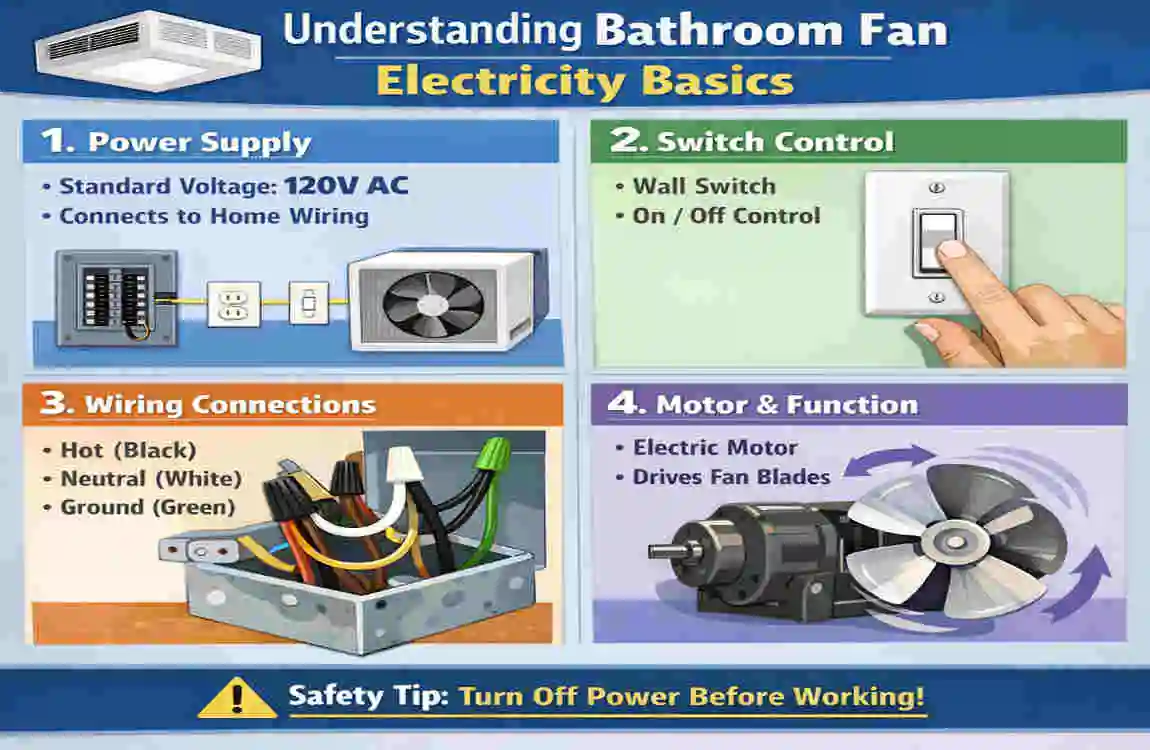
To really get a handle on your energy bill, we first need to look under the hood—or rather, behind the grille—of your bathroom fan. It might seem like a simple box that sucks air, but understanding what powers it is the first step to efficiency.
What Powers a Bathroom Fan?
At its core, a bathroom exhaust fan is a relatively simple machine. It relies primarily on an electric motor. When you flip the switch, electricity flows into the motor, creating a magnetic field that spins a shaft. Attached to this shaft are blades (or a blower wheel) that physically push air out of the room and through a duct to the outside of your house.
This motor is the main component that draws electricity. For a basic, no-frills exhaust fan, the wattage requirement is surprisingly low. You are usually looking at 5 to 60 watts. To put that in perspective, that is roughly the same amount of electricity used by a single standard incandescent light bulb.
However, many modern bathroom fans are multi-functional units. They aren’t just fans; they are often combined with light fixtures or heating elements.
- Lights: If your fan has a light, add the bulb’s wattage (LEDs are low, old incandescents are high) to the total.
- Heaters: This is the big game-changer. Suppose your bathroom fan includes a built-in heater to warm you up after a shower, the electricity usage skyrockets. These heating elements can draw anywhere from 1000 to 1500 watts, which is comparable to running a hair dryer or a space heater.
Do All Bathroom Fans Use the Same Electricity?
The simple answer is no. Just like cars, bathroom fans come in different models with different fuel efficiencies. Electricity usage varies significantly depending on the type of fan and its age.
Standard Exhaust Fans: These are the most common types found in homes. They are strictly for ventilation. Because they only have a small motor to spin the fan blades, their energy consumption is on the lower end of the spectrum. An older, cheaper model might use more power to move less air, while a newer model acts more like a precision instrument.
Combo Fan/Light Units: These are the “medium” consumption units. You have the motor running, plus the electricity required for the light bulbs. If you are still using old-school 60-watt incandescent bulbs in your fan fixture, the light is actually using more electricity than the fan motor itself!
Heated Fans. As mentioned earlier, these are the heavy users. While they feel luxurious on a cold winter morning, they are energy hogs. Using the heater function changes the math completely, moving the appliance from a “negligible cost” category to a “significant draw” category if left running.
CFM vs. Watts. It is also important to understand the relationship between airflow and power. Airflow is measured in CFM (Cubic Feet per Minute). You might assume that a fan with a higher CFM (moving more air) always uses more watts, but that isn’t always true. High-quality, well-engineered fans can move a massive amount of air (high CFM) using very little electricity (low watts) because they are designed efficiently. Conversely, a cheap, poorly made fan might guzzle electricity while barely moving enough air to clear the mirror.
How Much Electricity Does a Bathroom Fan Actually Use?
Now that we understand the basics, let’s crunch some numbers. We want to know exactly what this is costing you. Is it costing you a coffee a month, or a nice dinner out?
Wattage Breakdown by Fan Type
To give you a clear picture, let’s look at the typical wattage and associated costs for the different types of fans we discussed. We will assume an average electricity rate of $0.13 per kWh (kilowatt-hour), which is a fairly standard residential rate.
Fan TypeTypical WattageHourly Cost (approx.)Cost for Daily Use (30 min/day)
Basic Exhaust Fan 10 – 50 Watts $0.001 – $0.006 Less than $0.01
Fan + Light Combo 36 – 80 Watts $0.005 – $0.010 $0.02 – $0.04
Heated Fan Unit 1000+ Watts $0.13+ $0.10+
As you can see from the table, the cost for a standard fan is almost negligible. Even if you run a fan with a light, the cost is very low. The only time you really need to worry about the meter spinning quickly is when using a heated fan.
Real-World Usage Calculations
Let’s do a little math together to see what this looks like over a month or a year. It helps to break this down to see that, for most people, the fan itself is not the villain of the electric bill.
- You take a shower every morning and leave the fan running to dry out the room. Let’s say it runs for 30 minutes (0.5 hours) a day.
- Formula: Watts x Hours used / 1000 = kWh.
- Calculation: 50 watts x 0.5 hours = 25 watt-hours per day.
- Divide by 1000 to get kilowatts: 0.025 kWh per day.
Now, let’s look at the monthly cost:
- 0.025 kWh x 30 days = 0.75 kWh per month.
- At a rate of $0.13 per kWh: 0.75 x $0.13 = $0.097.
That’s right. Running that fan for 30 minutes every single day costs you roughly 10 cents a month, or about $1.20 a year. Even if you have a large family and the fan runs for 4 hours a day, you are still looking at less than $1.00 a month in direct electricity costs.
So, if the direct electricity cost is so low, why are we even talking about saving money with bathroom fans? Because the direct power usage isn’t the whole story.
Hidden Costs: Why Bathroom Fans Affect Your Energy Bill
While the fan motor sips electricity gently, the fan’s function can inadvertently drain your wallet. This is where the concept of “conditioned air” comes into play, a factor many homeowners overlook.
Overuse and Inefficiency Traps
The purpose of a bathroom fan is to remove humid, stale air from your bathroom and vent it outside. But nature hates a vacuum. When you push air out of your house, new air must be pulled in to replace it.
Where does that replacement air come from? It seeps in through cracks in your windows, under doors, and through your attic insulation.
- In the winter, your furnace has worked hard to heat your air to a cozy 72 degrees. When you leave the bathroom fan running for hours, you are pumping that expensive, heated air right out the roof. Cold air is sucked into your house to replace it, forcing your furnace to work harder to heat the new air.
- In the summer, the reverse happens. You pump out the nice, cool air your air conditioner creates, and suck in hot, humid air from outside.
Leaving a fan running for hours after a shower doesn’t just waste pennies on the motor; it wastes the dollars you spent heating or cooling your home. This is the overuse trap.
Poor Installation Issues
Another hidden cost comes from how the fan was installed. If you have leaky ducts, the fan might not be effectively pushing the humid air outside. Instead, it might be pushing it into your attic. This doesn’t just waste energy; it can lead to mold growth in your attic, which is a massive expense to fix.
Furthermore, if the ducting is too long, too twisted, or the wrong size, the fan motor has to work much harder to push the air. This increases motor wear and can slightly increase electricity draw, but it also makes the fan ineffective. You end up running it longer to get the same result, compounding the heat-loss problem we discussed above.
Energy-Efficient Bathroom Fans: Do They Really Save Money?
If you are looking to replace a noisy, rattling old fan, you have probably seen stickers for “Energy Efficient” or “ENERGY STAR” models. You might be asking yourself: if electricity costs are already low, is it worth paying extra for an efficient model?
Top Features for Low Electricity Use
The answer is yes, but not for the reasons you think. Energy-efficient fans aren’t just about saving a few watts; they are about better performance and durability.
DC Motors High-end, efficient fans often use DC (Direct Current) motors rather than standard AC motors. DC motors are incredibly efficient, run much cooler, and—best of all—are significantly quieter. A DC motor can maintain high airflow even with some resistance in the ductwork, ensuring your bathroom actually gets dry.
Humidity Sensors. This is the “killer feature” for energy savings. Fans with built-in humidity sensors turn on automatically when steam is detected and turn off automatically when the humidity drops. This eliminates the “I forgot to turn the fan off” problem, saving you from having to pump out all your heated air for 3 hours while you are at work.
LED Lighting: Energy-efficient models almost exclusively use LED lighting technology, which uses a fraction of the power of incandescent bulbs and lasts years longer without needing a replacement.
Best Models Comparison
If you are in the market for an upgrade, here is a quick look at how different fan tiers stack up in terms of efficiency.
Model TierWattageCFM/Watt Ratio (Efficiency)Annual Savings Estimate
High-Efficiency (e.g., Panasonic FV Series) 5 – 11 Watts 10+ (Excellent) $20 – $30 (mostly in heat retention)
Mid-Range (e.g., Broan-NuTone) 20 – 30 Watts 5 – 7 (Good) $10 – $15
Builder Grade (Cheap Standard) 50 – 70 Watts < 3 (Poor) Baseline
Proven Ways to Reduce Bathroom Fan Electricity Costs
You don’t always need to buy a brand-new fan to save money. Here are ten actionable steps you can take right now to lower your energy footprint and keep your bills in check.
install a Timer Switch. This is the number one upgrade for any bathroom. Swap your standard toggle switch for a countdown timer. Set it for 20 minutes when you hop in the shower. It ensures the fan runs long enough to clear the moisture without running all day. It removes human error from the equation.
Follow the 20-Minute Rule. How long should the fan run? The sweet spot is typically 20 to 30 minutes after a shower. This is enough time to cycle the air and dry out surface moisture. Running it for less time risks mold growth; running it longer wastes energy.
Upgrade to Low-Watt Models If your fan sounds like a jet engine and is more than 15 years old, replace it. Newer models with DC motors use significantly less power and are so quiet you will barely know they are on.
Clean Your Fan Yearly. Dust is the enemy of efficiency. As dust builds up on the fan blades and the motor, the fan has to work harder to spin, moving less air. Once a year, pull the cover down, vacuum the inside, and wipe the blades. It improves airflow and extends the motor’s life.
Switch to LED Bulbs. If your fan has a built-in light, check the bulb immediately. If it is an incandescent or halogen bulb, swap it for an LED. You will go from using 60 watts for light to using 9 watts, with the same brightness.
Integrate with Smart Home Tech. If you have a smart home system, install a smart switch. You can program schedules, control the fan from your phone, or set it to turn off automatically when you leave the house.
Use Natural Ventilation (When Appropriate) On a mild spring or fall day, consider cracking the window instead of using the fan. If the humidity outside is lower than inside, and the temperature is pleasant, you can ventilate for free without using electricity or losing conditioned air.
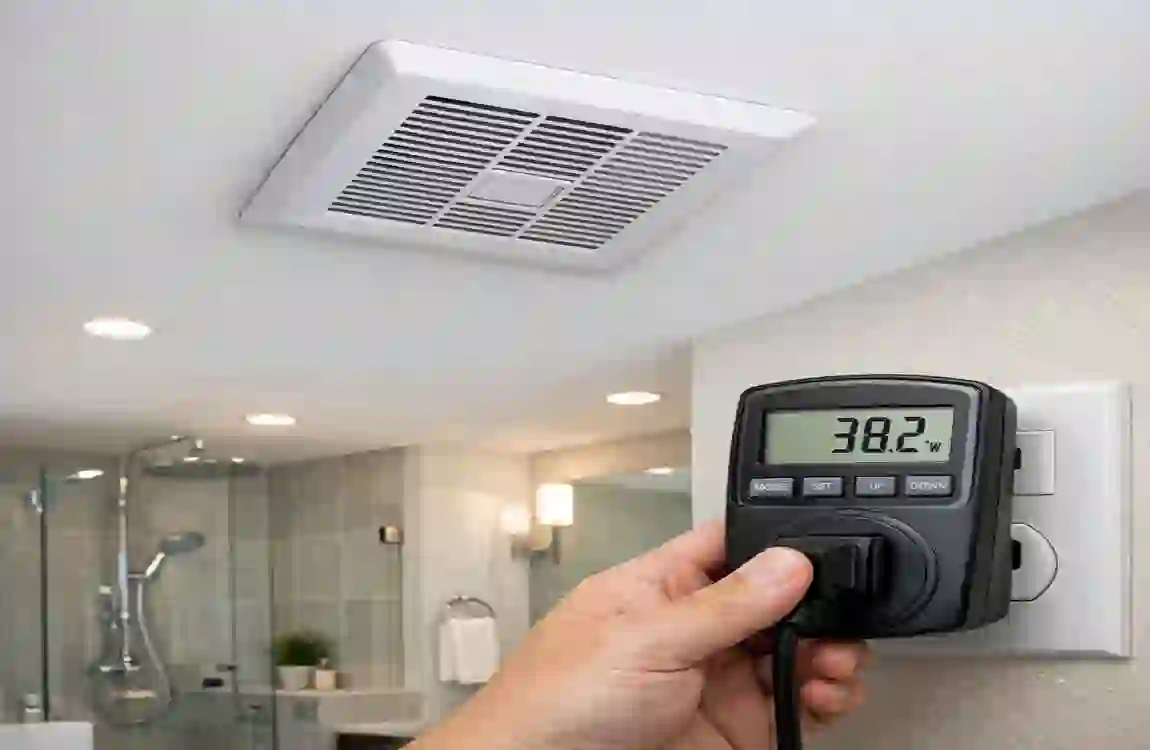
Monitor with Energy Meters. Curious about your specific fan? You can install a simple energy monitor on the circuit, or if it plugs in (rare for bathroom fans, but possible), use a usage monitor. Seeing the real-time cost can be a great motivator to turn it off.
Off-Peak Usage If your utility company charges different rates at different times of the day, try to shower during off-peak hours. While the savings per shower are tiny, it builds good habits for overall household energy usage.
Get a Professional Audit. If your bathroom constantly feels damp despite running the fan, or your energy bills are unexplainably high, consider a home energy audit. A pro can check if your ductwork is disconnected or blocked, ensuring you aren’t paying for a fan that isn’t actually doing its job.
Bathroom Fan vs. Other Home Energy Hogs
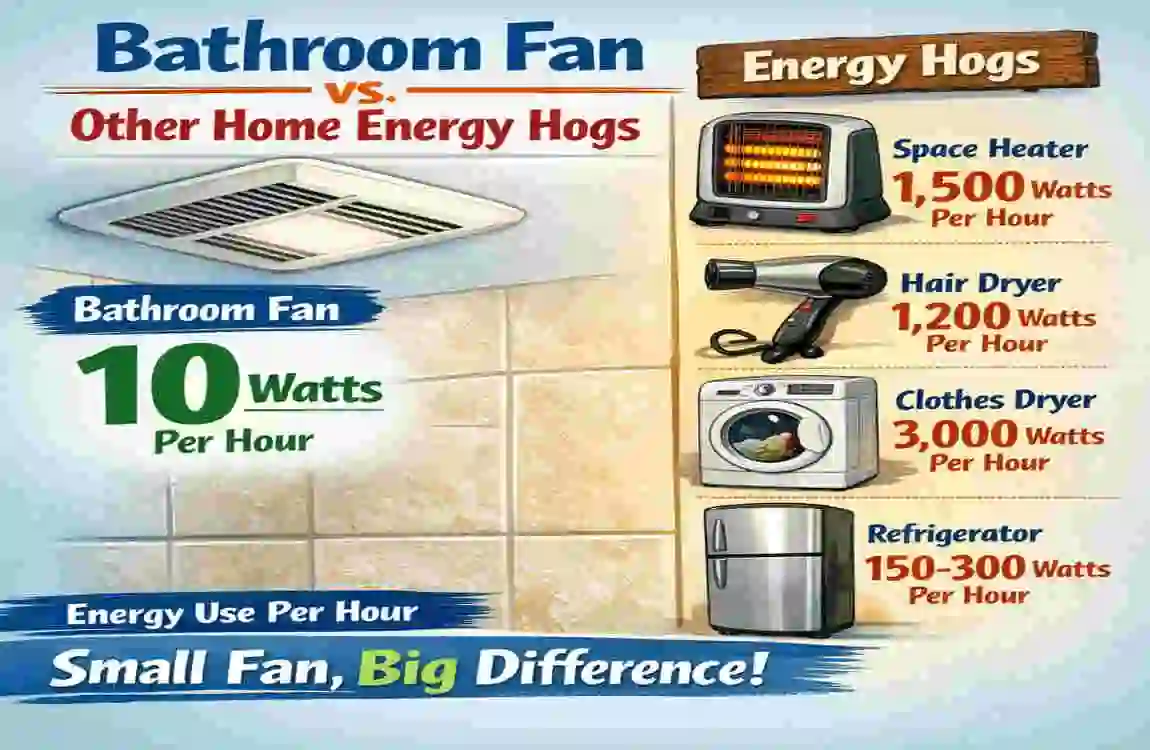
It is easy to get fixated on the little spinning fan, but let’s take a step back and look at the big picture. To manage your budget effectively, you need to know where the real money is going.
Compared to other appliances in your home, the bathroom fan is a very minor player. It is important to be efficient, but don’t lose sleep over it if you occasionally leave it on.
Quick Comparison Table
ApplianceAverage Daily kWhEstimated Monthly Cost
Bathroom Fan 0.025 $0.10
Water Heater 10+ $40.00+
Air Conditioner 5+ $20.00+
Refrigerator 1 – 2 $4.00 – $8.00
As you can see, your water heater uses roughly 400 times more energy per day than your bathroom fan. If you really want to save money, focus on shorter showers (which save water-heating costs) and use the fan efficiently to protect your home from mold.
FAQs: Does Bathroom Fan Use Electricity?
You may still have a few specific questions. Here are the answers to the most common queries homeowners have about bathroom ventilation.
Does a bathroom fan use a lot of electricity? No, generally speaking, it does not. A standard ventilation fan uses a very small amount of electricity, comparable to a light bulb. The cost to run it is usually pennies per month.
How many watts is a standard bathroom fan? Most standard residential bathroom fans fall into the 20-80-watt range. High-efficiency models can be as low as 5-10 watts.
How much does it cost to run a bathroom fan 24/7? If you left a 50-watt fan running 24 hours a day for a full month, it would consume about 36 kWh. At average rates, this would cost roughly $4.50 to $5.00 per month. While not a fortune, it is a waste of money and increases the risk of motor burnout.
Can I use a bathroom fan to cool down the room? Not effectively. Bathroom fans are designed to exhaust air, not circulate it like a ceiling fan. While it removes hot air, it draws in other air from the house. It is not an efficient way to cool a person down.
Are there eco-friendly bathroom fan options? Yes! Look for fans with the ENERGY STAR label. These are independently certified to use less energy and move air more efficiently.
