

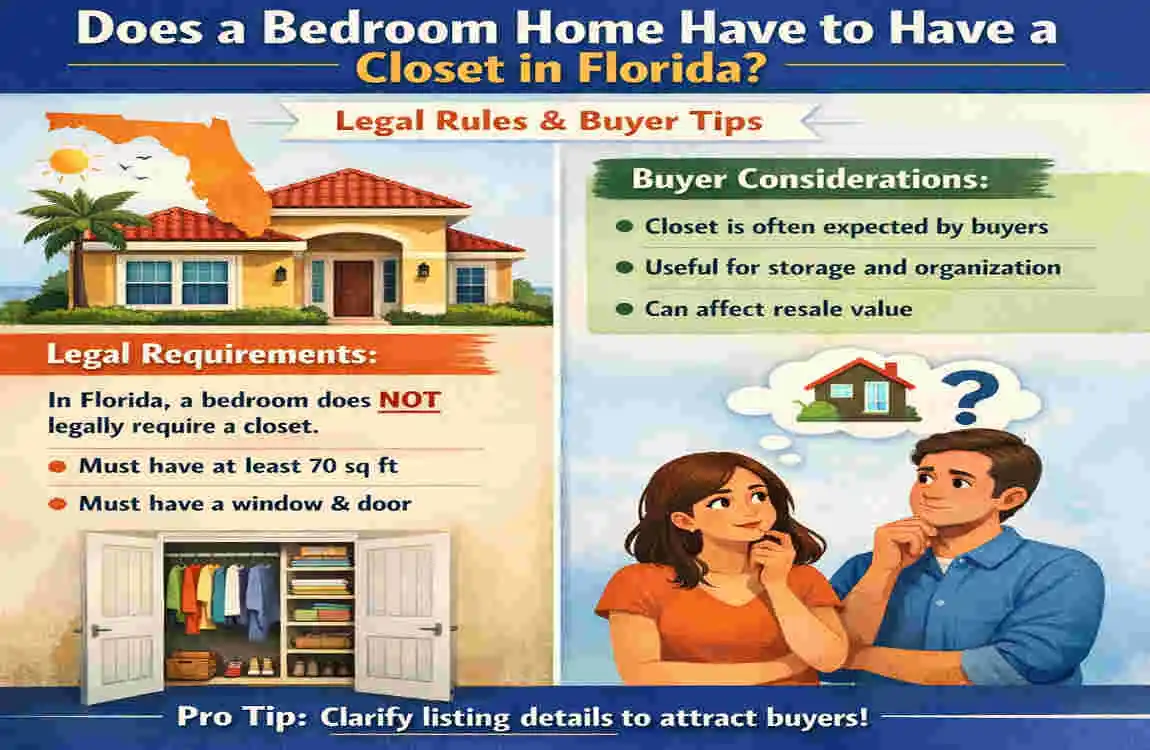
You have finally found what looks like your dream home in a sunny Florida neighborhood. It’s listed as a “3-bedroom, 2-bath” property. You walk through the front door, excited to tour the main suite and the guest rooms. But when you step into the third “bedroom,” you notice something strange. There is a window, a door, and plenty of space for a bed—but there is absolutely no closet.
This is a very common situation in the Sunshine State, especially with older homes or renovated properties. So, let’s answer the big question right away to put your mind at ease about the focus keyword: No, a bedroom home in Florida does not have to have a closet under state law.
However, while the answer is a simple “no” from a legal standpoint, the reality of buying, selling, and financing a home without closets is much more complicated. There is a significant difference between what the Florida Building Code requires and what a mortgage lender or future buyer expects.
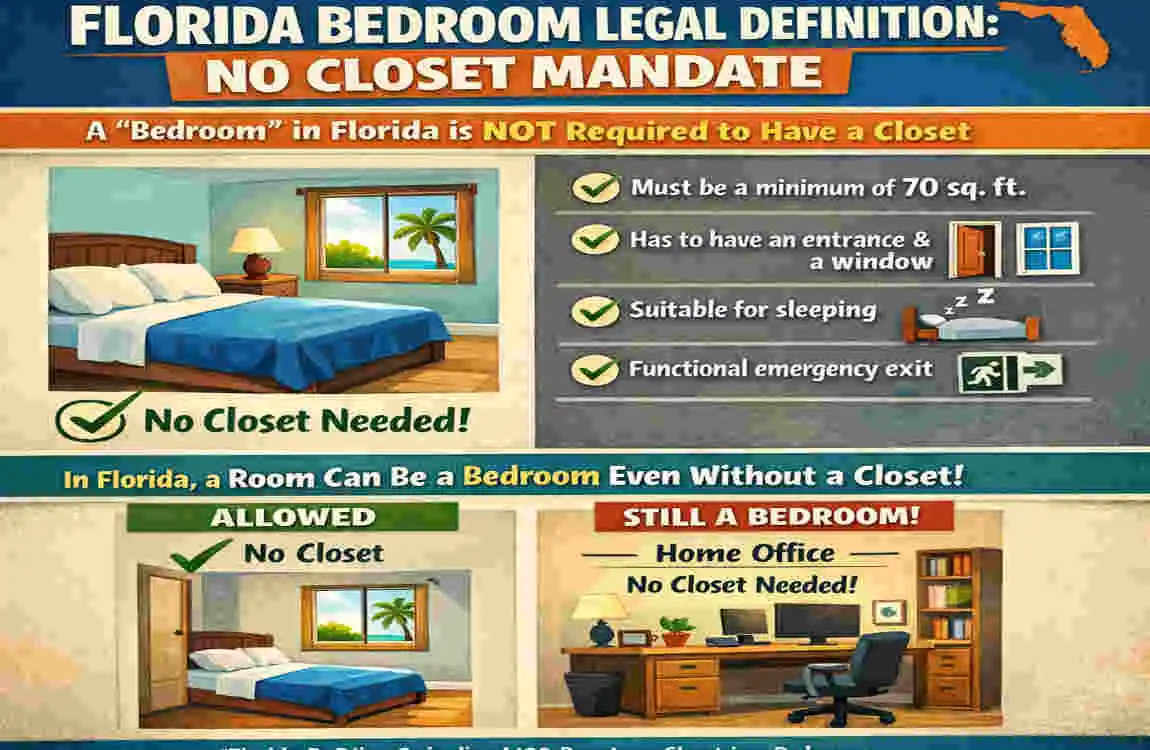
Florida Bedroom Legal Definition: No Closet Mandate
Let’s get technical for a moment, but keep it simple. When we ask, “does a room need a closet to be a bedroom Florida,” we are usually asking about the Florida Building Code (FBC). The code is the rulebook that builders and inspectors follow to ensure a house is safe to live in.
Surprisingly, the FBC focuses heavily on safety and very little on your wardrobe storage. According to Section R304 of the Florida Building Code (based on the International Residential Code), a room must meet specific criteria to be legally labeled a habitable sleeping room. Notably absent from this list? A closet.
The Real Requirements for a Legal Bedroom
If a closet isn’t required, what is? Here are the actual Florida building code bedroom requirements you need to know:
- Minimum Square Footage: The room generally needs to be at least 70 square feet (approx 6.5 square meters). If you want it to be comfortable, typical standards suggest around 120 square feet, but 70 is the legal minimum.
- Horizontal Dimensions: The room cannot be a long, skinny hallway. It generally needs to measure at least 7 feet in any horizontal direction.
- Ceiling Height: You can’t call a low-ceiling attic a bedroom. The ceiling must be at least 7 feet high for at least 50% of the floor area.
- Egress (Escape Route): This is the most critical safety feature. A bedroom must have two exits. Usually, this means one door leading to the hallway and one window (or door) leading directly to the outside. This allows you to escape in the event of a fire.
- Natural Light and Ventilation: The room generally requires a window that opens to provide natural light and ventilation.
Busting the Closet Myth
Why do so many people believe a closet is mandatory? It is a classic case of confusing lender preferences with state law. For decades, organizations such as the FHA (Federal Housing Administration) and the VA (Department of Veterans Affairs) preferred homes with bedrooms with closets for valuation purposes. Over time, real estate agents and buyers began to assume this preference was a legal requirement.
However, if you look at the FBC 2023 edition (and previous versions), you will not find a single line mandating a built-in closet. The code cares that you don’t burn to death in a fire (hence the window requirement) and that you don’t suffocate (hence the ventilation requirement). It does not care where you hang your pants.
Comparison: Florida Code vs. Common Myths
To make this crystal clear, let’s look at a comparison between what the law says and what most people think the law says.
Requirement: Florida Building Code (The Law)Common Misconception ( The Myth)
Closet Not required Must have a built-in closet
Egress 1 window + 1 door (usually) Must have 2 full windows
Size 70 sq ft minimum . Must be at least 100 sq ft
Ceiling 7 ft minimum height . Must be 8 ft or higher
Heating must have a heat source. Must have central AC (AC is not required by code!)
As you can see, the bar for a “legal” bedroom is actually quite low. This is why you will often see “dens” or “offices” listed as bedrooms in older Florida cottages.
Evolution of Florida’s Bedroom Closet Rules
To understand why the rules are the way they are, we need to look back at history. The phrase “Florida bedroom closet laws history” isn’t just about storage; it’s about the evolution of housing in the South.
The Pre-2002 Era
Before Florida adopted a unified building code, rules varied wildly from county to county. In many historic Florida homes—think of those 1920s bungalows in Seminole Heights or strict Art Deco homes in Miami—closets were considered luxury furniture, not structural requirements. People used armoires and wardrobes. It wasn’t until the post-war boom that built-in closets became the American standard. Even then, the code never officially caught up to mandate them.
The Hurricane Andrew Effect
In 1992, Hurricane Andrew devastated South Florida. In the aftermath, the state realized its building codes were a mess. This led to the creation of the unified Florida Building Code (FBC).
When the FBC was written (and in subsequent updates, such as the 7th Edition in 2020 and the 8th in 2023), the focus was entirely on structural integrity and life safety. The priority was ensuring the roof stayed on during a Category 4 storm and that windows could withstand impact. In the grand scheme of safety, whether a bedroom had a closet was deemed irrelevant by code officials.
Regional Variations: Miami-Dade vs. The Panhandle
While the definition of a bedroom remains consistent across the state, does a bedroom home in Florida have to have a closet? No other requirements have changed.
For example, in Miami-Dade and Broward Counties, the “High Velocity Hurricane Zone” codes are incredibly strict regarding windows. If you convert a garage into a bedroom in Miami, the egress window requirements are much more expensive to meet than in Ocala. However, neither county will force you to build a closet to call it a bedroom on the blueprints.
Expert Insight: According to veteran Florida building inspectors, the confusion often arises during renovations. An inspector will fail a room addition because the window is too small (egress violation), not because the closet is missing.
Why Closets Matter in Florida Real Estate
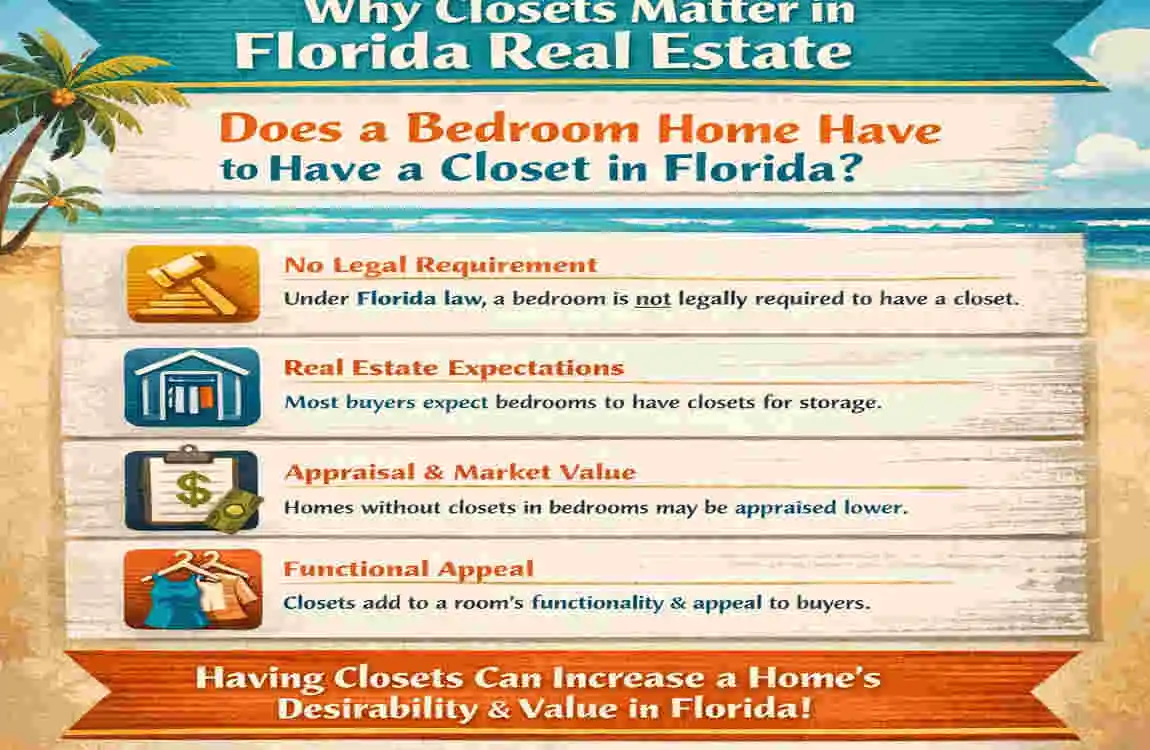
Just because you can have a bedroom without a closet doesn’t mean you should. In the world of real estate, “legal” and “marketable” are two very different things. If you are asking, “Does a bedroom home have to have a closet in Florida for loans?” the answer gets murky.
Lender and Appraisal Impacts
This is where the rubber meets the road for buyers. While the building code doesn’t care about closets, appraisers and lenders certainly do.
- FHA and VA Loans: Government-backed loans like those from the FHA or VA are strict. They want to ensure the property is marketable. If an appraiser walks into a room listed as a bedroom and sees no closet, they might reclassify it as a “Den,” “Office,” or “Bonus Room.”
- The Consequence: If a “3-bedroom” house is reclassified as a “2-bedroom” house by the appraiser, the value of the home could drop significantly. This could cause your loan to fall through because the house is no longer worth what you offered to pay.
- Fannie Mae / Freddie Mac: Conventional loans are generally more lenient. They rely on the appraiser’s judgment of the local market. If you are buying a historic home in St. Augustine that has no closets, it might be accepted. But in a modern Orlando subdivision? It will likely be penalized.
- Appraisal Value: Data generally shows that homes with functional closets in all bedrooms appraise 5% to 10% higher than comparable homes without them. This is what appraisers call “functional utility.”
Buyer and Seller Perspectives
For Buyers: Buying a house without bedroom closets in Florida comes with risks.
- Resale Value: You might be okay with an armoire, but will the next buyer be? You might struggle to sell the home later if families feel the storage is inadequate.
- Insurance: While rare, some insurance companies look at the “number of bedrooms” to determine liability and rates. If there is a discrepancy between the listing and the actual build, it creates friction.
For Sellers: If you are selling, be careful.
- Marketing Strategy: If you list a room without a closet as a bedroom, be prepared for buyers to push back on the price.
- Liability: Listing a room as a bedroom when it doesn’t meet the expectation of a bedroom (even if it meets the code) can lead to angry buyers and wasted time on pending contracts that fall through during inspection.
Closet Alternatives for Florida Homes
So, you’ve fallen in love with a closet-less bedroom, or you own one and want to increase its value. What can you do? Fortunately, “Florida real estate closet rules alternatives” is a thriving topic for interior design. You don’t always need to frame out a new wall to solve the problem.
The Build-Out (Permitted)
The most permanent solution is to frame a new closet.
- The Process: You build a frame using 2x4s, add drywall, install a door, and paint.
- The Catch: In Florida, if you alter the structure or electrical system, you may need a permit. However, adding a non-load-bearing partition wall is often straightforward.
- Cost: Professional installation usually runs between $1,500 and $3,500, depending on the size and finishes.
Wardrobes and Armoires
This is the classic solution for historic homes.
- Why it works: It requires no construction. A high-quality, heavy wooden armoire serves the same function as a closet.
- Design Tip: In Florida’s humid climate, ensure the armoire has some ventilation. Tightly sealed wooden boxes can trap moisture, leading to mildew on leather shoes or clothes.
The “IKEA” Hack (Built-in Look)
You can buy large wardrobe units (like the IKEA Pax system) and bolt them to the wall.
- Value Add: If you add trim molding around the edges to make it look “built-in,” appraisers will often count this as a closet!
- Cost: $500-$1,500.
Wall-Mounted Organizers
Open closet systems are trendy and practical.
- Setup: You mount racks, shelves, and rods directly to the wall. You can hide it behind a curtain or leave it exposed for an industrial “boutique” look.
- Benefit: It keeps airflow moving around your clothes, which is excellent for preventing mold in Florida.
Murphy Bed Hybrids
In smaller rooms, you can install a Murphy bed with storage cabinets on either side. This turns a small “den” into a fully functional guest bedroom with storage, maximizing the square footage.
Step-by-Step Buyer Tips for Florida Properties
If you are actively looking at listings and searching “buying a house without bedroom closets in Florida,” follow this step-by-step checklist to protect your investment.
Verify the Listing Details. Don’t unquestioningly trust the Zillow description. If a room looks small in photos or lacks a visible closet door, ask your real estate agent specifically: “Is this room legally a bedroom, and does it have a closet?” Ask the seller to provide any documents showing that the room meets the FBC egress code requirements.
The Home Inspection is Key. During your inspection period, do not just stand around.
- Check Egress: Make sure the windows open. In older Florida homes, windows are often painted shut. If it doesn’t open, it’s not a bedroom—closet or not.
- Measure: Bring a tape measure. Is it 70 square feet? If it’s smaller, it’s a closet, not a room!
- Quote the Cost: If there is no closet, ask a contractor how much it would cost to build one.
Negotiate the Price. Use the lack of a closet as leverage. If the home is listed at the same price as a neighbor’s house that does have closets, you are overpaying.
- Strategy: Ask for a $2,000-$5,000 credit at closing to cover the cost of installing closets or buying wardrobes.
Secure the Right Financing. If you are using a VA loan, be upfront with your lender. Send them photos of the room early in the process. If they flag it, you might need to switch to a conventional loan or ask the seller to install a wardrobe unit before the appraisal takes place to satisfy the “storage” requirement.
Check 2025/2026 Market Stats. According to recent data from Redfin and Florida Realtors, approximately 20% of homes built before 1970 in Florida lack built-in closets in at least one bedroom. You are not alone in this search, but being informed puts you ahead of the competition.
Seller Disclosures and Legal Risks in Florida

If you are on the selling side, you need to navigate the “legal bedroom definition Florida no closet” minefield carefully.
Mandatory Disclosures
Under Florida Statute 689.25 and general real estate law, sellers must disclose facts that materially affect the value of the property. While you don’t have to disclose “no closet” if it’s visible, you do have to be careful not to misrepresent.
The Risk of Mislabeling
Let’s say you have a 10×10 room with no closet. You list it as “Bedroom 3.” A buyer goes under contract, pays for an inspection and appraisal, and then the financing falls through because the appraiser calls it a “Den.”
- The Fallout: You have now wasted weeks. The house has been off the market, and you now have a “stigma” on the listing.
- Lawsuits: There have been cases (like a 2024 dispute in Tampa) in which sellers were sued for misleading advertising after buyers realized the “4-bedroom” home they bought was legally only a 2-bedroom home due to egress and size issues, affecting the home’s resale value.
Pro Tips for Sellers
- Be Honest: List it as a “2-Bedroom with Den/Office” rather than a “3-Bedroom.” It manages expectations.
- Stage It: If you must list it as a bedroom, put a freestanding wardrobe in the room during showings. This shows buyers exactly how the room functions as a sleeping space.
Future Trends: Florida Bedroom Codes
As we move through 2026, the concept of a “bedroom” is changing. The “Does a bedroom home have to have a closet in Florida?” question is evolving alongside our lifestyles.
- Remote Work Impact: The demand for “Flex Rooms” is at an all-time high. Many Florida buyers now prefer a room without a closet because it offers more wall space for a home office setup or Zoom background. The strict “bedroom” definition is becoming less important than the “usable space” definition.
- Resilient Storage: With climate change concerns, we might see future building codes (FBC 9th Edition pending) addressing moisture-resistant storage solutions, encouraging open-air closets over dark, enclosed spaces that breed mold in high humidity.
- Smart Homes: We are seeing a rise in automated storage solutions and modular furniture that make traditional framed closets look outdated.
FAQ
Does a bedroom home have to have a closet in Florida? No. The Florida Building Code requires bedrooms to have specific square footage, ceiling height, and egress (exit) points. Still, it does not mandate a built-in closet.
Does a room need a closet to be a bedroom for appraisal purposes in Florida? Often, yes. While not a law, FHA and VA appraisers usually require a closet for a room to be counted as a bedroom. If it lacks one, they may devalue it as a “den” or “bonus room.”
What are the Florida building code bedroom requirements? A bedroom generally needs to be at least 70 square feet, have a ceiling height of at least 7 feet, and have two means of egress (usually a door and a window).
Can I finance a Florida home without bedroom closets? Yes, usually with a conventional loan. However, government-backed loans (FHA/VA) are stricter and may require you to install a wardrobe or closet to secure the loan.
Is a window required in a bedroom in Florida? Yes. A window is required for two reasons: natural light/ventilation and, most importantly, as an emergency escape route (egress) in case of fire.
Does a closet count as square footage in a bedroom? Yes. When measuring the total square footage of a home or a specific room, the closet space is included in the total heating/cooling area calculation.
