
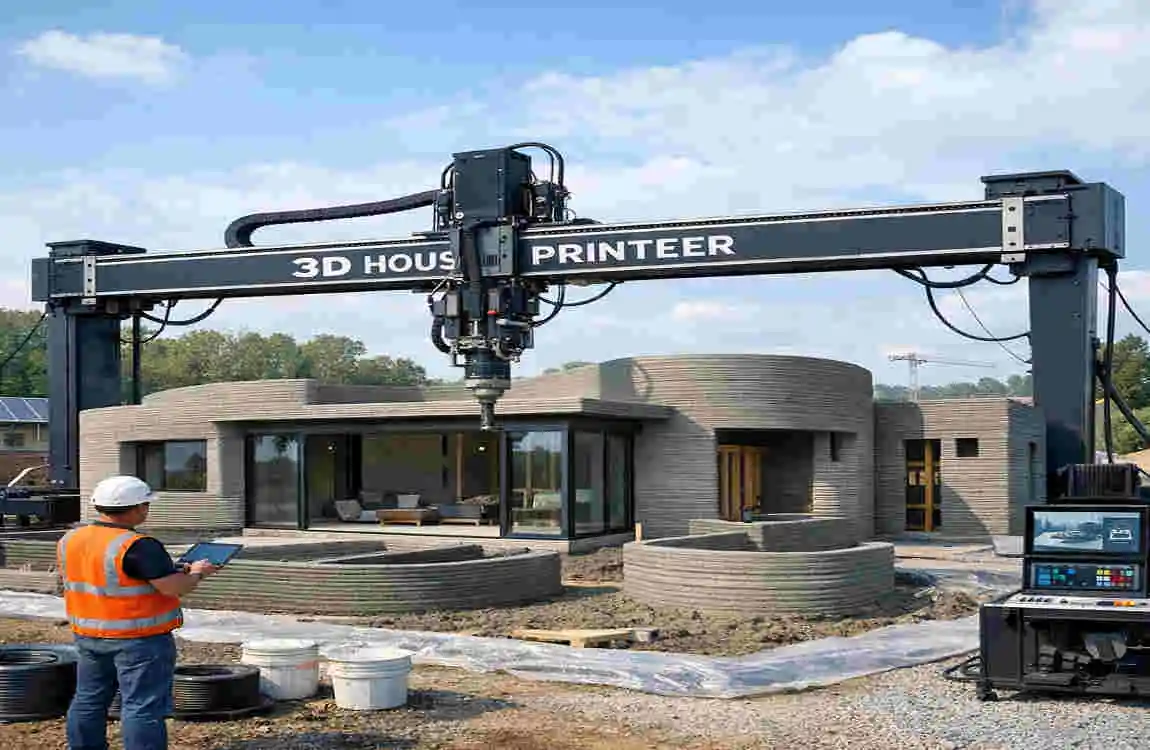
A vacant lot on a Monday morning, and by Wednesday evening, walking through the framed walls of a brand-new home. It sounds like a scene straight out of a science fiction movie, doesn’t it? For decades, we’ve dreamed of instant housing, but today, that dream is rapidly becoming a reality. The secret behind this transformation isn’t a team of super-speedy construction workers; it is the house architectural printer.
These massive machines are quietly (and sometimes not so quietly) rewriting the rulebook of construction. We are witnessing a shift that is as significant as the industrial revolution was for manufacturing. The concept of architectural house printing is moving from fringe experiments to mainstream solutions, tackling global issues such as housing shortages, rising material costs, and environmental sustainability.
What is a House Architectural Printer?
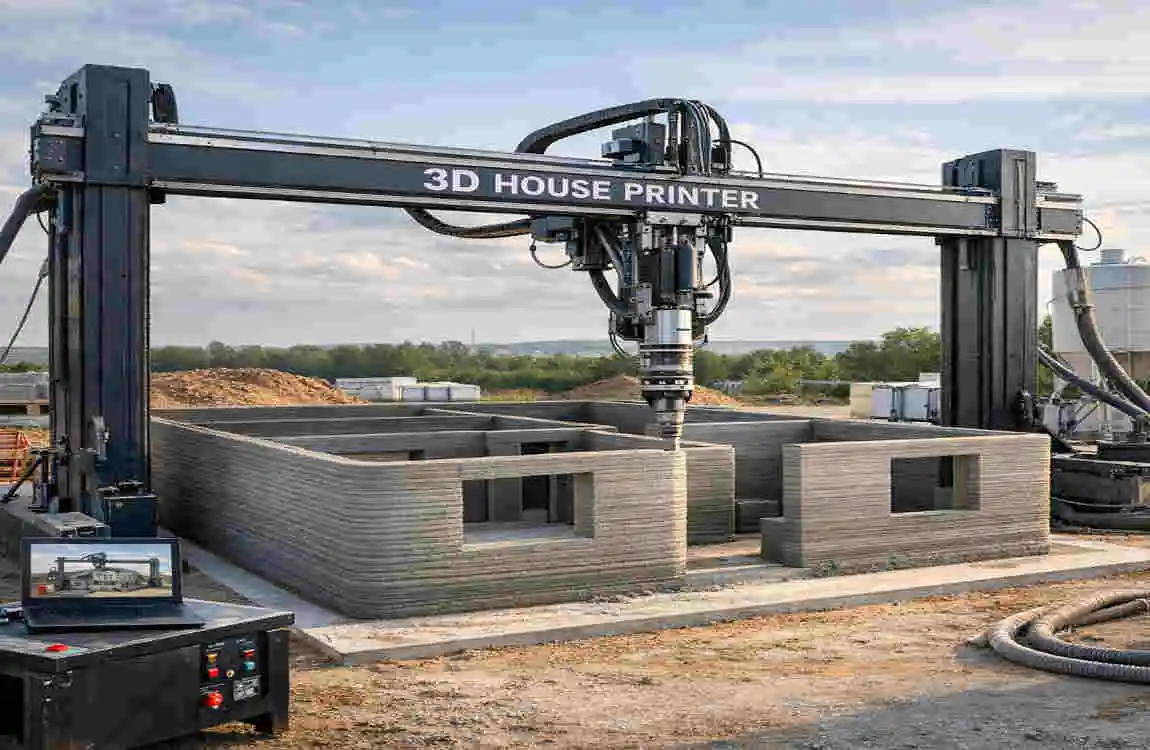
To understand the revolution, we first need to understand the machine. When you hear “3D printer,” you probably picture a small box sitting on a desktop, printing plastic Yoda figurines or spare drone parts. A house architectural printer operates on the same principle, but on a gargantuan scale.
The Core Concept
At its heart, a house architectural printer is a large-scale robot designed to extrude construction materials—usually a proprietary concrete mixture, polymers, or even mud—layer by layer to create the walls and foundation of a building. Think of it like a giant, computer-controlled piping bag used for icing a cake. But instead of frosting, it is piping out robust, structural concrete that cures quickly and supports the weight of a roof.
These machines utilize digital files, usually created in CAD (Computer-Aided Design) software, to tell the printer exactly where to go. The printer follows these coordinates with sub-millimeter precision, creating shapes and structures that would be incredibly difficult, expensive, or time-consuming for human hands to build using traditional bricks and mortar.
Key Components of the Beast
Most architectural 3D printing systems rely on three main components to function:
- The Gantry or Robotic Arm: This is the printer’s physical body. Some look like massive cranes (gantry systems) that slide on rails built around the construction site. Others look like robotic arms (similar to those used in car manufacturing) mounted on a mobile base.
- The Extruder: This is the nozzle at the end of the arm. It controls the flow of the material, ensuring the layers are consistent in width and height.
- The Material Delivery System: A mixer pumps the concrete or polymer from a reservoir through a hose to the extruder. The mix has to be perfect—fluid enough to pump, but solid enough to hold its shape the moment it hits the previous layer.
From Prototypes to Skyscrapers
The evolution of the house architectural printer has been nothing short of meteoric. In 2014, the world watched in awe as a Chinese company printed rudimentary concrete huts. Fast forward just a decade, and we are seeing fully permitted, multi-story homes in the United States and massive office complexes in Dubai.
Unlike the early days, when finishes were rough and walls looked like squeezed toothpaste, modern printers offer sleek, refined aesthetics. The technology has graduated from “cool experiment” to a viable industrial solution capable of printing entire neighborhoods.
The Technology Behind House Architectural Printers
Understanding how 3D printing works for homes demystifies the process and highlights why this method is gaining so much traction. It isn’t magic; it is a brilliant marriage of software, chemistry, and robotics.
The Step-by-Step Workflow
The journey of a 3D printed home begins long before the printer arrives at the job site.
- Digital Design: Architects create a 3D model of the house. This allows for incredible creativity—curved walls, organic shapes, and complex internal structures are just as easy to draw as straight lines.
- Slicing: The 3D model is fed into “slicing” software. This program cuts the digital house into thousands of horizontal layers. It translates these layers into G-code, a programming language that tells the printer exactly how to move (X, Y, and Z coordinates) and how fast to extrude material.
- Site Preparation: Just like a normal house, you need a flat foundation. Once the slab is poured and cured, the house architectural printer is set up around the perimeter.
- Printing: The printer hums to life. It moves along its tracks, laying down the first bead of concrete. It creates the wall’s inner and outer shells. Often, it leaves a hollow zig-zag pattern inside the wall for insulation and strength.
- Curing and Finishing: As the layers stack up, the material cures (hardens). Once the walls are done, human workers step in to install windows, doors, plumbing, electrical wiring, and the roof.
Material Science: The Secret Sauce
You can’t just put sidewalk cement into a house architectural printer. Standard concrete takes days to cure; 3D printing requires a mix that sets in minutes so the next layer doesn’t squash the one below it.
Innovators have developed “Lavacrete” and other proprietary bio-mixtures. These materials often incorporate recycled plastics, fly ash, or locally sourced soil, making them stronger and more resilient than standard cinder blocks.
Advancements in Printer Models
Several companies are leading the charge in architectural 3D printing hardware:
- ICON’s Vulcan: Perhaps the most famous, this printer has been used to build homes in Texas and Mexico. It is designed to work in rugged conditions and can print homes up to 3,000 square feet.
- Apis Cor: Known for their robotic arm approach, which allows for easier transport and setup compared to gantry systems. They famously printed a building in Dubai in record time.
- COBOD: A European leader whose BOD2 printer is one of the fastest on the market, capable of printing up to 100 cm per second.
These machines are integrating AI to monitor print in real time. If the weather changes or the mix consistency fluctuates, the AI instantly adjusts the print speed to prevent errors, achieving precision with error margins of less than 1%.
Benefits of House Architectural Printers in Home Design
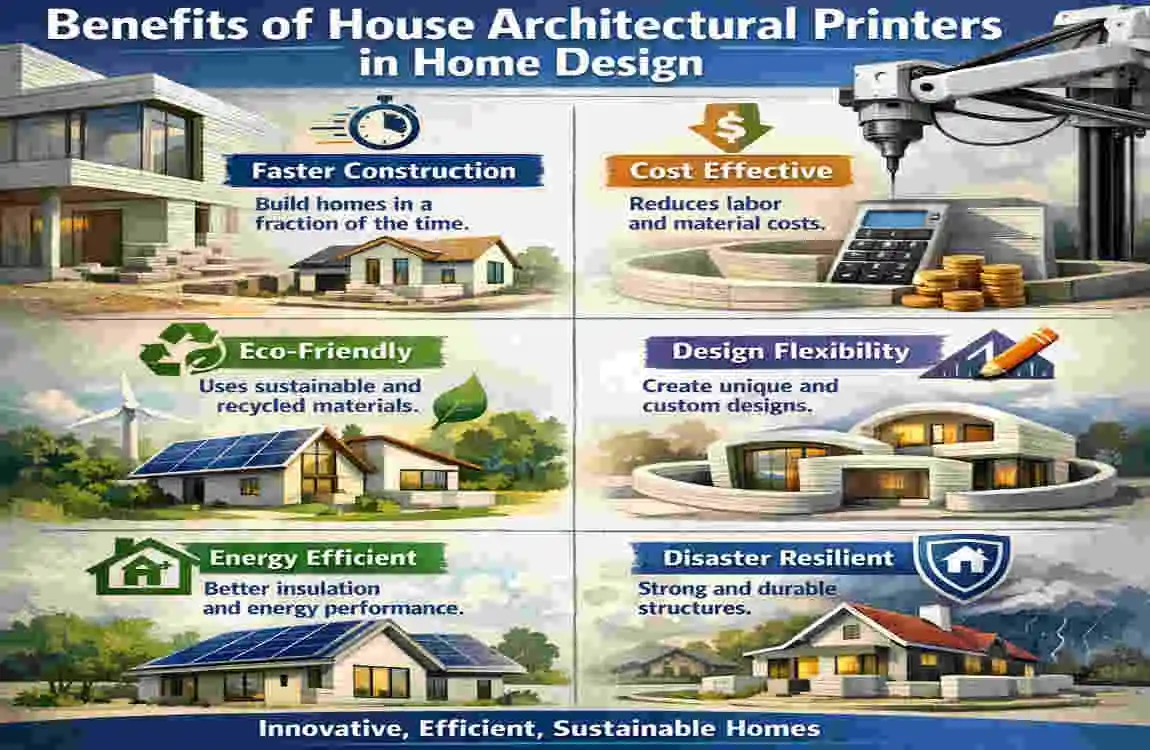
Why go through the trouble of reinventing construction? Because the traditional method of building—laying one brick at a time or framing with wood—is slow, wasteful, and increasingly expensive. House architectural printers offer a suite of benefits that address these pain points directly.
Unmatched Speed
Time is money in real estate. A traditional home frame might take weeks to erect. A house architectural printer can print the walls of a 1,000-square-foot home in 24 to 48 hours of print time. When you factor in setup, you are looking at days, not months. This speed is a game-changer for disaster relief scenarios that require immediate shelter.
Significant Cost Savings
While the printers themselves are expensive (often costing $500,000+), the cost per house drops dramatically.
- Labor: You don’t need a massive crew of masons. You need a few technicians to monitor the robot.
- Materials: The printer uses exactly the amount of material needed. There is no pile of cut-off 2x4s or wasted bricks.
- Affordability: Companies have successfully printed homes for under $10,000 in wall materials. This opens up homeownership to demographics previously priced out of the market.
Sustainability and Eco-Friendliness
Construction is notoriously wasteful. 3D printed architecture changes this narrative. By using additive manufacturing (adding material only where needed) rather than subtractive, waste is reduced by up to 60%. Furthermore, many companies are experimenting with biodegradable materials and geopolymer concrete, which produce significantly less CO2 than traditional cement.
Design Freedom and Customization
This is where architects get excited. In traditional building, a curved wall is a nightmare—it requires custom framing, drywall bending, and skilled labor. For a house architectural printer, a curve is just a different line of code. It costs the same to print a straight wall as it does a wave. This allows for parametric design, where homes can be optimized for wind flow, solar gain, or pure aesthetic beauty without breaking the budget.
Durability and Safety
Don’t let the speed fool you; these houses are tanks. The continuous bonded layers create a monolithic structure that is incredibly resistant to lateral forces. 3D printed homes in Florida and Texas have been tested to withstand hurricane-force winds that would shred a wooden stick-frame house. They are also naturally fire-resistant and termite-proof.
Comparison: Traditional Build vs. 3D Printed Home
Feature Traditional Wood/Brick Build3D Printed Home
Construction Time (Walls) 2 – 6 Weeks 24 – 72 Hours
Waste Generated High (Average 3-5 tons per home) Low (Near zero waste)
Design Flexibility Limited (Square/Rectangular is cheapest) Unlimited (Curves cost the same)
Labor Requirement Large Crew (Carpenters, Masons) Small Crew (2-3 Technicians)
Weather Resistance Moderate (Susceptible to rot/termites) High (Fire, wind, & insect proof)
Precision Human Error Margin Millimeter Precision
Real-World Case Studies and Success Stories
This isn’t just theory. House architectural printers are already on the ground, building communities. Let’s look at some real-world examples that prove the concept.
Icon’s “Community First! Village” (Texas, USA)
Based in Austin, Texas, ICON is a titan in the industry. They partnered with a non-profit to build homes for the chronically homeless in the “Community First! Village.” Using their Vulcan printer, they created beautiful, dignified, and durable 400-square-foot homes.
- The Impact: These homes were built in a fraction of the time it would normally take, allowing vulnerable people to get off the streets more quickly. The design features organic curves that make the small spaces feel larger and more welcoming.
Project Milestone (The Netherlands)
Europe is pushing the boundaries of design with Project Milestone. Located in Eindhoven, this project aims to print five concrete houses. The first, a boulder-shaped single-story home, has already been rented out.
- The Innovation: This project highlights the aesthetic potential of architectural 3D printing. The homes look like natural rock formations. It proves that printed homes can meet strict European building codes and energy-efficiency standards while still looking like pieces of art.
The World’s First 3D Printed Office (Dubai)
Dubai has set a mandate that 25% of its buildings will be 3D printed by 2030. To kick this off, they built the “Office of the Future.”
- The Stats: The entire structure was printed in just 17 days and installed in 2 days. Labor costs were cut by 50% compared to a building of similar size. It currently serves as the headquarters for the Dubai Future Foundation, acting as a functional monument to the technology.
3D Printed Schools (Madagascar & Ukraine)
Non-profit organization Thinking Huts is using house architectural printers to build schools in areas with limited infrastructure. In Madagascar, they printed a school in a location where sourcing traditional materials and labor was incredibly difficult. The honeycomb wall structure provided natural cooling, essential for the local climate.
Challenges and Limitations of House Architectural Printers
While I am clearly a fan of this technology, it is important to take a balanced view. The revolution has hurdles to clear before you see a house architectural printer on every street corner.
Scalability and Height
Currently, most 3D house printing is limited to single-story or low-rise buildings. Printing a skyscraper is technically possible but logistically a nightmare with current gantry systems. You would need a printer taller than the building itself! While companies are working on “climbing” robots, we are largely stuck on the ground floor for now.
Regulatory Hurdles
Technology always moves faster than the law. Building codes in most cities were written for wood and brick, not printed polymers.
- Permitting: Getting a permit for a 3D-printed home can be a long battle with local municipalities that don’t understand the safety data.
- Inspection: Inspectors often don’t know what to look for, leading to delays. However, international standards (like UL 3401) are being developed to streamline this.
Material Constraints and Costs
While the walls are cheap, the printer is not. The high upfront capital investment prevents small contractors from adopting the tech. Additionally, we are still limited in the materials we have. You can’t yet print a house with built-in wiring, plumbing, and insulation in one go. Human labor is still required for the “guts” and finishings of the house, which bottlenecks the speed benefits.
The “Ugly” Factor
Early printed homes had very visible layers, often called “layer lines.” While some find this textured look appealing, traditionalists often see it as unfinished. Smoothing these walls requires extra labor, which cuts into the cost savings.
Future of House Architectural Printers in Home Design
So, where is this all going? If we look into the crystal ball for house architectural printing, the future looks incredibly integrated and smart.
Mass Adoption by 2030
Analysts predict that by 2030, 3D printed architecture will be a standard option in new housing developments. We will likely see “hybrid” construction sites where printers handle the shell, and prefabricated modules handle the kitchen and bath.
Multi-Material Printing
The holy grail of printing is the ability to use multiple materials simultaneously. Imagine a house architectural printer that lays down concrete for structure, sprays conductive ink for wiring, and injects foam for insulation—all in a single pass. Research is already underway to make this happen, which would virtually eliminate the need for follow-up trade labor.
Space Exploration
It is impossible to talk about the future of this tech without mentioning Mars. NASA is actively funding competitions for 3D printed habitats. The idea is to send autonomous printers to the Moon or Mars ahead of astronauts. These printers would use local regolith (moon dust) to print radiation-shielded shelters. If we can print a house on Mars, printing one in the suburbs will be a piece of cake.
Integration with VR and Smart Homes
Future homeowners might design their house in Virtual Reality (VR), walk through it digitally, customize the wall curvature with a hand gesture, and then hit “Print.” The house architectural printer will then execute that exact custom design. This level of personalization is currently available only to billionaires, but 3D printing will democratize it.
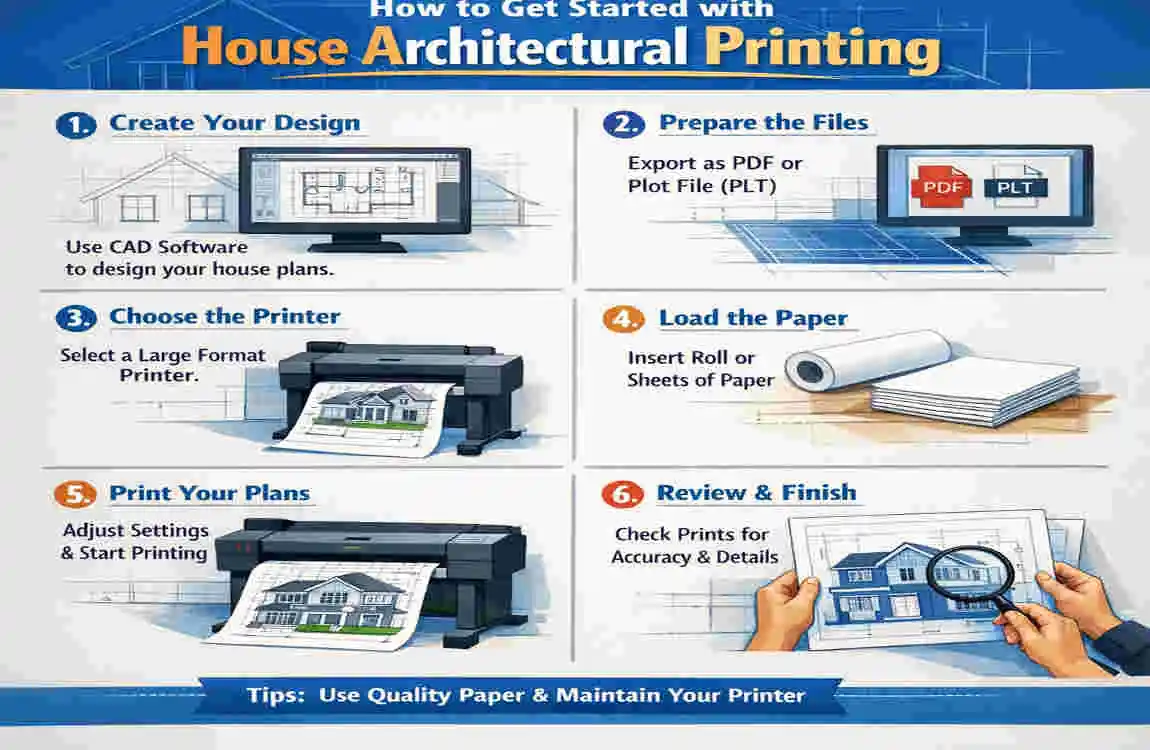
How to Get Started with House Architectural Printing
You might be reading this and thinking, “This is great, but how do I get involved?” Whether you are an architect, a builder, or a prospective homeowner, there are ways to step into this world.
For Architects and Designers
If you want to design for house architectural printers, you need to master parametric design tools.
- Learn the Software: Tools like Rhino (with the Grasshopper plugin) and Autodesk Fusion 360 are the industry standards. They let you create the mathematical geometry printers love.
- Understand the Constraints: Learn the “overhang” limits. A printer can’t print into thin air; it needs a layer below it. Designing for 3D printing requires a new way of thinking about gravity and structure.
For Investors and Builders
If you are looking to start a business, the barrier to entry is high but lucrative.
- Partnerships: Instead of buying a $500k printer immediately, partner with existing service providers like Black Buffalo or Mighty Buildings.
- Identify Markets: Look for areas with high labor costs or housing shortages. These are the markets where the margins for 3D printed homes make the most sense.
For Homeowners
Want to live in one?
- Search for Developments: Look for “3D printed communities” in places like Texas, California, and Florida.
- Custom Builds: If you own land, you can hire a specialized firm to print on your lot. Be prepared for a longer permitting process, but the result will be a home unlike any other in your neighborhood.
