


You are scrolling through property listings late at night, coffee in hand, and then you see it: the home. It has the right location, the layout you want, a decent yard, and the kind of look that instantly makes you picture your future there. You click it with real excitement, only to find a frustrating label: ‘off-market‘.
Now you pause and wonder: if a house is off-market, what does that mean? Is it sold? Is it still available? Can you make an offer? Did you miss your chance?
That confusion is very common. Many buyers assume “off-market” always means the home is gone for good. In reality, the answer is not always that simple. In real estate, an off-market property can mean several different things, and some of those situations may still create opportunities for you as a buyer.
This matters because off-market deals are not rare. In many areas, estimates suggest they account for around 10% to 20% of property sales, depending on market conditions, local practices, and agent networks. That means a noticeable share of homes changes hands without ever being widely advertised on public listing platforms.
For buyers, this can feel unfair at first. After all, how can you compete for homes you never even get to see? But there is another side to the story. Off-market properties can also open doors to less competition, quieter negotiations, and better deals if you know where to look and how the process works.
What “Off-Market” Means in Real Estate

If a House Is Off Market, What Does It Mean?
Let’s start with the basic definition.
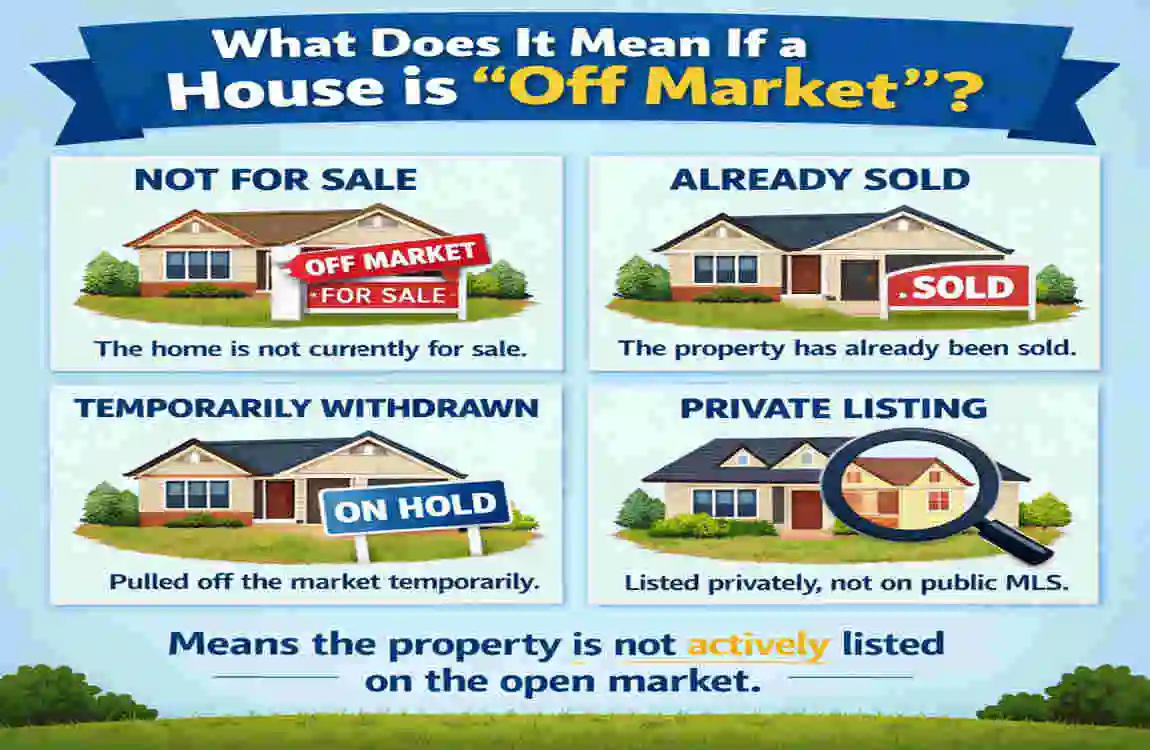
An off-market house is a property that is not being publicly advertised for sale on the usual platforms, such as MLS databases, major real estate websites, or public property portals. In simple words, the house may still be available to buy, but it is being sold more privately.
Instead of being shown to everyone, it may be shared through:
- a real estate agent’s private network
- direct contact between buyer and seller
- investor circles
- builder contacts
- word of mouth
- local community connections
So, if you have ever asked, ” If a house is off market, what does it mean, the short answer is this: the property is not openly listed for the public, but it may still be in play.
That is why the term can be confusing. “Off-market” does not always mean “sold.” Sometimes it means “quietly available.”
Off-Market vs On-Market Homes
An on-market home is easier to understand. It is listed publicly. Buyers can see it online, agents can schedule showings, and the seller is openly inviting offers.
An off-market home works differently. The seller does not want full public exposure. They may want to choose who sees the property, avoid crowds, or handle the sale in a more controlled way.
Here is the key difference:
- On-market: public listing, broad exposure, more buyers
- Off-market: private sale path, limited exposure, fewer buyers
This difference changes the entire buying process. On-market homes often create competition. Off-market homes often rely more on relationships, timing, and negotiation.
Common Types of Off-Market Properties
Off-market is a broad term, and it helps to break it down into the most common categories.
Pocket Listings
A pocket listing is one of the best-known forms of off-market property. In this setup, the seller hires an agent, but the home is not entered into the public MLS. Instead, the agent keeps the listing “in their pocket” and shares it only with select buyers or trusted contacts.
This often happens when a seller wants privacy or wants to test interest before going public.
For example, a high-profile family or a local business owner may not want dozens of strangers walking through their home. So the agent quietly speaks only to serious buyers.
Expired Listings
An expired listing is different. This property was once on the market but did not sell during the listing period. The seller may have pulled it back rather than renewing the listing.
Sometimes these owners still want to sell. They may be tired of the public process or unhappy with the earlier results. That can create an opening for buyers who know how to approach them carefully.
This is why the term “expired MLS ” often comes up in discussions about hidden inventory.
Pre-Market or “Whisper” Listings
Some homes are in a pre-market stage. The seller plans to sell soon, but the property has not officially launched. Agents may quietly mention it to a few buyers to measure interest.
This is sometimes called a whisper listing because the home is being discussed behind the scenes before it reaches the wider market.
For buyers, this can be a big advantage. You may get access before the property sparks public attention.
Direct Private Sales
In some cases, there is no public listing at all. The homeowner may sell directly to a neighbour, investor, friend, or someone who approached them with interest. This is a true private sale.
You will often see this with:
- family transfers
- builder direct deals
- investor purchases
- for-sale-by-owner situations
- relocation cases where speed matters
Real-World Examples of Off-Market Sales
Off-market deals happen at every level of the market.
Celebrities often use private sales to protect their privacy. They do not want public photos, open houses, or media attention. So their homes are shown only to vetted buyers.
But off-market sales are not just for luxury homes.
A normal example could be a family in a neighbourhood telling a local agent, “We may sell, but only if the right buyer comes.” The agent then quietly shares the opportunity with a few serious clients. No public ad is posted, but the house is effectively available.
Another example is a property owner whose MLS listing expired. They still want to move but do not want the stress of staging and repeated showings. If you approach them with a clean, serious offer, you may get a conversation that other buyers never knew was possible.
That is what makes off-market real estate so interesting. It exists in the spaces that public listings do not fully show.
Why Houses Go Off-Market
There are many reasons a seller chooses not to list a home publicly. In most cases, the choice comes down to privacy, speed, control, or convenience.
Here are the most common reasons:
- Seller privacy: The owner may be going through a divorce, an inheritance issue, a financial challenge, or a sensitive relocation. They do not want neighbours, coworkers, or the public watching the process.
- Quick sale: Some sellers want to avoid weeks of showings, marketing, and open houses. A direct buyer can make the process faster and simpler.
- Testing demand: A seller may want to quietly test buyer interest before fully launching the property.
- Builder or FSBO deals: Some builders and for-sale-by-owner sellers prefer direct transactions rather than using public listing systems.
- Tenant-occupied property: Landlords often avoid public listings because they can disturb tenants and create scheduling problems.
- Property condition: If the home needs repairs, the seller may worry that a public listing will attract low opinions or too many questions.
- Family or local network sale: Sometimes the seller already has likely buyers in mind, such as relatives, neighbours, or investors.
Why This Appeals to Sellers
From the seller’s perspective, an off-market sale can offer real benefits.
First, it provides more control. The seller can decide who sees the home and when. They do not have to deal with endless viewings or strangers entering the property.
Second, it can save time and stress. A seller who is moving for work or facing a personal life change may value simplicity over maximum exposure.
Third, it may lead to a quicker and cleaner transaction. If the right buyer appears early, the seller may be happy to skip the full marketing process.
What This Means for Buyers
For buyers, these same reasons can work in your favour.
Because the home is not publicly advertised, there may be less competition. Fewer buyers know it exists. That lowers the chance of a bidding war.
At the same time, seller motivation can be stronger. A person who wants privacy or speed may be more open to flexible terms, smoother negotiation, or a reasonable offer from a serious buyer.
So while off-market homes can seem mysterious, they often exist because the seller wants a simpler path. If you understand that motivation, you can position your offer more attractively.
Benefits for Home Buyers
Buying off-market is not always easier, but it can bring major advantages. In the right situation, it can save you time, money, and a lot of emotional stress.
Key Benefits at a Glance
BenefitDescription
Less Competition. You may avoid bidding wars because fewer buyers know the property is available.
Better Pricing: Some sellers accept fair offers below full market hype in exchange for speed or privacy.
Faster Closing: Fewer marketing steps can make the transaction move more smoothly.
Unique Properties: You gain access to homes that never appear on public platforms.
Less Competition Means Less Pressure
One of the biggest benefits of off-market buying is simple: you are not fighting the whole market.
When a home is publicly listed, dozens of buyers may schedule viewings within days in active areas, which often leads to rushed decisions and emotional overbidding.
With off-market properties, you may be one of only a handful of people seeing the home. That gives you breathing room. You can ask better questions, think more clearly, and negotiate with less panic.
For many buyers, this alone is worth the effort.
Better Pricing Is Sometimes Possible
Let’s be realistic. Off-market does not automatically mean cheap. Some sellers still expect full value or even premium pricing.
But there are situations where better pricing is possible.
For example, a seller who wants a fast and private sale may accept a lower but cleaner offer. They may value certainty more than squeezing every last rupee or dollar out of the property.
This is especially true when:
- The home needs repairs.
- The seller has already relocated.
- The prior listing expired.
- The owner wants to avoid an agent-heavy public marketing approach.
- The buyer can move quickly.
In those cases, you can negotiate below the price the home would likely command in a public bidding environment.
Faster Closings Can Happen
Off-market deals can also move faster.
There is often less delay because the seller is not preparing for waves of showings or waiting for multiple offers. If both sides are serious, the process can be more direct.
That does not mean you should skip inspections or legal checks. The path can be more straightforward when fewer parties are involved.
For buyers who need to move quickly, this can be a strong advantage.
You See Homes Other Buyers Never Find
Some of the most appealing homes never hit public websites.
This is especially true in neighbourhoods where owners stay for years and only consider selling if a trusted buyer appears. It also happens with inherited homes, quiet family sales, or builder inventory not widely promoted.
When you tap into off-market channels, you expand your options beyond what everyone else sees.
That matters because the perfect home for you might never show up on a major platform.
Case Study: A Quiet Deal With Strong Value
Consider this example.
A buyer had been searching for a modest family home in a well-established area for months. Public listings kept attracting multiple offers. Prices were climbing beyond the buyer’s comfort zone.
Then their agent learned of a pocket listing through another broker. The seller was relocating quickly and did not want dozens of showings. The buyer viewed the home privately, made a clean offer, and purchased it for about 8% below what similar public listings were attracting in bidding wars.
The seller got speed and privacy. The buyer got a better price and less stress.
Case Study: Saving Time and Hidden Costs
In another situation, a buyer targeted small off-market homes needing cosmetic updates. Since these homes were not heavily promoted, fewer investors competed for them.
The buyer quickly closed on one property, spent modestly on paint and fixtures, and moved in within weeks. If the same property had hit the market after light improvements, it would likely have attracted stronger competition.
The takeaway is simple: off-market does not just create price opportunities. It can also reduce the hidden costs of searching, waiting, losing bidding wars, and repeatedly paying for inspections on properties you never win.
Why This Matters
In a market where some regions are slowing while others remain uneven, off-market opportunities are becoming more important. Buyers are looking for smarter ways to avoid inflated asking prices and chaotic competition.
That does not mean every off-market house is a bargain. But it does mean that buyers who understand these channels are often better positioned than buyers who rely only on public listings.
Drawbacks and Risks
Off-market properties offer real benefits but also carry risks. You should go in with your eyes open.
Here are the most common drawbacks:
- Limited information: You may not have enough public sales data, listing history, or neighbourhood comparison points.
- Financing hurdles: Lenders still need appraisals, and if the price is not well supported, financing can get tricky.
- Potential scams or overpricing: Some sellers or middlemen may claim “exclusive” value that is not real.
- Legal and disclosure issues: If the process is informal, paperwork and disclosures may be incomplete or poorly handled.
- Less transparency: Without public marketing, it is harder to know whether the deal is genuinely fair.
Limited Data Can Make Pricing Hard
On the open market, buyers often compare recent nearby sales, listing photos, days on market, and prior price reductions.
With off-market properties, that context may be missing or incomplete. This can make it harder to judge whether you are getting a strong deal or simply buying into a private process with little evidence to support the price.
That is why independent valuation matters so much.
Financing Can Be Slower Than You Expect
Many buyers assume off-market means quick and easy. Sometimes it does. But your lender still needs to do its job.
If the home is unusual, under-improved, poorly documented, or priced too aggressively, the appraisal may come in low. That can create a financing gap.
So even in a private sale, you should expect the lender to ask hard questions.
Scams and Informal Deals Can Be Dangerous
The more private a sale becomes, the more careful you need to be.
If someone pressures you to pay a deposit without proper documents, avoids legal paperwork, or refuses standard checks, step back. A real opportunity should still stand up to professional review.
Due Diligence Is Not Optional
This is the most important rule: never let the word “exclusive” push you into skipping due diligence.
You still need:
- title verification
- inspection or condition review
- disclosure checks
- price analysis
- legal review
- financing confirmation
An off-market deal should be quieter, not riskier. The safest buyers are the ones who stay patient and verify everything.
How to Find Off-Market Houses
If a House Is Off Market, What Does It Mean for Your Search Strategy?
It means your search cannot depend only on apps and public property websites.
If you want access to off-market homes, you need a more active strategy. You must combine relationships, local observation, direct outreach, and persistence.
Let’s walk through the main steps.
Build Relationships With Local Agents
Your first and strongest move is to connect with well-networked local agents.
Not every agent has access to pocket listings, but experienced agents often hear about homes before they go public. Some sellers call their preferred agent first and say, “Bring me a serious buyer before we list this.”
When you speak with agents, be specific. Tell them:
- your budget
- preferred neighborhoods
- property type
- timeline
- whether you can move quickly
- whether you are open to repairs or fixer-uppers
The clearer you are, the easier it is for them to match you with quiet opportunities.
In cities like , this matters even more. Many transactions happen through reputation, community relationships, and local brokerage networks rather than polished online listings alone. If you are searching in DHA, Bahria Town, Gulberg, Johar Town, Model Town, or nearby localities, an agent with a strong neighbourhood presence can uncover options you will never see online.
Drive or Walk the Neighbourhoods You Like
This old-school step still works.
Some homes are not aggressively advertised, but the owner may place a simple sign, talk to neighbours, or quietly mention a possible sale. By driving or walking through your target areas, you may notice:
- handwritten “for sale” signs
- under-renovation homes likely to be sold soon
- vacant houses
- builder inventory
- homes with subtle local marketing only
This is especially useful, where not every seller depends on a major property portal. Local visibility still matters.
If you see something promising, note the address and ask your agent to investigate, or make a polite inquiry through proper channels.
Join Investor Groups and Local Online Communities
Investor groups often hear about off-market properties before regular buyers do. These groups may operate through community circles, WhatsApp groups, Facebook groups, or local real estate networks.
You do not have to be a full-time investor to benefit. You need to pay attention.
In these spaces, people often discuss:
- distressed properties
- inherited homes
- landlord sales
- builder stock
- quiet family disposals
- expired MLS or expired portal listings
Be respectful in these groups. Do not spam. Introduce yourself clearly and state what you are looking for.
A simple message like, “I’m a serious buyer looking for a 5-marla family home with flexible cosmetic repair needs” can go much further than a vague “send deals” comment.
Look for Expired Listings
An expired listing can be one of the best off-market leads.
These are homes that were listed publicly but did not sell. The owner may still be interested, but they may be tired, discouraged, or waiting for the right moment.
This creates a potential opportunity because:
- The seller may already be motivated
- Public competition has faded
- You can approach with a fresh angle
- The owner may now prefer a quieter sale
Your agent can often identify expired listings through professional systems. In some cases, you can also spot old online records or neighbourhood clues.
Approach gently. Do not assume the seller is desperate. Some took a break. But if your offer solves a problem they still have, you can reopen the conversation.
Send Direct Mail or Make Thoughtful Outreach
Direct outreach can work surprisingly well when done respectfully.
If there is a neighbourhood you love and very little inventory, you can send simple letters to homeowners saying you are a serious buyer interested in the area. This works best when the message is personal and honest, not overly aggressive.
A good letter might explain:
- who you are
- Why do you like the area
- What type of home do you want
- that you are open to a private conversation
- that there is no pressure if they are not interested
This method is common in competitive markets because it helps buyers create opportunities rather than wait for them.
similar markets, direct outreach can also happen through local references, community elders, security office contacts in gated areas, or builders familiar with the block. The exact method depends on the neighbourhood culture.
Talk to Builders, Contractors, and Property Managers
Not every off-market lead comes from an agent.
Builders may have unsold inventory that they are willing to move quietly. Contractors may know homeowners planning to sell after repairs. Property managers may hear about landlords who are done with rental headaches and want to exit.
These professionals are often close to the property pipeline. They see movement before the public does.
Let Your Network Know You Are Looking
Never underestimate word of mouth.
Tell family, friends, coworkers, neighbours, and business contacts that you are looking to buy in a certain area. Be clear and specific.
This matters because many sellers first say, “Do you know anyone interested?” before they ever contact an agent.
The more people who know what you want, the better your odds of hearing about something early.
Be Ready to Move When the Right Property Appears
Off-market opportunities can disappear quickly because they are not always circulated widely.
If you want to compete well, prepare in advance:
- Get pre-approved if financing is needed
- Keep your documents organised
- know your budget ceiling
- Have your lawyer or advisor ready
- decide what repairs you can accept
- define your must-haves and deal-breakers
Preparation is what turns a lead into a purchase.
Search Strategy Tips
If you are buying, local behaviour matters as much as online search tools.
Keep these practical tips in mind:
- Use neighbourhood-specific agents, not just general agents.
- Ask about private-sale inventory, not just listed stock.
- Check with local developers and builders for unadvertised units.
- Speak to residents and shopkeepers in the target areas when appropriate; they often know who may be selling soon.
- Verify all ownership documents carefully, because document quality and property records can vary by area.
- Do not skip legal review, especially in private deals.
The off-market path can work well, but only if you combine local networking with strong due diligence.
Real-Life Examples and Case Studies
A Fixer-Upper Bought 15% Below Market
A buyer had been searching for an affordable home in an older neighbourhood but kept losing out to stronger offers on public listings.
Through a local agent, they learned about an off-market house owned by a family that had already moved abroad. The property needed updates to the kitchen, flooring, and paint, so the family did not want the hassle of staging and public showings.
Because fewer buyers saw it, the buyer negotiated calmly and purchased the home for roughly 15% below the price of comparable updated homes in the area. After basic repairs, the value improved significantly.
The key lesson here is not that every off-market home is cheap. It is that properties needing work often perform better in quiet channels because many sellers prefer simplicity over a long public sales process.
The Risk of Moving Too Fast
In another case, a buyer heard about a “private deal” through an informal contact and rushed into it, afraid someone else would take it.
The price sounded attractive, but the buyer skipped a full property check. Later, they discovered unresolved structural issues and documentation problems that delayed financing and increased costs.
What looked like a hidden gem turned into a stressful, expensive lesson.
This is the downside of the off-market world. Urgency can be real, but so can bad decisions. A private sale is still a real estate transaction, and it must be treated professionally.
Off-Market Trends in the Housing Slowdown
As parts of the housing market cool in 2026, off-market activity is becoming more visible for two reasons.
First, some sellers want to avoid the stigma of sitting publicly on the market too long. Second, buyers are becoming more selective and seeking value beyond the usual listing channels.
That creates opportunity, but it also separates prepared buyers from unprepared ones. The people who do best are usually those who combine patience, local relationships, and disciplined due diligence.
FAQs
If a house is off the market, what does it mean exactly?
It means the house is not publicly listed for sale on major property platforms or MLS systems. It may still be available, but the sale is happening privately through agents, networks, or direct seller contact.
Can I still buy an off-market house?
Yes, in many cases you can. An off-market label does not always mean sold. It may mean the owner is selling quietly. The best way to find out is through an agent, direct inquiry, or verified local contacts.
Is off-market the same as a pocket listing?
Not always. A pocket listing is one type of off-market property where an agent privately markets the home. But off-market can also include expired listings, private sales, pre-market homes, and direct builder deals.
Are off-market homes cheaper?
Sometimes, but not always. Some sellers accept lower offers for faster delivery and greater privacy. Others still want full market value. You should always compare prices, review local sales, and get professional advice before assuming it is a bargain.
Why would a seller avoid listing publicly?
Common reasons include privacy, quick sale needs, tenant issues, divorce, relocation, testing market demand, or simply wanting more control over the process.
Are off-market deals risky?
They can be, especially if you skip due diligence. Risks include poor pricing data, appraisal problems, weak documentation, disclosure issues, and scams. Always verify title, condition, and legal paperwork.
How do I find off-market houses in my area?
Start by networking with local agents, watching neighbourhoods closely, joining investor or community groups, checking expired listings, and using respectful direct outreach to owners in your target area.
