
Imagine this: You finally saved up enough money to buy that beautiful, five-acre plot of land you’ve been eyeing for years. Maybe it’s in the rolling hills of the countryside or a quiet corner of a developing suburb. You have big dreams for this land—perhaps a retirement home, a small orchard, or simply a place to go camping on the weekends. Since there is no house on it yet, you might assume that your financial obligations are minimal. After all, you aren’t using city water, you don’t have a mailbox, and no one is living there.
Then, the first mail arrives. It’s a bill from the county assessor. You realise that even though your land is “empty,” the government still wants its share. This leads many new landowners to a fundamental question: How long do you pay property tax on land without a house?
What Is Property Tax on Vacant Land?
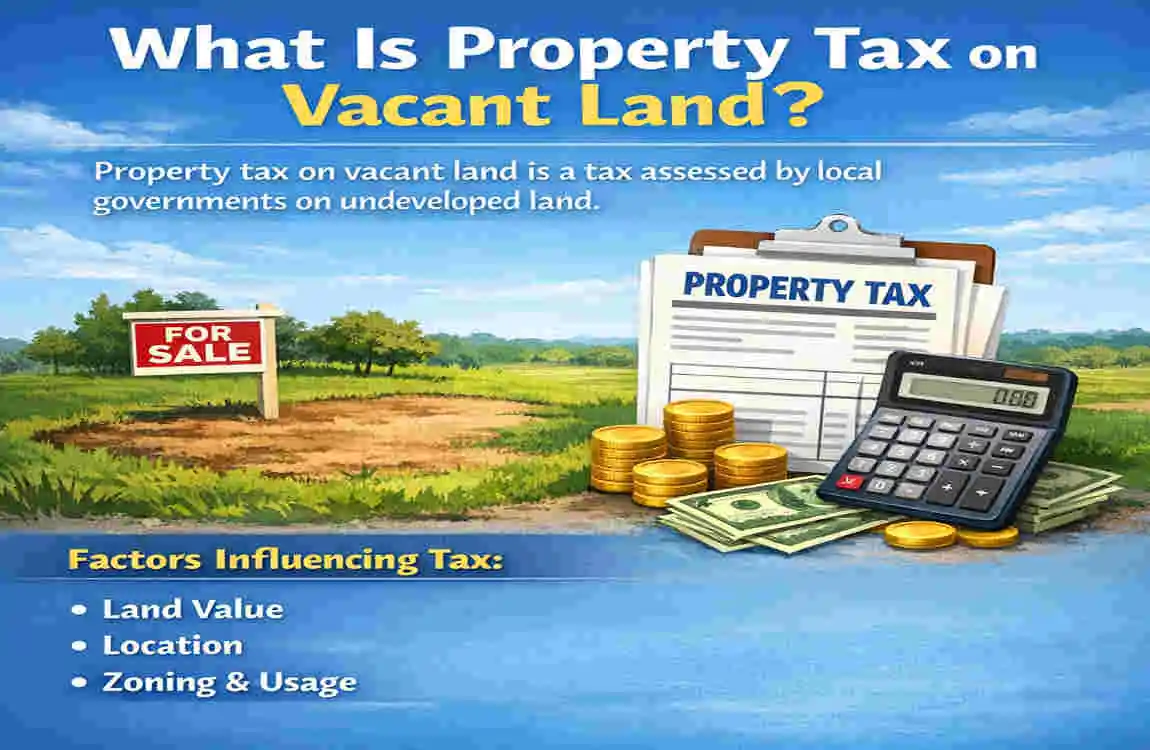
Before we talk about the “how long,” we need to understand the “what” and the “why.” Property tax is a “levy” or a fee charged by your local government—usually at the county level. This tax is based on the assessed value of the real estate you own.
Many people think that if they don’t have a structure on their land, they shouldn’t have to pay taxes. However, the law sees it differently. Even if your land consists only of dirt, grass, and trees, it is still considered a “real property asset.” The government views land as a permanent resource that benefits from the surrounding infrastructure.
Why Vacant Land Gets Taxed
You might wonder, “Why am I paying for schools and police if I don’t even live there?” It’s a fair question. The reality is that property taxes are the primary way local governments fund essential services.
Even if your land is empty, it still benefits from public infrastructure. If there is a paved road leading to your property, the county paid for that. If a fire breaks out in the nearby forest, the fire department will respond to protect the area, including your land. Furthermore, the value of your land is directly tied to the quality of the local school district and the neighbourhood’s safety.
When the government assesses your vacant land, they look at several factors:
- Location: Is it near a growing city or in the middle of nowhere?
- Size: How many acres or square feet are we talking about?
- Zoning: Is the land meant for a house, a farm, or a factory?
- Potential Use: What is the “highest and best use” of the land?
Vacant Land vs. Improved Property Tax Comparison
To help you visualise the difference, let’s look at how the tax man views a piece of dirt versus a piece of dirt with a house on it.
FactorVacant LandLand with House (Improved)
Is it Taxable? Yes, indefinitely Yes, indefinitely
Assessment Base Land value only Land value + structure value
Typical Tax Rate 0.5% to 2% of value. Often higher due to “mileage” rates
Exemptions : Agricultural, Conservation Homestead, Senior, Veteran
Maintenance Cost Low (mowing, taxes) High (repairs, utilities, taxes)
As you can see, while you pay taxes on both, the land with a house will almost always result in a much higher bill because the “improvement” (the house) adds significant value to the total assessment.
Core Answer: How Long Do You Pay Property Tax on Land Without a House?
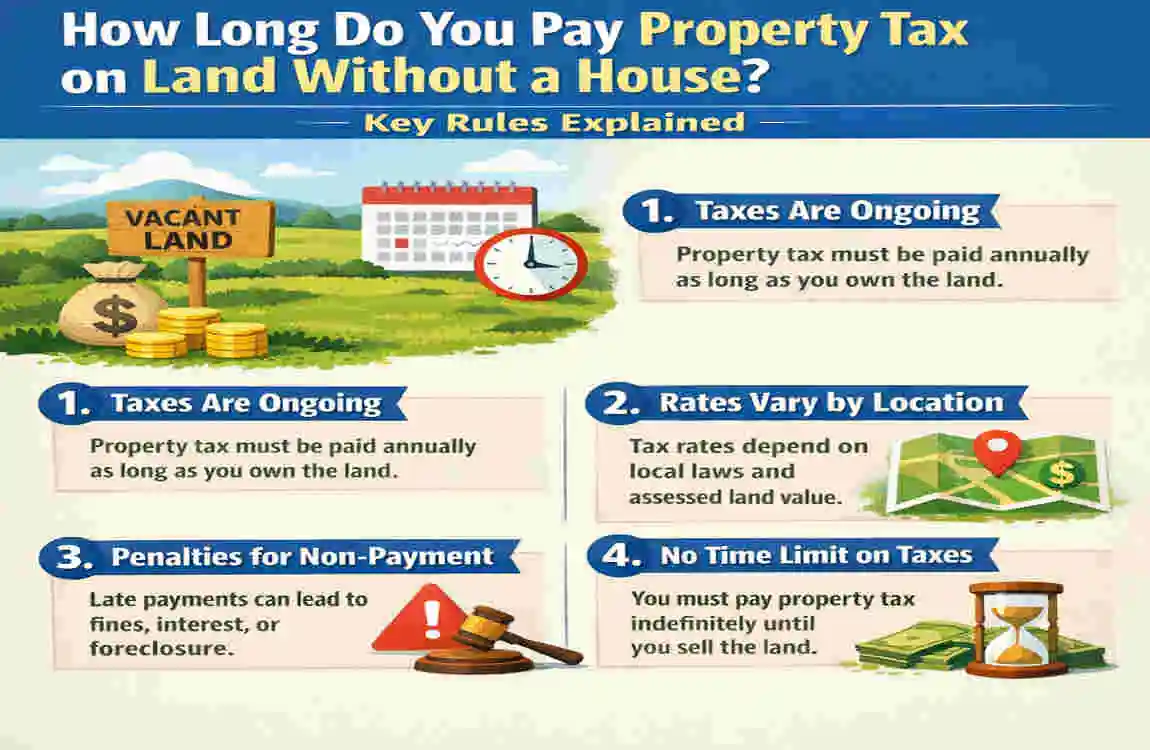
Let’s get straight to the point. You pay property tax on land without a house for as long as you own it. There is no “expiration date” for property taxes. Unlike a mortgage, which you eventually pay off and finish, property taxes are a perpetual obligation.
As long as your name is on the deed, the local government expects an annual payment. This is true whether you hold the land for five years or fifty years. The only way the tax stops is if the land’s ownership changes or the land is removed from the tax rolls (which is very rare for private citizens).
Key Rules You Need to Know
There are a few “universal truths” when it comes to the duration and nature of these taxes:
- Ownership Triggers Liability: The moment the deed is recorded in your name, you become responsible for the taxes. If you buy land mid-year, the taxes are usually “prorated” at closing, but from that point forward, it’s all on you.
- Taxes Accrue Yearly: Most counties bill you once or twice a year. If you don’t pay, the debt doesn’t just go away; it stays attached to the land itself.
- No “Empty Land” Discount: While vacant land is valued lower than land with a house, there is no rule that says you stop paying after a certain amount of time just because you haven’t built anything.
The Lifecycle of a Land Tax Bill
To understand the timeline, think of it as a cycle that repeats every single year:
- Assessment Phase: The county determines what your land is worth this year.
- Billing Phase: You receive a notice in the mail with the amount due.
- Payment Phase: You pay the bill (usually by a specific deadline in the fall or spring).
- Delinquency Phase (If you don’t pay): Interest starts to pile up. If left unpaid for years, the county can eventually take the land and sell it at a tax auction to recover the money.
Real-World Example: Imagine an investor named Sarah who buys a plot of raw land for $30,000. She plans to hold it for 15 years and sell it when the area develops. If her tax bill is $500 a year, she will pay a total of $7,500 in taxes over that period. She must factor this “carrying cost” into her investment strategy, or her profits will be eaten away.
State-by-State Rules for Property Tax on Land Without a House
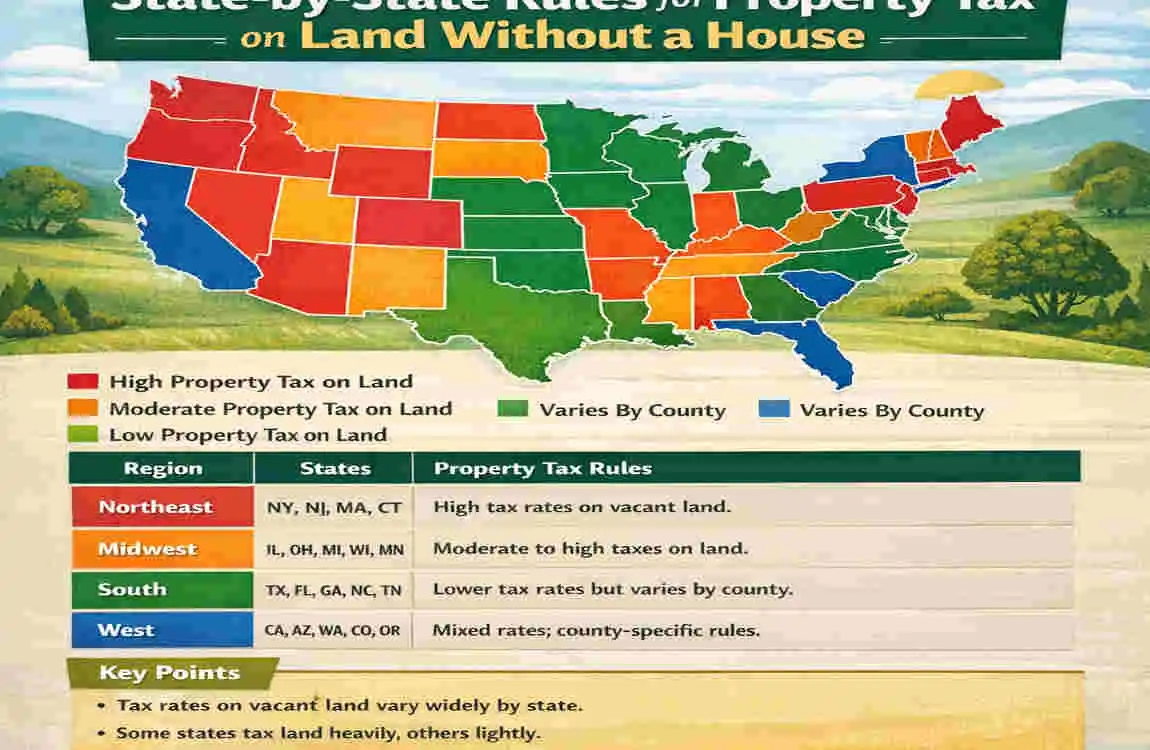
While the general rule is “pay forever,” the amount you pay and the specific local rules vary wildly depending on where the land is located. In the United States, property taxes are handled at the state and local levels, meaning there is no federal property tax.
California: The Land of Prop 13
In California, things are a bit unique due to Proposition 13. This law limits how much the assessed value of your land can increase each year (usually capped at 2%). However, even in California, you will pay property tax on vacant land indefinitely. The base rate is typically around 1% of the purchase price, plus local bonds.
Texas: High Rates but Agricultural Perks
Texas is famous for having no state income tax, but they make up for it with some of the highest property tax rates in the country. If you own vacant land in Texas, you could be paying 1.8% to 2.5% of the value every year. However, Texas is very friendly to landowners who use their land for agriculture. If you have a few cows or even bees on your land, you can apply for an “Ag Exemption” that can slash your tax bill by 90% or more.
Florida: The Homestead Factor
Florida offers a great “Homestead Exemption,” but here is the catch: it only applies to your primary residence. If you own a vacant lot in Florida, you get zero exemptions. You will pay the full “millage rate” (the local tax rate) forever, or until you build a house and move into it.
International Perspective: Pakistan (Punjab)
If you are looking at land in places like Lahore, Pakistan, the rules are similar but have different names. In the Punjab region, Urban Immovable Property Tax applies to vacant plots. The government assesses these plots based on their size and the area’s category. Just like in the U.S., there is no time limit; as long as the plot is in a developed area, the tax applies annually.
A Quick Look at Other States
StateGeneral RuleNotable Feature
Arizona Perpetual Tax: Very low rates for raw, undeveloped desert land.
New York: Perpetual Tax. The “STAR” program is for homes only; vacant land pays full freight.
Illinois Perpetual Tax: Some of the highest vacant land taxes in the Midwest.
Oregon Perpetual Tax has a heavy focus on “Forestry” exemptions for wooded land.
Pro Tip: Always visit the website of the County Assessor where your land is located. They often have “Property Look-up” tools where you can see the tax history of any piece of land before you buy it.
Exemptions and Reductions: How to Stop or Lower the Bleeding
If the idea of paying taxes forever sounds depressing, don’t worry! There are legal ways to reduce the amount you owe. While you rarely get to pay zero, you can often get the bill down to a much more manageable number.
The Power of Agricultural Use (Ag Exemptions)
This is the “holy grail” of land tax savings. In many states, if you use your land for “productive” purposes, the government rewards you with a lower tax rate.
- Farming: Growing crops or hay.
- Grazing: Letting a neighbour’s cattle or horses eat the grass on your land.
- Beekeeping: In some places, just having a few beehives qualifies you for a massive discount.
- Timberland: If you manage your trees for future harvest, you can often get a “Forestry” designation.
Conservation Easements
If you have no intention of ever building on the land and want to protect the environment, you can consider a conservation easement. This is a legal agreement where you permanently give up the right to develop the land. In exchange, the government often gives you a huge break on property taxes and even a one-time federal income tax deduction.
Government or Non-Profit Use
If you lease your land for a dollar a year to a local non-profit (like a community garden or a youth group), you can apply for a tax-exempt status. This is more complex and requires legal help, but it is a path some landowners take.
Step-by-Step: How to Apply for an Ag Exemption
- Check the Minimum Acreage: Most counties require at least 5 to 10 acres to qualify.
- Show Proof of Activity: You might need receipts from selling hay or a lease agreement with a farmer.
- Submit the Application: This is usually done between January and April at the county assessor’s office.
- Wait for Inspection: An appraiser might come out to see if there are actually “agricultural activities” happening.
What Happens If You Stop Paying Property Taxes on Vacant Land?
Some people think, “It’s just dirt. If I don’t pay, what are they going to do? Evict the trees?”
The truth is, local governments are very serious about collecting property taxes. If you stop paying, a very predictable (and painful) process begins.
The Short-Term: Penalties and Interest
Within a few months of missing a deadline, the county will add a late fee. This is usually a percentage of what you owe (often 5-10%). After that, interest accrues monthly. This interest rate is frequently much higher than what you’d get at a bank—sometimes as high as 18% per year!
The Long-Term: Tax Liens and Foreclosure
If you continue to ignore the bills for 2 or 3 years, the county will place a tax lien on the property. This is a legal claim against the land. In many states, the county will then sell this lien to an investor. If you don’t repay the investor (with interest), the investor can eventually take ownership of your land.
In some states, the county will skip the lien and go straight to a tax deed sale. They will literally put your land up for auction to the highest bidder. You could lose a $50,000 piece of land over a $2,000 tax bill.
Case Study: In Michigan, a landowner forgot about a small strip of vacant land for three years. The back taxes totalled about $1,100. Because the owner had moved and didn’t update their mailing address, they never saw the warnings. The county foreclosed, sold the land at auction, and the owner lost their entire investment. Moral of the story: Always keep your address updated with the county!
Tips to Minimise Property Taxes on Land Without a House
Since you know you’ll be paying these taxes for a long time, you need a strategy to keep those costs as low as possible. Here are some practical tips for any landowner:
- Appeal Your Assessment: Did you know you can argue with the tax man? If you think the county says your land is worth $100,000 but you know it’s only worth $70,000 (maybe because it’s in a flood zone), you can file an appeal. Many landowners who appeal their valuation see a 10% to 20% reduction in their taxes.
- Lease the Land: Even if you don’t want to farm it yourself, lease it to someone who does. A local farmer might pay you a small fee to graze cattle, and their presence helps you qualify for that sweet agricultural exemption.
- Time Your Purchase: If you buy land right after a county-wide revaluation, your taxes might stay stable for a few years. If you buy right before, be prepared for a potential jump in the bill.
- Use an LLC: If you hold land for investment, talk to a CPA about putting it in an LLC. While this doesn’t lower the property tax itself, it might allow you to deduct the property taxes as a business expense on your income tax return.
