

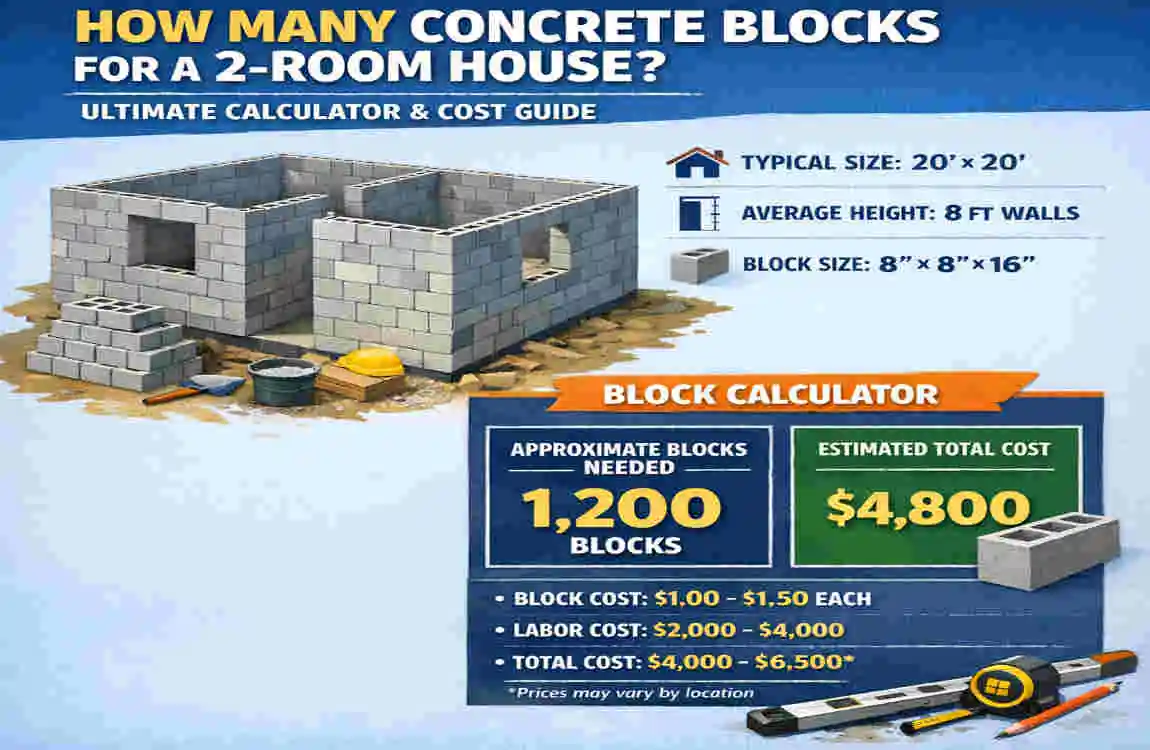
Planning a cozy 2-room house, but how many blocks will you need for a 2-room house? We’ve all been there. Whether you are building a guest annex in your backyard, a small rental unit for extra income, or a starter home in a bustling city like Lahore, getting the block count right is the first major hurdle.
If you buy too few, your project halts, leaving laborers standing around while you scramble for more materials. Buy too many, and you’re left with a pile of expensive concrete blocks eating up your budget and yard space. Getting this number right saves money, time, and a whole lot of headaches.
You might be asking, “Is there a simple way to figure this out?” The answer is yes. This guide delivers an ultimate calculator, step-by-step math that anyone can follow, and specific cost estimates tailored for 2026. We are going to break down the dimensions, the “hidden” math of mortar and waste, and give you the confidence to order exactly what you need.
Why Calculate Blocks for a 2-Room House Accurately?
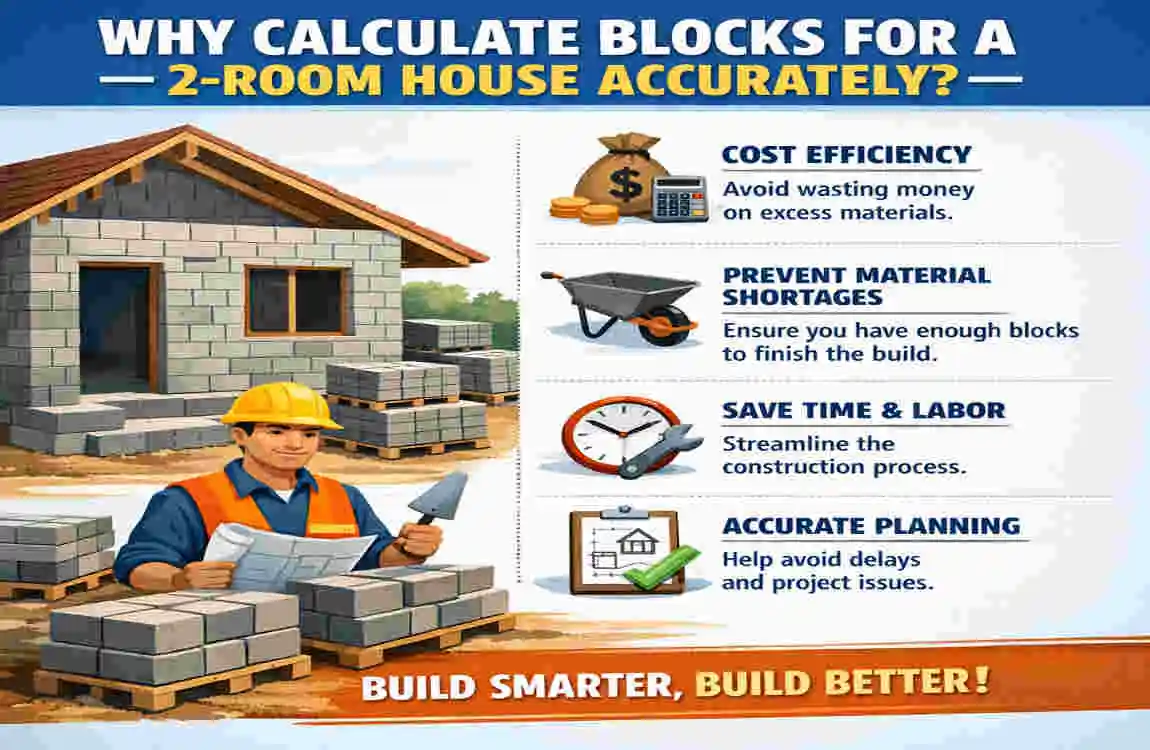
You might be tempted to ask a local mason (Mistri) for a rough estimate and run with it. While experience is valuable, “guesstimates” often lead to budget blowouts. Calculating the exact number of concrete blocks for 2 rooms is a critical step for any DIY builder or project manager.
Common Mistakes in Estimating Blocks for a 2 House Room
When people try to guess how many blocks are needed for 2 house room projects, they usually fall into a few common traps:
- The “Safety Net” Overbuy: Fear of running out leads many people to overbuy by 20-30%. On a budget build, that is money sitting on the ground that could have been spent on better fixtures or paint.
- Ignoring the Openings: It sounds obvious, but many rough estimates calculate the total wall length and forget to subtract the massive spaces taken up by doors and windows. This significantly skews the blocks for 2-room house calculation.
- Regional Size Confusion: A block in Punjab might have slightly different standard dimensions than one in Sindh. If you calculate based on a standard internet size but buy a local variation, your math will be off by hundreds of blocks.
Benefits for DIY Builders in Pakistan
If you are managing this project yourself, accuracy is your superpower. Here is why taking ten minutes to calculate matters:
- Massive Cost Savings: In 2026, concrete block prices rose. Saving even 100 blocks puts Rs. 5,000 to Rs. 10,000 back in your pocket.
- Time Efficiency: For small projects like 2-room extensions, you want the materials delivered in one or two batches. Halting work to order another truckload kills momentum.
- Structural Integrity: Accurate calculation forces you to plan your wall heights and lintel levels properly, ensuring a safer build.
- Eco-Friendliness: Construction waste is a huge issue. By buying only what you need, you are reducing the environmental footprint of your build.
Standard Dimensions for Concrete Blocks in Pakistan
Before we do the math, we need to know what we are measuring. Concrete blocks (often called CMUs or Hollow Blocks) have become the standard in modern Pakistani construction, overtaking the traditional red brick in many areas due to speed and insulation properties.
Common Block Sizes and Coverage
When asking how many blocks for a 2-house room, the answer depends entirely on the size of the block. In Pakistan, the standard concrete block is larger than a red brick.
Here is a quick reference table for the most common block types you will find at suppliers:
Block Type Dimensions (L x H x W in mm)Blocks per sqm Approx. Price Range (PKR)
Standard Solid 390 x 190 x 190 mm ~12.5 40 – 60
Half Block 390 x 190 x 90 mm ~25 (double wall) 25 – 40
Hollow Block 390 x 190 x 190 mm ~12.5 45 – 70
4-Inch Partition 390 x 190 x 100 mm ~12.5 35 – 50
Note: “Blocks per sqm” usually includes the mortar joint thickness.
Regional Variations (Lahore vs. Others)
It is crucial to note that while the table above lists “Standard” sizes, local manufacturers often have their own molds.
- Punjab (Lahore/Faisalabad): You often find “Solid” blocks are more popular here for load-bearing walls.
- Sindh/KPK: Hollow blocks are frequently used to improve thermal insulation and reduce the dead load on the structure.
Step-by-Step: How to Calculate How Many Blocks for a 2 House Room
Now, let’s get to the math. Don’t worry, we will keep this simple. We will calculate the number of concrete blocks needed for 2 rooms, assuming a standard single-story structure.
Key Assumptions for a Basic 2-Room House
To make this calculation work, we need a hypothetical model. You can adjust these numbers for your specific plan, but let’s assume the following for this example:
- Total Layout: Two adjacent rooms.
- Room Size: Each room is 10 ft x 15 ft.
- Wall Height: 10 ft (standard ceiling height).
- Openings per Room: One door (3.5 ft x 7 ft) and one large window (6 ft x 6 ft).
- Wall Type: Single-story, load-bearing walls using standard 8-inch wide blocks (390x190x190mm).
Formula for Blocks Needed
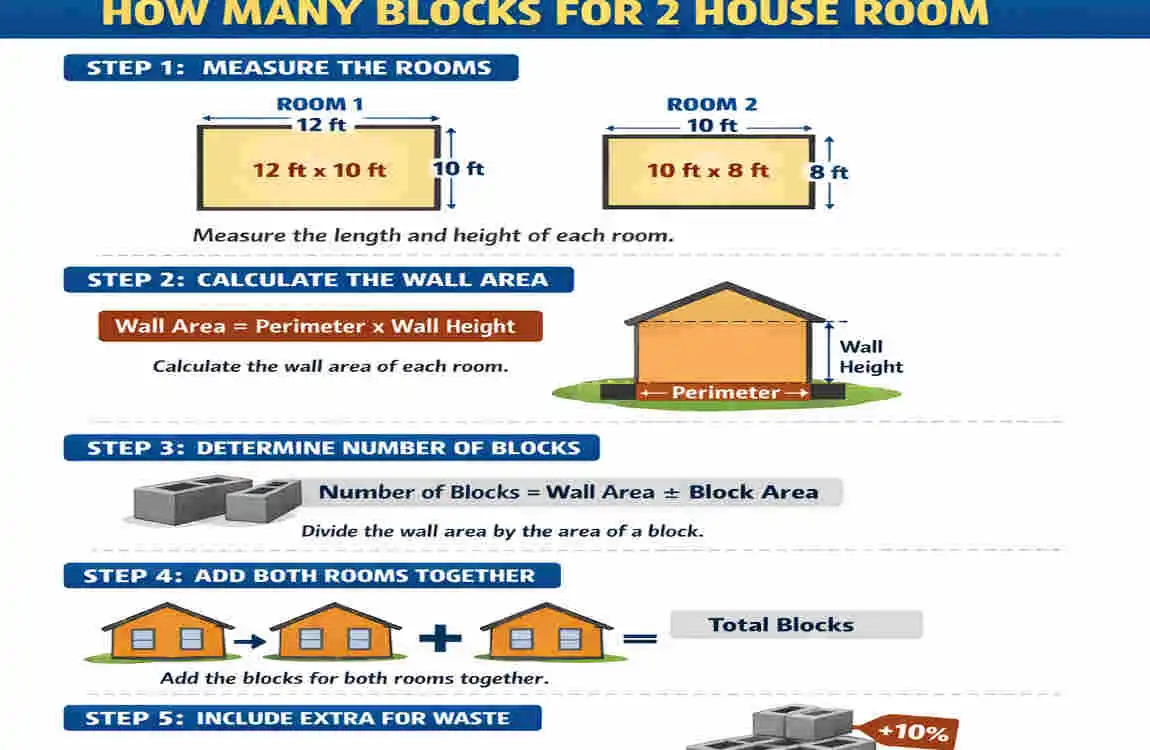
The math logic is straightforward: You calculate the total area of the walls, subtract the holes (doors/windows), and divide by the size of one block.
Here is the formula written out:
Total Wall Area = (Sum of all wall lengths) × (Height of the wall)
Net Wall Area = Total Wall Area − Area of Doors & Windows
Total Blocks = (Net Wall Area ÷ Area of one Block) + 5% to 10% Waste
Detailed Wall-by-Wall Breakdown
Let’s calculate exactly how many blocks are needed for a 2-house room using our example dimensions.
Calculate the Perimeter
We have two rooms, each 10×15 ft. If they are side-by-side, sharing a middle wall:
- 2 Long walls (outer): 20 ft + 20 ft = 40 ft
- 2 Short walls (outer): 15 ft + 15 ft = 30 ft
- 1 Shared wall (middle): 15 ft
- Total Wall Length: 85 running feet.
Get Total Wall Area
Multiply the length by the height.
- 85 ft (length) × 10 ft (height) = 850 sq. ft.
Subtract Openings
- Doors: 2 doors (3.5 x 7) = 49 sq. ft.
- Windows: 2 windows (6 x 6) = 72 sq. ft.
- Total Deductions: 49 + 72 = 121 sq. ft.
Net Wall Area
- 850 sq. ft. (Total) – 121 sq. ft. (Openings) = 729 sq. ft.
Convert to Blocks
A standard block (with mortar) covers roughly 0.89 sq. ft. (This varies, but it is a safe standard).
- 729 sq. ft. ÷ 0.89 sq. ft./block = 819 Blocks.
Add Waste (The Real-World Factor)
Add 10% for breakage and cutting.
- 819 + 81 = 900 Blocks.
So, for this specific 2-room layout, you should order 900 to 1,000 blocks.
Ultimate Blocks Calculator for 2-Room House
Since I cannot embed a live JavaScript tool directly in this text, I will provide you with a Manual Calculation Table and a formula you can copy and paste into Excel or Google Sheets to create your own calculator in seconds.
The “Copy-Paste” Excel Formula
Open Excel/Google Sheets.
- Cell A1: Enter Total Wall Length (ft)
- Cell B1: Enter Wall Height (ft)
- Cell C1: Enter Total Area of Doors/Windows (sq ft)
- Cell D1: Enter Block Face Area (usually 0.89 for standard blocks)
Paste this formula into Cell E1: =ROUND(((A1*B1)-C1)/D1,0)*1.1
Quick Reference Look-Up Table
If you don’t want to do the math, find the row that matches your approximate room size to see how many blocks you need for a 2-house room.
Room Size (Per Room)Total Wall Length (2 Rooms)Est. Blocks Needed (Standard)
10 x 10 ft ~70 ft 750 – 800
12 x 12 ft ~82 ft 900 – 950
12 x 14 ft ~90 ft 1,000 – 1,100
14 x 16 ft ~105 ft 1,200 – 1,300
Cost Breakdown: How Much for Blocks in a 2-Room House?
Knowing the number is half the battle. Knowing the cost is the other half. Construction prices in Pakistan fluctuate, so these estimates are based on early 2026 market rates.
Total Cost Estimate (Pakistan 2026 Prices)
Let’s go back to our calculation of 900 blocks. How much cash do you need to have ready?
- Average Cost per Block: Rs. 55 (Mid-range quality)
- Block Cost: 900 x 55 = Rs. 49,500
However, blocks don’t stick themselves together. You need a full system.
ComponentEstimated QuantityUnit Cost (PKR)Total Cost (PKR)
Concrete Blocks 900 Units 55 49,500
Cement 15 Bags 1,250 18,750
Sand (Ravi/Chenab) 1 Trolley 8,000 8,000
Labor (Mason + Helper) ~6 Days 4,000/day 24,000
Misc (Water/Transport) – – 5,000
GRAND TOTAL Rs. 105,250
Factors Affecting Costs in Lahore & Major Cities
If you are building in Lahore, costs differ from those in a rural village.
- Transport: This is the hidden killer. If your site is far from the brick kiln or block factory, transport can add Rs. 5-10 per block.
- Labor Rates: In 2026, a skilled Mistri charges significantly more in urban centers than in rural areas.
- Bulk Discounts: If you order all blocks for a 2-room house at once, you can negotiate a discount of Rs. 2-3 per block.
Vs. Alternatives (Bricks vs. Blocks)
Why choose blocks?
- Red Bricks: You would need roughly 4,000+ red bricks for the same wall area. At Rs. 18/brick, the material cost is roughly Rs. 72,000.
- Comparison: Blocks are generally 30% cheaper overall when you factor in the speed of labor and less mortar usage.
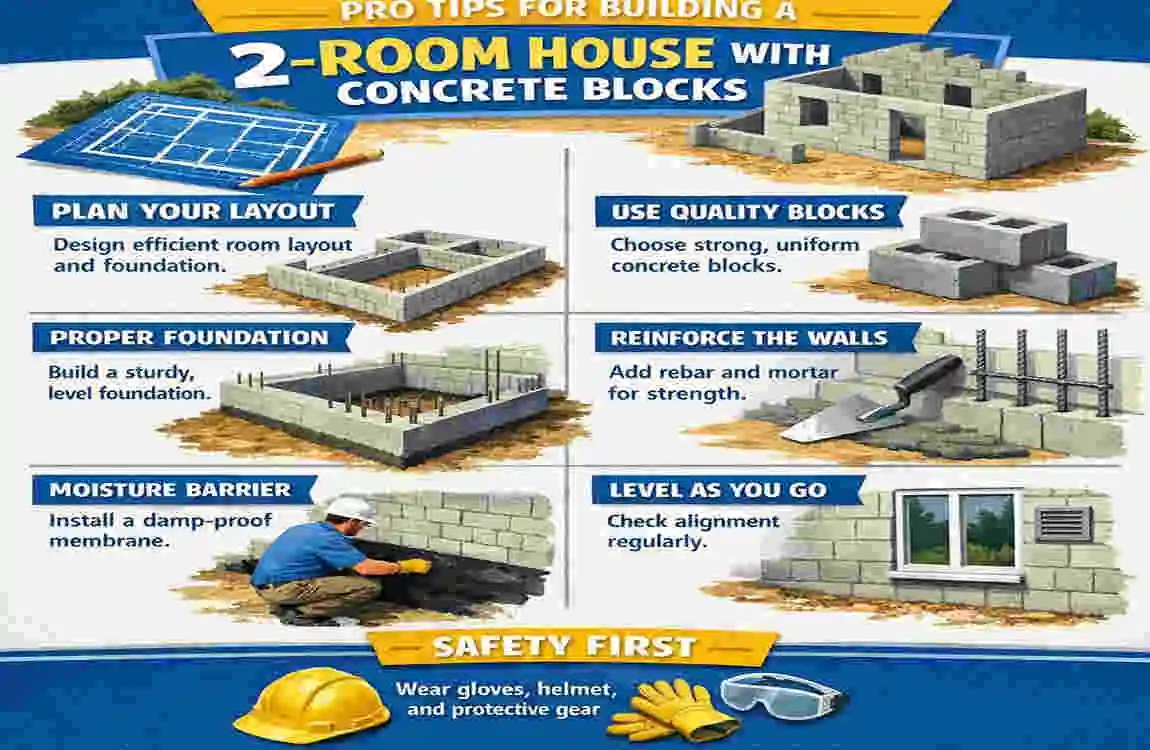
Pro Tips for Building Your 2-Room House with Concrete Blocks
You have your number and your budget. Now, how do you ensure the blocks for a 2-room house stay standing for 50 years?
Material Selection: Hollow vs. Solid
- Choose Hollow Blocks if you want a cooler house. The air gaps inside the blocks act as insulation against the scorching Pakistani summer sun. They are also lighter, putting less stress on your foundation.
- Choose Solid Blocks for the first 2-3 layers above the DPC (Damp Proof Course). This prevents moisture from rising through the hollow cavities.
Construction Best Practices
- Soak them First: Unlike red bricks, you shouldn’t soak concrete blocks for hours; just keep them moist. If they are bone dry, they will suck the water out of your mortar, leading to weak joints and cracks.
- The “Running Bond”: Ensure your mason uses a “running bond” pattern (staggered joints). The vertical joints should never line up from one row to the next. This locks the wall together.
- Lintel Beams: Don’t skip the concrete beams over doors and windows. Blocks cannot support the roof load over an opening without a reinforced lintel.
Common Challenges & Fixes
- Cracking: Concrete blocks shrink slightly as they dry completely. This can cause hairline cracks.
- Fix: Use a “Chicken Wire” mesh when plastering the walls later to prevent these cracks from showing up in your paint.
- Plumbing Issues: Cutting hollow blocks for pipes can cause them to shatter.
- Fix: Plan your plumbing pipes before laying the wall, or fill the specific blocks where pipes will run with concrete for stability.
Real-Life Examples: Blocks for 2 House Room Projects
Sometimes, seeing real-world numbers helps visualize the project. Here are two examples of how many blocks were used for a 2-house room in different scenarios.
The Lahore Rental Unit
Project: Mr. Bilal added two rooms on his roof in Johar Town, Lahore, to rent out to students.
- Size: Small rooms (9×10 ft).
- Block Type: Lightweight Hollow Blocks (to protect the old roof).
- Calculation: His total wall area was smaller. He needed 750 blocks.
- Outcome: By using hollow blocks, he saved on lifting costs and completed the walls in just 4 days.
The Rural Storage Annex
Project: Mrs. Kausar, in a village near Sheikhupura, built a 2-room storehouse for farm equipment.
- Size: Large rooms (12×15 ft) with high ceilings (11 ft).
- Block Type: Heavy Solid Blocks for security.
- Calculation: The extra height and larger footprint meant she required 1,450 blocks.
- Outcome: She bought 1,500 blocks. She had about 40 left over, which she used to build a small outdoor bench—perfect planning!
FAQs: How Many Blocks for a 2 House Room
H2: Frequently Asked Questions
Q: How many blocks do I need for a 12×12 room? A: For a single 12×12 ft room with standard height walls, you typically need between 450 and 500 standard blocks, depending on your door and window sizes.
Q: What is the current price of a concrete block in Lahore? A: As of 2026, prices range from Rs. 45 to Rs. 65 per block, depending on quality and whether it is solid or hollow.
Q: Are concrete blocks cheaper than red bricks? A: Yes. While individual blocks cost more than bricks, you need far fewer of them. The total wall cost with blocks is usually 20-30% lower than with red bricks, thanks to savings in labor and mortar.
Q: Can I build a roof directly on block walls? A: For a small 2-room house, yes, but it is highly recommended to pour a Ring Beam (concrete band) at the top of the walls to tie them together before placing the roof slab. This prevents cracks and structural failure.
Q: How much sand and cement do I need for 1000 blocks? A: A good rule of thumb is that for every 100 blocks, you need about 1.5 bags of cement and roughly 6-7 cubic feet of sand for masonry work.
