


Imagine walking through a corridor where the sunlight slices through a rhythmic series of open arches, casting long, dramatic shadows across a cool stone floor. The air feels open, yet the structure feels undeniably solid and protective. You aren’t in a modern villa, but you have stepped back in time over a thousand years. This is the essence of early medieval design.
If you have ever found yourself gazing at pictures of ancient German buildings or medieval monasteries and asked, “What is the arcade in Ottonian house architecture?”—you are asking about one of the most pivotal design elements in history. It is a feature that bridged the gap between the fall of Rome and the rise of the great cathedrals.
When we think of the “Dark Ages,” we often picture gloomy, windowless castles. But the Ottonian era (roughly the 10th and early 11th centuries) was anything but dark. It was a time of cultural rebirth in Germany and the Holy Roman Empire, a period known as the Ottonian Renaissance. At the heart of this architectural revival was a specific feature that changed how buildings flowed and functioned: the arcade.
In simple terms, an arcade is a series of arches supported by columns or piers. In the context of Ottonian design, these weren’t just decorative trims. They were structural workhorses that created open galleries, defined courtyards, and separated the main aisles of great halls and churches. They allowed people to move and air to flow while supporting the heavy roofs above.
Why does this matter today? Because the Ottonian arcade is the grandfather of the modern hallway, the patio, and the veranda. If you love open-concept homes or covered walkways in your garden, you are appreciating a design concept perfected during the reign of the Ottonian emperors.
Historical Background of Ottonian Architecture
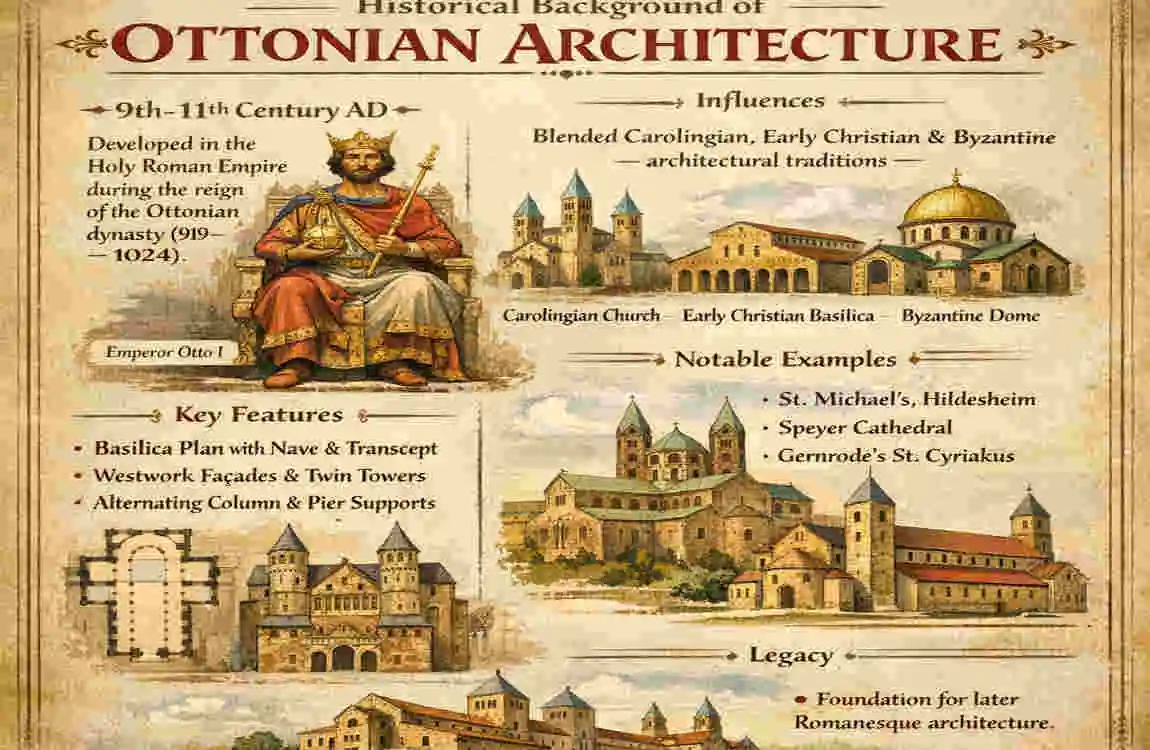
To truly understand the arcade, you have to understand the world it was built in. The Ottonian era spans roughly from 936 AD to 1024 AD. It is named after the three Emperors named Otto (Otto I, Otto II, and Otto III) of the Saxon dynasty.
The Roots of the Style
Before the Ottos, there was Charlemagne and the Carolingian empire. Charlemagne sought to revive the glory of the Roman Empire, and his architecture reflected that ambition. When the Ottonian rulers took power, they picked up right where Charlemagne left off.
However, they didn’t just copy the past; they evolved it. Ottonian architecture is often called “Pre-Romanesque.” It is the bridge between the older, clunky styles and the massive, refined Romanesque and Gothic cathedrals that would come later.
The Socio-Political Context
Why were they building so much? It was all about power and faith. The Ottonian rulers traveled constantly. They didn’t have one single capital city. Instead, they moved between fortified palaces (called a Pfalz) and immense monasteries.
Because the Emperor was always on the move, these “houses” and palaces had to be impressive. They had to look like the heir to Rome. The arcade became a symbol of this authority. It echoed the great aqueducts and colosseums of ancient Rome. Still, it adapted them for the colder, harsher climate of Northern Europe.
Key Historical Takeaway: Understanding arcades requires knowing the foundations of Ottonian house architecture. It wasn’t just about shelter; it was about making a statement: “The Roman Empire is back, and it is here in Germany.”
What Exactly Is an Arcade? Core Definition
Let’s get technical for a moment, but keep it simple. If you look at a blueprint and ask, “What is the arcade in Ottonian house architecture?”, you are looking for a specific pattern.
An arcade is, by definition, a row of arches supported by vertical columns. In Ottonian buildings, these supports were either columns (round pillars) or piers (square or rectangular pillars).
Breaking Down the Elements
The Ottonian arcade is distinct for its clean, flat, and rhythmic character. Here is what you need to look for:
- The Arch: Unlike the pointed arches you see in later Gothic churches (think Notre Dame), Ottonian arches are semicircular or round. They look like a perfect half-circle.
- The Supports: This is where Ottonian architects got creative. They didn’t just use one type of support. They often alternated them. You might see a square pier, then two round columns, then another square pier. This created a visual rhythm, almost like a musical beat in stone.
- The Materials: These were built to last. They used local stone—sandstone or limestone—and sometimes reused bricks from old Roman ruins (a practice called spolia).
Visualizing the Difference
It can be hard to visualize how an ancient arcade compares to what we build today. Here is a quick comparison table to help you spot the differences.
Feature Arcade in Ottonian Houses Modern Equivalent
Shape Perfectly Round (Semicircular) Arches, Squared openings, or gentle curves.
Function : Structural support & light circulation , Aesthetic decoration or patio shading
Support System : Alternating Piers and Columns , Uniform steel or wood posts
Materials : Heavy Stone blocks , Concrete, Wood, or Steel
Vibe Monumental, heavy, rhythmic Light, airy, minimalist
Fun Fact: In Ottonian times, an arcade wasn’t just a hallway. It was often used to symbolize the “City of God.” The orderly repetition of columns represented the order of the universe.
Key Features of Arcades in Ottonian House Architecture
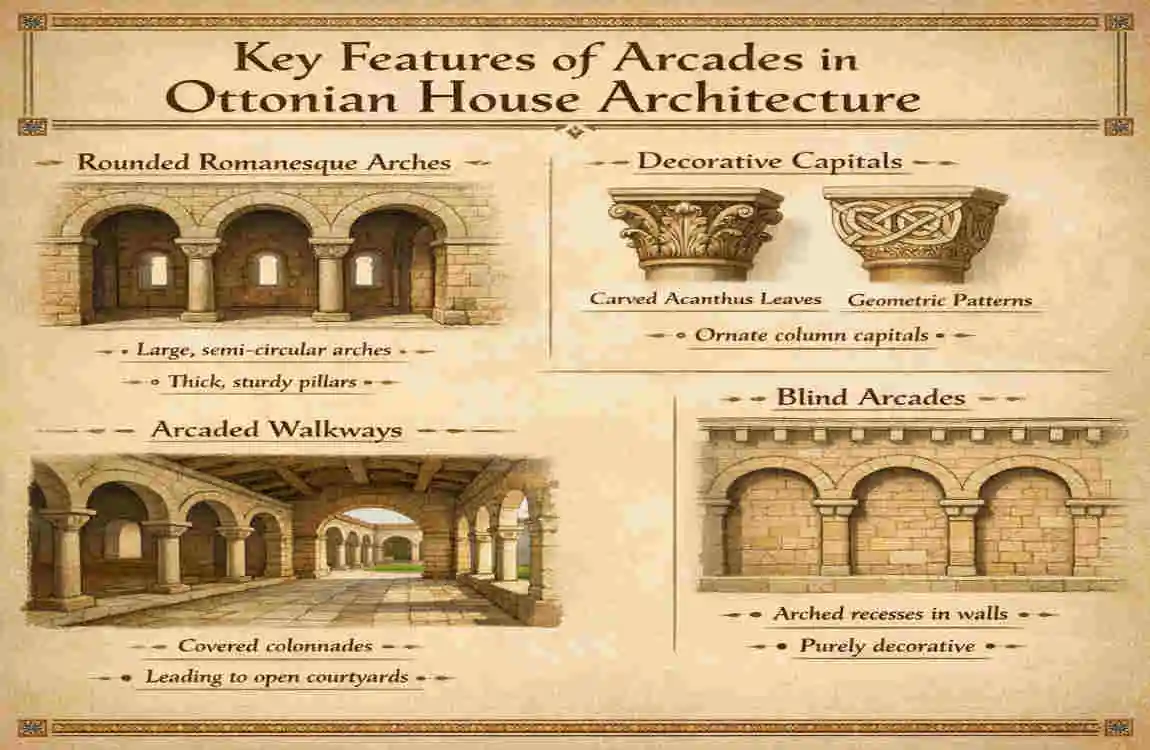
Now that we know what it is, let’s talk about what makes it special. The arcade was the superstar of the Ottonian interior and exterior. Whether it was in a grand church or the domestic quarters of a Bishop’s palace, the arcade served several critical roles.
The Rhythm of the Design
The most defining feature of the Ottonian arcade is the Alternating Support System. This is a technical term, but it is easy to spot.
In many other architectural styles, you have Column-Column-Column. Boring, right? Ottonian architects spiced it up. They used patterns like A-B-B-A (Pier, Column, Column, Pier). This is often called the “Saxon alternation.” It breaks up the monotony of a long wall and draws your eye down the length of the room.
Engineering Without Steel
You have to remember, these builders didn’t have steel beams or reinforced concrete. The arcade was a brilliant engineering solution.
- Load Bearing: The arches distributed the weight of the heavy walls above them to the columns below.
- Openness: By using arches instead of solid walls, they could open up the space. This was crucial in “Ottonian houses” (palaces and monasteries) because it allowed light from high windows to filter into the center of the building.
Simplicity and Flatness
Unlike later styles that are full of carvings and statues, Ottonian arcades are relatively plain. The beauty is in the geometry. The walls often feel flat and smooth. The excitement comes from the capitals—the top part of the column. Ottonian architects invented something called the Cushion Capital (or Cube Capital). Imagine a sphere sliced on four sides to form a square top. It looks like a sturdy cushion holding up the arch. It is simple, geometric, and very strong.
How Arcades Enhanced Daily Life
If you lived in an Ottonian complex, the arcade was where life happened.
- Climate Control: In the rainy German weather, the exterior arcade (or cloister) allowed you to walk outside for fresh air without getting wet.
- Social Space: The wide spaces between columns served as meeting points for monks, soldiers, and courtiers to talk.
Famous Examples of Ottonian Arcades
We can’t answer “what is the arcade in Ottonian house architecture” without looking at the real thing. Since most private wooden houses from 1000 AD have rotted away, we look at the “Houses of God” and the Imperial Palaces to see these arcades in their full glory.
Here are three standout examples that define the style.
St. Michael’s Church in Hildesheim
If you only look at one example, make it this one. Built by Bishop Bernward (a tutor to Emperor Otto III), this is the masterpiece of the era.
- The Arcade: It features the classic Saxon alternating support system: one square pier followed by two round columns.
- Why it stands out: The rhythm creates a stunning visual flow. Above the arcade, the walls are flat and unadorned, drawing your eyes up to the famous painted wooden ceiling. It is a perfect example of how the arcade anchors the whole room.
The Collegiate Church of St. Cyriakus in Gernrode
This is one of the oldest preserved examples of Ottonian architecture.
- The Arcade: Here, you can see the early experiments with galleries. The arcade separates the central nave from the side aisles.
- Unique Feature: It has a gallery above the main arcade, which was very innovative for the time. This added a second layer of arches, enhancing the interior’s complexity and beauty.
The Imperial Palace (Pfalz) at Goslar
While much of this was rebuilt later, the foundations and layout date back to the Ottonian and early Salian periods.
- The Arcade: The residential halls (the Palas) utilized arcades on the ground floor to create an open undercroft or basement level, often used for storage or heating systems, while the upper floors featured grand arcaded windows looking out over the courtyard.
A Quick Summary of These Sites:
- St. Michael’s: Best for seeing the rhythmic columns.
- Gernrode: Best for seeing galleries.
- Goslar: Best for seeing how emperors lived.
Evolution and Influences on Later Styles
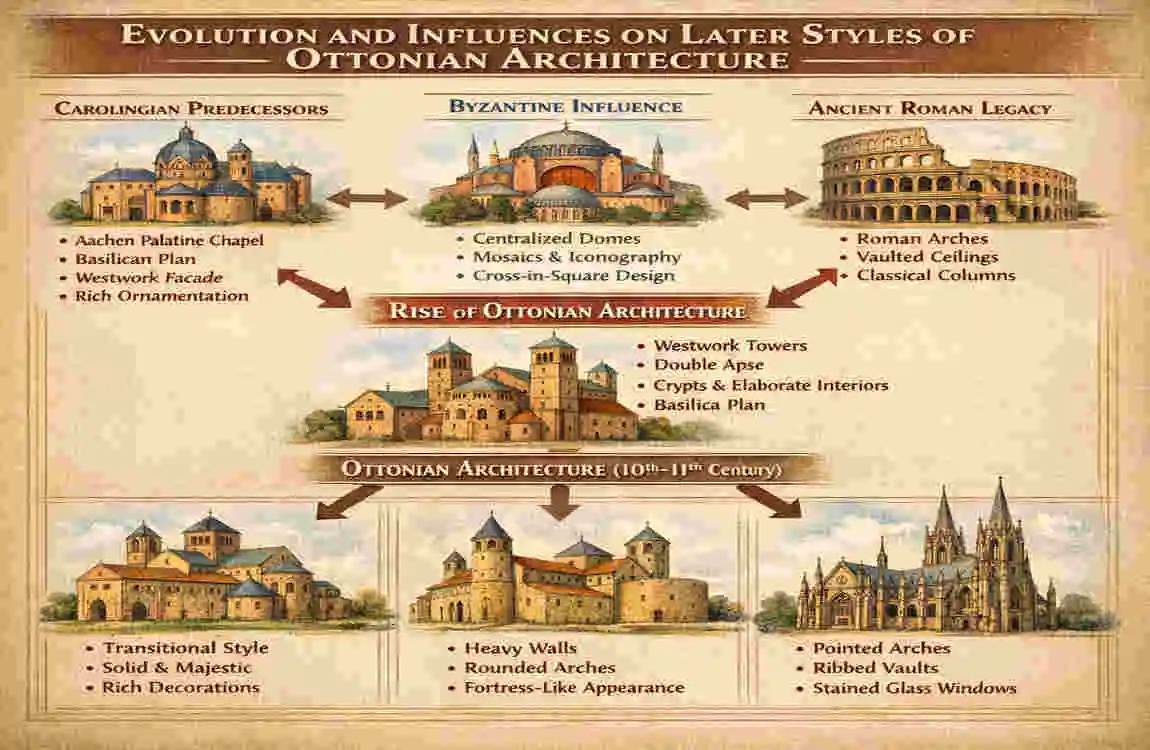
The Ottonian arcade didn’t just disappear when the last Otto died. It evolved. It laid the groundwork for the massive Romanesque style that took over Europe in the 11th and 12th centuries.
From Ottonian to Romanesque
As time went on, builders wanted to go higher and heavier. The delicate, flat walls of the Ottonian era got thicker. The arcade’s columns became massive drum-like piers. However, the basic concept—the round arch—stayed the same.
The Global Impact
You can see echoes of the Ottonian arcade in places you might not expect.
- Byzantine Parallels: Because Otto II married a Byzantine princess (Theophanu), Ottonian arcades sometimes share features with buildings in Constantinople (modern Istanbul).
- The Normans: When the Normans built cathedrals in England (such as Durham or Ely), they used the same alternating rhythm of piers and columns perfected by the Ottonians.
The Decline
Eventually, the round arch was replaced. In the 12th century, architects in France figured out that pointed arches (the Gothic style) were stronger. The round Ottonian arcade fell out of fashion, viewed as “old-fashioned” compared to the soaring heights of Gothic vaults.
Arcades in Modern Home Architecture: Lessons from Ottonian Design
Okay, so we have covered a lot of history. But how does this answer “what is the arcade in Ottonian house architecture” for you, the modern homeowner?
Believe it or not, this 1000-year-old design is incredibly trendy right now. We call it by different names: loggias, colonnades, or breezeways.
Bringing the Arcade Home
If you are designing a home in Lahore, London, or Los Angeles, you can incorporate the spirit of the Ottonian arcade.
- The Outdoor Corridor: Instead of a closed hallway, consider an open arcade along the side of your house facing the garden. It provides shade (perfect for hot climates) while letting the breeze through.
- Visual Rhythm: Use the “alternating support” trick. If you are building a pergola, try using thick brick piers on the corners and thinner wooden or stone columns in the middle. It adds instant sophistication.
Pros and Cons of the Arcade Style
Before you call your contractor, here is a quick reality check.
Pros:
- Timeless Aesthetic: Arches never really go out of style.
- Natural Light: They let light penetrate deeper into the house than solid walls.
- Airflow: Excellent for natural ventilation.
Cons:
- Cost: Building arches is more expensive than building square lintels.
- Space: Columns take up floor space.
- Maintenance: If open to the elements, the flooring needs to be weather-resistant.
DIY Tip: You don’t need to build with heavy stone. You can achieve the “Ottonian look” using modern brick veneers or even shaped stucco to create the illusion of heavy, round arches.
Frequently Asked Questions (FAQ)
Here are some quick answers to the most common questions about this architectural style.
What is the arcade in Ottonian house architecture?
In Ottonian architecture, an arcade is a series of semicircular (round) arches supported by columns or piers. It was used to separate aisles in churches or create open walkways in palaces and monasteries, characterized by a rhythmic alternation of supports (piers and columns).
Where can I see real Ottonian arcades today?
The best examples are in Germany. St. Michael’s Church in Hildesheim and the Church of St. Cyriakus in Gernrode are two of the best-preserved sites where you can walk through original Ottonian arcades.
How do Ottonian arcades differ from Roman ones?
While inspired by Rome, Ottonian arcades are generally simpler and flatter. They introduced the “alternating support system” (swapping between piers and columns) and the geometric “cushion capital,” which were not standard in classic Roman architecture.
Can I replicate arcades in modern homes?
Absolutely! Modern architects often use the arcade concept for outdoor patios, verandas, and loggias. Using round arches and columns creates a classic, Mediterranean, or medieval feel that adds luxury to a home.
Why were arcades important in Ottonian design?
They were essential for structural support, holding up heavy roofs without the need for solid walls. This allowed for larger, more open interior spaces and let light from upper windows reach the building’s center, symbolizing divine illumination.
