
Did you know that mobile homes currently make up roughly 8% of the entire U.S. housing market? That is a massive chunk of real estate. Yet, despite their popularity, a silent crisis is unfolding in the market: owners are consistently leaving money on the table.
It is estimated that many owners undervalue their property by 20% to 30% simply because they don’t understand the nuances of the market. Unlike traditional site-built homes, mobile homes have unique valuation rules. If you ignore critical factors like the specific park location, the HUD code status, or the intricacies of the land lease, you are essentially guessing at the price.
If you are thinking about selling, or even if you are looking to buy, understanding how to value a mobile home accurately is the single most important step you can take. You don’t want to rely on a hunch. You want data.
Why Accurate Mobile Home Valuation Matters

Before we dive into the “how-to,” we need to talk about the “why.” You might be thinking, “Can’t I just look at what my neighbor sold their home for?” The short answer is: No, not really.
The mobile home market is complex. First, we need to get our terminology straight. Technically, anything built after 15 June 1976, is a “Manufactured Home” built to HUD standards. Anything built before that date is a “Mobile Home.” While we will use the terms interchangeably in this article for simplicity (as most people do in conversation), this distinction matters immensely to banks and appraisers.
The Cost of Getting It Wrong
Let’s look at a quick scenario. Imagine an owner, let’s call him Bob. Bob has a pristine double-wide on a permanent foundation. He assumes that because mobile homes “depreciate like cars,” his home is only worth $50,000. He lists it, and it sells in one day. Bob is happy.
However, Bob didn’t realize that demand for affordable housing had skyrocketed. Similar homes in his area—specifically those on their own land—were selling for $85,000. Bob just lost $35,000 because he didn’t do a proper valuation.
Market Trends in 2026
Looking at 2026 housing data, demand for affordable housing isn’t slowing. With traditional site-built homes becoming unaffordable for many first-time buyers, the average value of well-maintained manufactured homes is rising, often sitting between $100,000 and $200,000 depending on the region.
If you don’t know the mobile home market value in 2026, you open yourself up to risks:
- Leaving money on the table (like Bob).
- Overpricing the home, causing it to sit on the market for months until it becomes “stale.”
- Legal headaches if you promise a buyer a value that the bank refuses to finance.
Research Comparable Sales (Comps) in Your Area
The absolute best way to gauge value is by looking at what actual buyers are currently paying. In the real estate world, we call these “Comps” (comparable sales).
You need to find recently sold homes that are similar to yours in three key areas: Size, Age, and Condition.
How to Find Your Comps
You can start your investigation online. Sites like Zillow, Redfin, and Realtor.com are great starting points. However, you have to be careful. You need to filter your search results to show “Sold” listings, not “Active” ones. An asking price is just a wish; a sold price is a fact.
When looking for comps, try to stay within a 5-mile radius if you are in a rural area, or a 1-mile radius if you are in a city or a specific mobile home park.
The Land Factor: The Big Variable
This is where most people get tripped up on valuing a mobile home. You must compare apples to apples when it comes to land ownership.
- Chattel (Personal Property): This is a home typically located in a park where you pay lot rent. You own the metal and wood, but not the dirt.
- Real Property: This is a home permanently affixed to land that you own.
Pro Tip: If you own the land, your home is likely worth 20% to 50% more than a similar home in a lease-land park. Never compare a home on leased land to a home on deeded land.
Visualizing the Comparison
To give you an idea of how to structure this, look at the table below. This is how an appraiser organizes the data.
Feature Your Home (Subject)Comp #1 (Sold 2 mos ago)Comp #2 (Sold 1 mo ago)
Size 1,200 sq. ft. 1,200 sq. ft. 1,000 sq. ft.
Year Built 2010 2011 2010
Land Status Leased Land (Park) Leased Land (Park) Leased Land (Park)
Condition Excellent Average Excellent
Sold Price ??? $45,000 $42,000
Notes New Roof Needs Carpet Smaller, but updated
By looking at this, if Comp #1 sold for $45k but was only in “Average” condition. Your home is “Excellent,” you can likely justify a higher price, perhaps closer to $50,000.
Assess Age, Make, and Model
Just like cars, the brand and the year matter. A 1980 Mercedes is worth more than a 1980 Ford Pinto. The same logic applies to manufactured homes.
The HUD Label Hunt
First, you need to verify exactly what you have. Go outside and look for a small metal plate affixed to the exterior siding (usually near the rear or a corner). This is the HUD Label. It serves as the home’s birth certificate.
Inside the home, look for the “Data Plate” (usually a paper sticker inside a kitchen cabinet, bedroom closet, or electrical panel). This will tell you the:
- Date of Manufacture
- Serial Number
- Wind Zone Rating
- Roof Load Rating
If your home was built before 15 June 1976, financing will be difficult for buyers. This significantly lowers the value because it limits your pool of potential buyers to those with cash.
Brand Power
Not all mobile homes are built the same. Some manufacturers are known for luxury builds with 2×6 sidewalls and drywall interiors, while others used cheaper materials. High-quality brands command a 10-15% premium.
Top Brands that Hold Value:
- Silvercrest: Known for high-end finishes.
- Skyline: A staple in the industry with solid construction.
- Fleetwood: Very common, easy to find parts for.
- Cavco: often associated with modern, energy-efficient designs.
- Palm Harbor: strong reputation for durability.
The Depreciation Curve
It is a sad reality that mobile homes (especially those on leased land) rarely appreciate as traditional real estate does. They follow a depreciation curve similar to automobiles, though usually slower.
- New: 100% Value
- 1 Year Old: ~90% Value
- 5 Years Old: ~75% Value
- 10 Years Old: ~60-70% Value
However, excellent maintenance can flatten this curve. A 20-year-old home in mint condition can outsell a 5-year-old home that has been trashed.
Evaluate Physical Condition and Upgrades
This is the step where you have to take off your “homeowner goggles” and put on your “inspector glasses.” You might love your home, but the market only cares about its condition. To figure out how to appraise the condition of a mobile home, you need to be critical.
The Big Ticket Items
Focus on the structural elements first. These are the things that scare buyers away and tank appraisals.
- The Roof: An asphalt shingle roof on a mobile home typically lasts 15-20 years. If yours is 18 years old, a buyer will immediately deduct $4,000 to $6,000 from their offer.
- HVAC System: Is the furnace original? Mobile home furnaces are specific (often narrower) than standard home furnaces. Replacing one is costly.
- Plumbing: This is huge. Older homes used polybutylene pipes (often grey), which are notorious for bursting. If you have updated your plumbing to PEX or Copper, make sure you advertise that loudly! (Check out our related posts on home plumbing maintenance for more details on this).
Upgrades with the Best ROI
If you are looking to do some quick fixes to bump up the value, focus on these areas:
- Kitchen Refresh: You don’t need a full remodel. Painting cabinets and updating hardware can increase perceived value by 15%.
- Energy Efficiency: Installing double-pane windows or adding insulation.
- Skirting: Never underestimate the power of skirting. Broken, vinyl skirting looks trashy. Replacing it with stone-look skirting creates a permanent, high-end feel for a low cost.
DIY Inspection Checklist
Grab a notepad and walk through your home. Rate these items on a scale of 1-10:
- Foundation/Leveling: Do doors close properly? If not, the home may need re-leveling (Cost: ~$800-$1,500).
- Floors: Any soft spots? Soft spots indicate water damage, often caused by the particleboard subflooring used in older models. Hidden water damage can instantly reduce your value by 25%.
- Windows/Doors: Do they seal tight?
- Siding: Is it clean and free of rot or dents?
Factor in Location and Park Rules
In real estate, location is everything. In mobile home real estate, the Park is everything.
If your home is in a park, the value of your home is directly tied to the reputation of that park. You could have a gold-plated palace, but if it sits in a park with high crime, massive potholes, and unkempt yards, your value plummets.
Analyzing Park Quality
Buyers are buying a lifestyle, not just a structure. Ask yourself:
- Amenities: Does the park have a pool, clubhouse, or playground?
- Lot Rent: Is the monthly lot rent reasonable for the area? Low lot rent = higher home value. If the lot rent is astronomically high, buyers can afford less for the actual home.
- Restrictions: Strict rules can be a double-edged sword. They keep the park nice (good for value) but might limit buyers (e.g., “55+ only” or “No Pets”).
Land Multipliers
We touched on this in Step 1, but let’s look at the multipliers.
- Urban/Metro Area: +20% Value (High demand for jobs).
- Rural/Remote: -10% Value (Unless it comes with significant acreage).
- Deeded Land: 2x Value compared to Leased Land.
Google Maps Test: Open Google Maps. Look at what is within a 10-minute drive. Grocery stores? Good schools? Highway access? These are selling points you should monetize.
Calculate Replacement Cost Minus Depreciation
If you can’t find good comps because your home is unique, you can use the “Cost Approach.” This is a bit more math-heavy, but it’s a standard appraisal method.
The Formula
The formula is relatively simple:
Value = (Replacement Cost of Brand New Home × Condition %) – Depreciation
How to Do the Math
- Find Current Build Cost: Call a local manufactured home dealer. Ask what the “going rate” per square foot is for a new home of your class. It’s currently $80 per square foot.
- Calculate Base Price: If you have a 1,200 sq. ft. home: $80 × 1,200 = $96,000 (Cost New).
- Apply Condition Factor: If your home is 10 years old but well maintained, it may have 70% of its useful life left.
- The Result: $96,000 × 0.70 = $67,200.
This gives you a baseline “brick and mortar” value before you add in location factors.
Note on Calculators: You will find many “mobile home worth calculators” online. Use these with caution. They are algorithms that cannot see your beautiful new backsplash or smell the neighbor’s cat litter. Use them as a guide, not a gospel.
Account for Personal Property and Accessories
Appraisers have a strict rule: they separate Real Estate (the home and land) from Chattel (the home alone) and Personal Property.
However, when you are selling directly to a buyer, especially a cash buyer, you are selling the whole package.
What Adds Value?
- Additions: A screened-in porch or a sunroom adds massive livable space.
- Sheds and Outbuildings: A high-quality storage shed can add 5-10% to the deal, especially in parks where storage is tight.
- Carports/Awnings: In hot climates, covered parking is a premium necessity.
- Appliances: High-end washer/dryers or stainless steel fridges can be negotiated into the price.
Staging for Profit
To get the maximum value for these items, you need to stage them. Don’t just list “shed” in the description. Clean out the shed, organize it, and take a photo showing how much storage it offers. Clear off the countertops to show off the kitchen.
Max Profit Tip: If you have old, ratty furniture, get rid of it. An empty room looks bigger and more valuable than a cluttered one.
Get a Professional Appraisal and Market Test
You have done your research, checked the HUD tags, and inspected the roof. Now, it might be time to call in the cavalry.
When to Hire a Pro
If you are selling a home on its own land, you almost certainly need a professional appraisal, as the buyer’s bank will require one.
- Drive-by Appraisal: Costs around $300. The appraiser looks at the exterior and neighborhood. Good for a quick estimate.
- Full Appraisal: Costs $500+. The appraiser inspects the interior, measures rooms, and runs a detailed report.
Ensure you hire an appraiser certified by the Appraisal Institute with experience in manufactured housing. A residential appraiser who only does mansions won’t know how to value your home correctly.
The Market Test
If you don’t want to pay for an appraisal, use the market as your judge.
- Take your estimated value from Step 1 and Step 5.
- List the home at that price (or slightly higher to allow for negotiation).
- Wait 2 weeks.If you get zero calls: You are overpriced. Drop the price by 5%.
- If you get tons of calls and immediate offers: You might be underpriced (or you just hit the sweet spot).
Case Study: The 15% Gain
I once worked with a seller who wanted to list her double-wide for $60,000 because that’s what she “felt” it was worth. We paid $400 for a professional appraisal. The appraiser noted that because the home was in a “Resident Owned Community” (ROC), the value was actually $72,000. She listed it at $72,000 and sold it for $70,000. That $400 investment made her $10,000.
Additional Tips to Maximize Mobile Home Profit
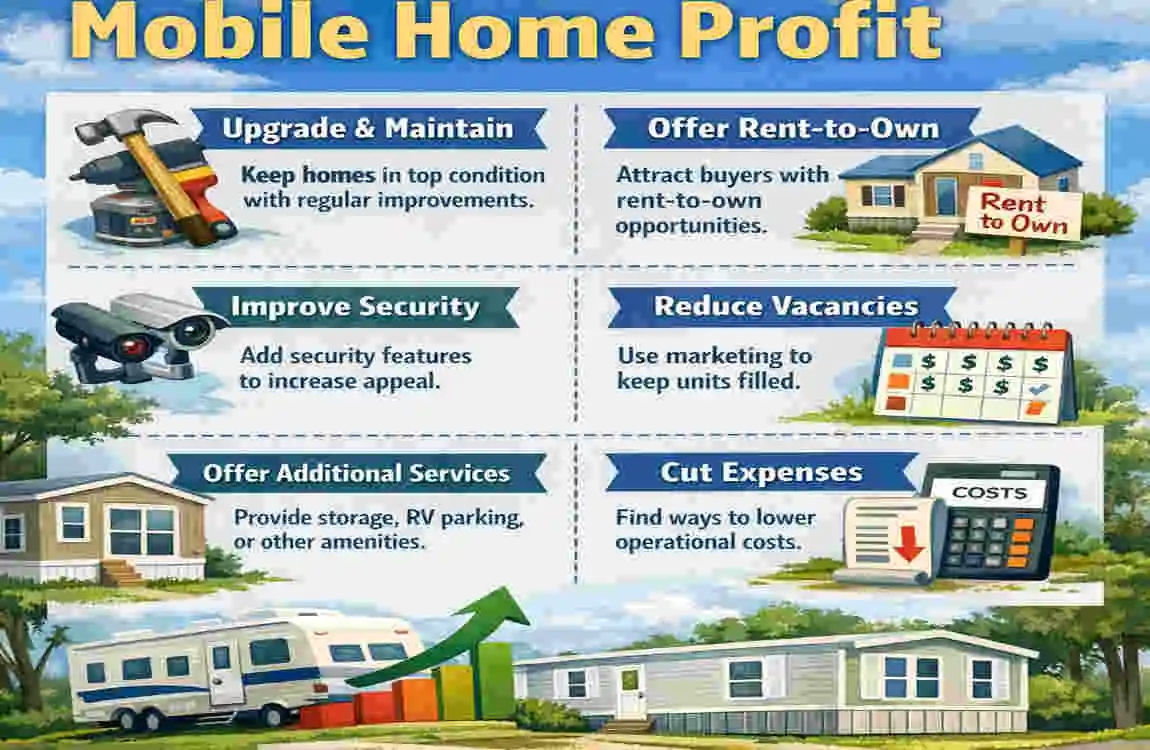
You want to squeeze every penny out of this sale. Here are some “Quick Wins” to boost perceived value.
Quick Wins Checklist
- Power Wash Everything: The siding, the driveway, the deck. Green algae kills value.
- Paint the Front Door: A fresh, bright door creates a welcoming first impression.
- Title Clearance: Ensure you have the physical title in hand and that there are no liens. A clean title is worth its weight in gold to a buyer who wants a fast closing.
- Fix the Skirting: I mentioned this before, but it bears repeating. Straight skirting makes the home look structurally sound.
Valuation Factors Cheat Sheet
Use this table to understand what carries the most weight in your final price.
Factor Weight on Value Notes
Location/Park 30% The most critical factor.
Condition/Maintenance 25% Water damage is the enemy.
Age/Year Built : 20% Financing is harder for older homes.
Size/Beds/Baths 15% 3 bedrooms sell faster than 2.
Extras (Sheds/Decks) 10% The cherry on top.
Common Mistakes to Avoid When Valuing Mobile Homes
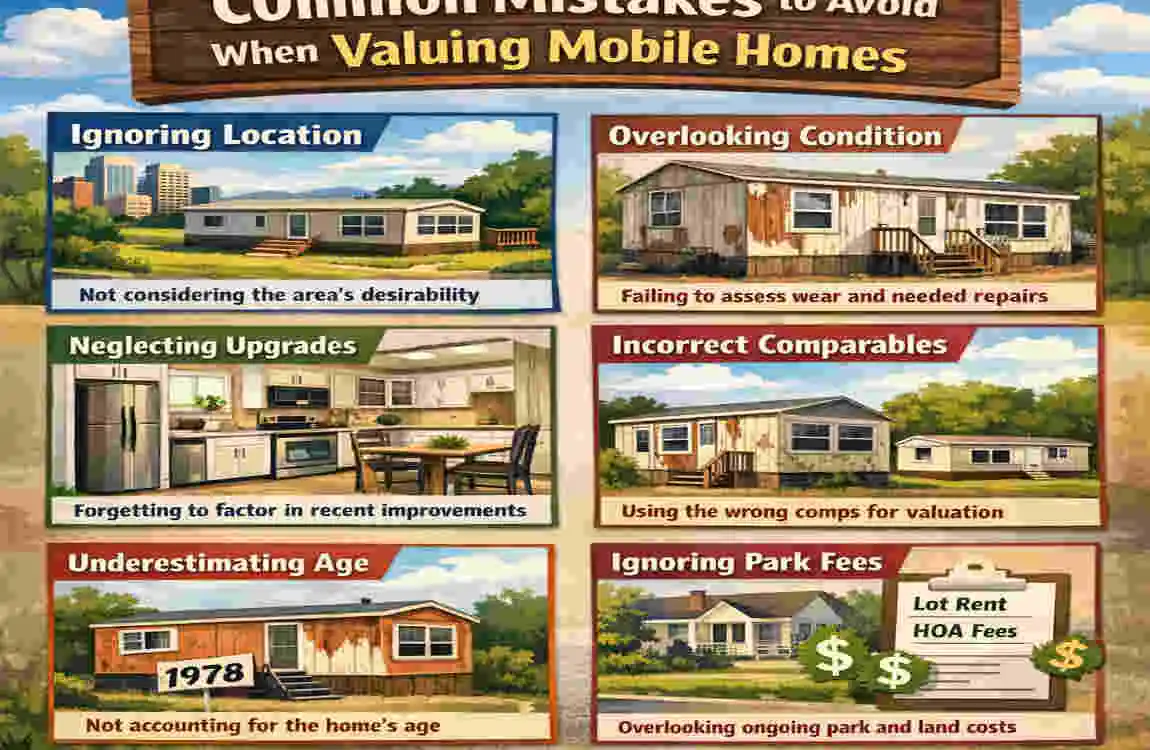
Even smart sellers make mistakes. Here are the top errors to avoid:
- Ignoring Park Transfer Fees: Some parks charge a percentage of the sale or an application fee. Know these costs upfront so they don’t eat your profit.
- Emotional Pricing: “I raised my kids here” does not add monetary value. Be objective.
- Over-improving: Don’t put granite countertops in a 1975 single-wide located in a budget park. You will never get that money back. Match the upgrades to the neighborhood.
- Hiding Defects: If you know the roof leaks, disclose it. If a buyer finds it during inspection (and they will), they will lose trust and demand a huge price cut.
- Confusing Asking Price with Selling Price: Just because your neighbor is asking $100k doesn’t mean they will get it. Only look at sold data.
FAQs: How to Value a Mobile Home
How much is my mobile home worth? There is no single number without analysis. However, you can determine it by comparing 3-5 recent sales of similar homes in your specific park or county, adjusting for condition and upgrades.
Are there free ways to value a mobile home? Yes. You can use free online tools like Zillow (filter for “sold” manufactured homes) or search the NADA Guides (they charge a small fee for a detailed report, but basic info is often available). Talking to a local park manager is also a free way to get “word on the street” pricing.
What is the difference between mobile home and manufactured home appraisal? Technically, “mobile homes” are pre-1976 and “manufactured homes” are post-1976. Appraisers treat post-1976 homes more favorably because they meet HUD safety standards, making them easier to finance. This usually results in a higher valuation for manufactured homes.
Does NADA value include land? No. The NADA book value (J.D. Power) typically values the home as chattel (the structure only), assuming it is in average condition. It does not account for the value of the land it sits on.
How do I find the VIN or Serial Number on my mobile home? Look for the HUD Data Plate inside the home (closet, cabinet, or electrical panel) or the metal HUD Certification Label on the exterior siding of each transportable section.
